

Dear reader: This article contains links to products and services that I may be compensated for, at no extra cost to you.
On my recent three-day stay in Shanghai, I dedicated one of those days to a Hangzhou day-trip.
Rather than trying to squeeze in every major attraction Hangzhou has to offer, my day trip was specifically focused on two things: gazing upon West Lake and going to Longjing village to buy some of China’s most famous green tea.
It was an unexpected bonus that I got to see cherry blossoms at the lake and managed to squeeze in a few other attractions in Hangzhou before returning to Shanghai.
In this article, I’ll share exactly how I planned and executed this memorable trip, including High Speed Rail bookings and some amazing foods I enjoyed in Hangzhou.
I’ll just add that this was a bucket list trip for me, after living in Taiwan for 10+ years (which means that I can speak Mandarin) and getting into tea there. I have several articles about Taiwanese tea here and here.
Also read about my positive experience using a Holafly eSIM in China (or just order one here).
Table of Contents
Hangzhou Quick Intro

Hangzhou (杭州) is the capital of Zhejiang province, which is adjacent to Shanghai. As the crow flies, the city is about 150 kilometers from the Shanghai city center.
I’m not gonna go into detail about Hangzhou’s long history and importance in Chinese culture – you can check Wikipedia for that. But suffice to say that it has a long history as one of the most important ancient capitals in China.

Hangzhou is especially known for West Lake (西湖), which is a UNESCO World Heritage Site.
The lake has attracted admirers since the Tang Dynasty (618–907), who to this day come to walk the four causeways across the lake and admire the dozens of ancient temples, pavilions, and mausoleums surrounding it.

The hills west of West Lake are where Longjing tea, the most famous green tea in China, is grown. The tea has had that status ever since the Qing Dynasty emperor Qianlong visited. He thought tea was so good that he gave it imperial status. I cover this area in much more detail in my guide to Longjing village.
Hangzhou is in fact a huge city of 8.5 million (or 12.5 if you count the suburbs). But for my day-trip purposes, I just stuck to the West Lake and Longjing area, which to me didn’t feel like being in a big city at all.
Also read my guides to trekking Tiger Leaping Gorge and things to do in Lijiang, Yunnan province, which I flew to after my Hangzhou visit!
Taking the High Speed Rail to Hangzhou

To prepare for my Hangzhou day trip, the only thing I had to book in advance was my HSR tickets from Shanghai to Hangzhou and back.
While there are nearly 200 HSRs running per day between the two cities, they can still sell out. And being the anxious traveler that I am, I always like to book things as early as I can so I don’t have to worry about it.
Moreover, I was going to Hangzhou the day after a long weekend, and I know some of the rush can spill over into the next week.

HSRs in China can be booked two weeks in advance, and the exact time you can start booking depends on the exact train departure time.
The cheapest way is buy tickets directly on the official China Railway 12306 website.
However, I found that if I booked my HSR tickets here on Trip.com, I could book them days or even weeks before the tickets were released.
Then, when the tickets were actually released, Trip would secure my tickets for me. This also meant I wouldn’t have to try to figure out what time my train’s tickets were released and possibly wake up in the middle of the night to buy them at that time.

Yes, this costs a few extra dollars, but that’s it – literally just a couple dollars.
When the day came, Trip actually didn’t succeed for one of my trains. It notified me right away that I was on a waiting list for that one.
Later that day, I just booked a different train a few minutes later, which still had seats, and canceled my spot on the waiting list for the original one. Easy!
Choosing the Stations, Times, and Seat Types

Browsing the list of departures, I found that the largest number of HSRs from Shanghai to Hangzhou departed from Shanghai Hongqiao station and arrived at Hangzhou East station (Hangzhoudong).
I also knew from looking at the Shanghai MRT map that Shanghai Hongqiao station was easiest to reach by MRT from my hotel in Shanghai. So departing from Shanghai Hongqiao made the most sense.
Then I had to choose from a very long list of possible departure and return times. After mapping out my day, I realized I needed a full 12 hours in the city to do everything I wanted to. I also wanted to go very early so I could come back not too late.
So, I booked an HSR departing Shanghai Hongqiao at 7:00 AM. This would get me to Hangzhou East just before 8. I didn’t want to go any earlier, because I also needed time to ride the MRT to the station and have enough time to transfer there.

For the return, I booked an HSR from Hangzhou East back to to Shanghai Hongqiao around 8 PM, for a full 12 hours in the city. It ended up being just right for my plans, which I’ll cover in detail below.
Now that I had chosen my train times, I had to select which class. The choices were 2nd class (about USD 8), 1st class (13 USD), or business class (30 USD).
For an easy one-hour ride, I’m certainly not going to bother paying more than double price for business class. However, for a mere $5 extra I could travel 1st class? Sure, why not!
What’s the difference? I’ll get to that below.
My Hangzhou Day Trip in Detail
Now I’ll walk you through every step of my day trip from Shanghai to Hangzhou. You can also see how this fit into my overall Shanghai itinerary here.
Riding from Shanghai to Hangzhou

It was an easy 30-minute MRT ride from my hotel, Jin Jiang Pacific (which by the way is a super cool historic hotel in a very convenient location in Shanghai) at People’s Square MRT to Hongqiao Railway Station on Line 2 (green line). See the Shanghai MRT map here.
For my 7:00 AM departure, I caught the first MRT of the day from People’s Park to Hongqiao at 5:37 AM. This would arrive at Shanghai Hongqiao Railway Station at 6:07, giving me nearly an hour at the station to find the way and have breakfast.
Make sure you don’t get off at Hongqiao Airport T2. Hongqiao Railway station is one stop after it.
As you might imagine, Hongqiao Railway Station is enormous. I didn’t try to figure out the directions before I got there. I just got off the MRT and followed the signs to the HSR station.

It took me about 10 minutes to get to the HSR station entrance, including going up a series of escalators. There were a stream of mostly businesspeople at this early morning hour, so I just followed the crowd.
Arriving at the HSR terminal, it was time to swipe in. In China, as long as you have a booked ticket, you just swipe your passport on the scanner to enter the HSR station (locals swipe their ID cards). There’s no need to show your ticket.
For foreign passport holders, the scanners may not work. You should go to one of the entries that has a human attendant, usually at either end. However, I’ve heard this is changing and you may be able to scan at any of them now.
After that, I had to put my bag through the luggage scanner, just like entering any airport, bus station, or MRT station in China – you get used to this after a while.

And then I was inside the huge terminal! It was larger than some airports I’ve been in. I had time to spare for finding breakfast, using the toilet, and then finding my boarding platform, which of course was wayyy at the end. I definitely wouldn’t recommend showing up here at the last minute before your departure!
At the gate, I had to swipe my passport again to enter the platform.
I was grossed out to find that in China, people even smoke on the HSR platforms. Every time an HSR pulls in, multiple men hop off and instantly start smoking, even when surrounded by crowds of people.

Anyways, I tried but found it impossible to tell which spot I should line up for my train car. There are markings on the ground, but different ones for different HSRs. I just waited until the train pulled in and there hurried over to my car. There was enough time.
For my 1st class ticket, I was in car 2 (car 1 was business class). So I even managed to get a photo of the front of the HSR and peek into business class (see photo above) as I got on.

In business class, there are only two seats on the left and one on the right, so the seats are huge. In 1st class, which I rode, there are two seats on each side, so they are still quite large and comfy.
On the way back, when I rode 2nd class, I found that there are three on each side, so you are noticeably closer to the person next to you, but it’s still not bad, especially for a short ride.
The actual ride to Hangzhou was super fast, quiet, and smooth, and there’s not much else to say about it!
Arriving in Hangzhou

From the Hangzhou MRT map, I knew there was a direct MRT from Hangzhou East station to some stations by West Lake (Line 1, red line).
Hangzhou East Station was huge, too. Again, I just followed the signs to MRT Line 1.
When I went to scan my Alipay transport QR code to enter the MRT station, just like I had done in for MRT rides in Shanghai, it didn’t work. That’s when I realized that for each city in China, you have to change the city at the top-left.
Once I changed the city to Hangzhou and clicked transport, I had to click through some screens to sign up for Hangzhou’s transport card. Then it finally produced my Hangzhou transport QR code, which worked to swipe in.
In China, figuring out all these apps can be challenging and frustrating for first-timers, but when you finally succeed, it feels like such an accomplishment!

I chose to get off at Fengqi Road MRT station (凤起路站), which is near the northeastern corner of West Lake. This worked for my plan to walk across the northern shore of the lake. I could have also rode to the next stop, Longxiangqiao (龙翔桥站), but that would have been a slightly longer walk to where I wanted to go.
The ride from Hongqiao East to Fengqi road took 15 minutes. I proceeded to exit B, which even had a map of the 800-meter walk to West Lake.
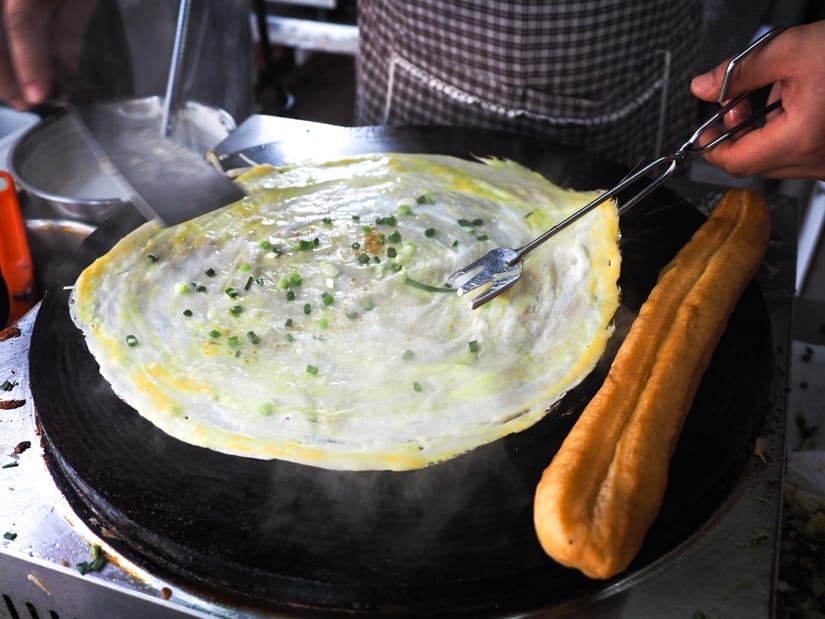
On the walk, I had a delicious jian bing (煎饼) or “breakfast wrap” stuffed with egg and fried dough stick for my breakfast No. 2 of the day.
In the end, I arrived at the lakeside 50 minutes after my arrival time at Hangzhou East Railway Station.
Exploring West Lake

West Lake is quite large. It is unlikely that you will walk the whole way around the lake, unless you want to spend the better part of a day doing it.
My plan was to walk across the north shore of the lake only. In the end, this took me just under two hours, at a leisurely pace with lots of photo stops.
My first view of West Lake was right at the northeastern corner of the lake, right about here. I was instantly impressed with the lake’s beauty. It exceeded my expectations.

I should say that I come from a part of the world with so many beautiful lakes. So my expectations for West Lake were actually low. In many people’s photos, it actually looks very smoggy or hazy.
Anyways, I was lucky, as it was a very clear morning and the lake was looking beautiful, with the hills of Longjing area clearly visible in the background. Still, it couldn’t compare to pretty much any lake in the Rockies, for example. But then, lakes in the Rockies don’t have dragon-shaped boats or temples around them!
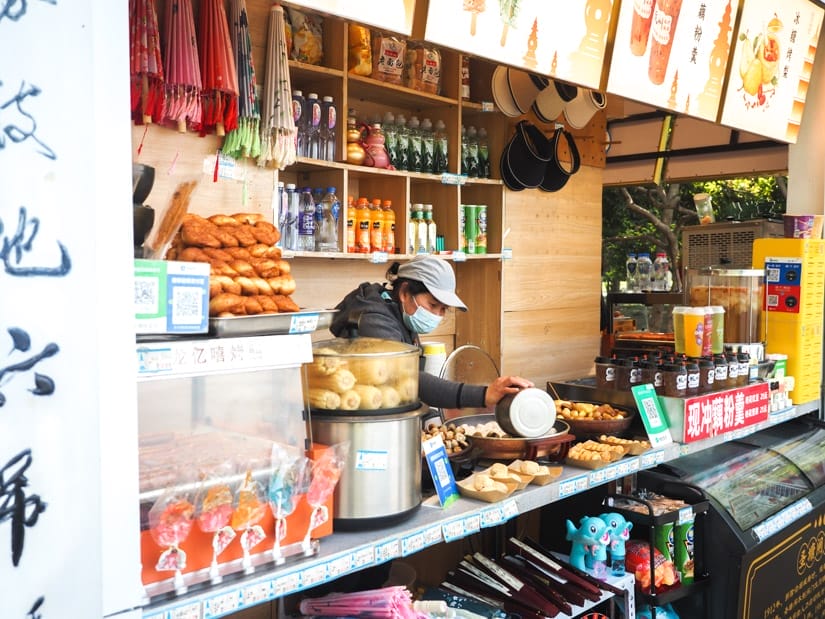
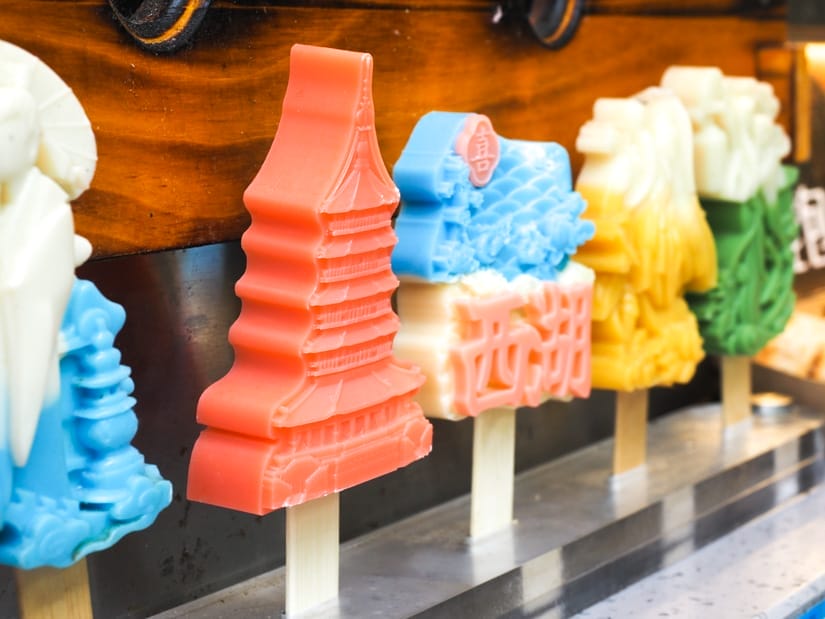
I spent some time just taking it in and watching local tourists board picturesque boats at the pier. Then I set out on my walk along the shore.
The lakeside trail was packed with visitors, a high percentage of which were elderly domestic tourists. I can’t even imagine how busy it would have been if I had come just a couple days before – I was visiting on Monday right after the Tomb Sweeping Festival long weekend.

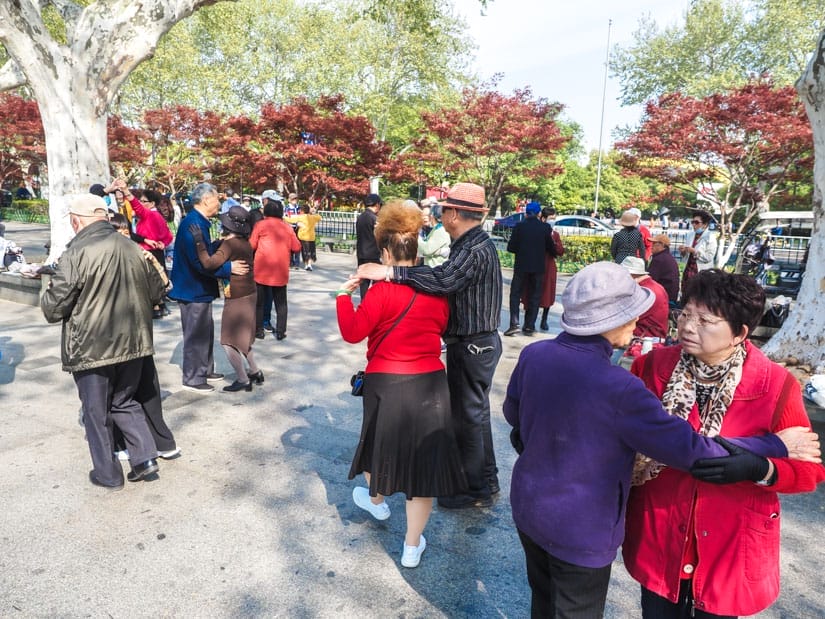
A group of elderly Chinese were even doing ballroom dancing beside the lake, which was very cute.
Before long, I reached the Bai Causeway, which leads to Gushan Island, the largest island on the lake.
To my surprise, the causeway was lined with hundreds of cherry blossom trees. In my trip planning, I didn’t even realize I’d timed it perfectly with cherry blossom season. The trees were in full bloom, with several different types ranging from white to light pink to dark pink.
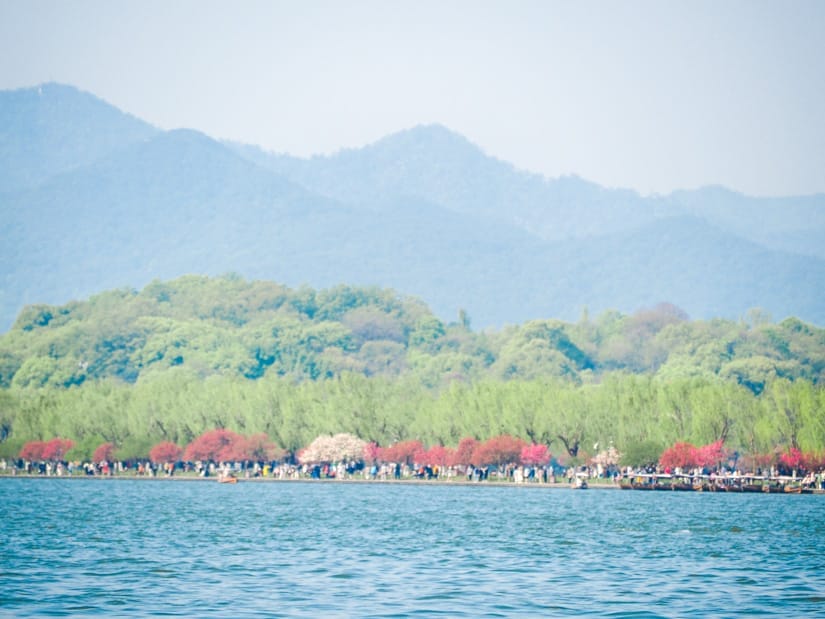
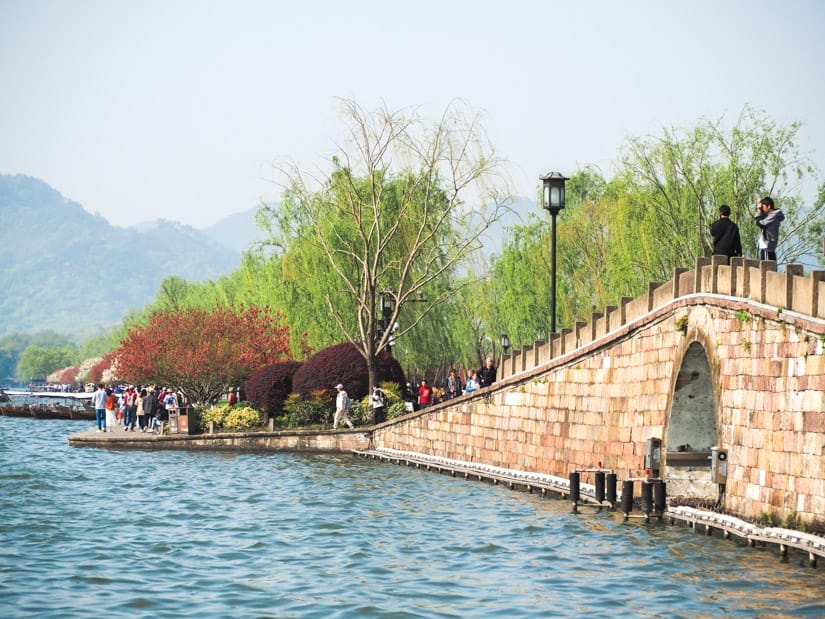
I took a silly amount of pictures on this part of my walk. The different colored cherry blossoms and photo ops just kept coming and coming as I continued along the causeway. It was breathtakingly beautiful.


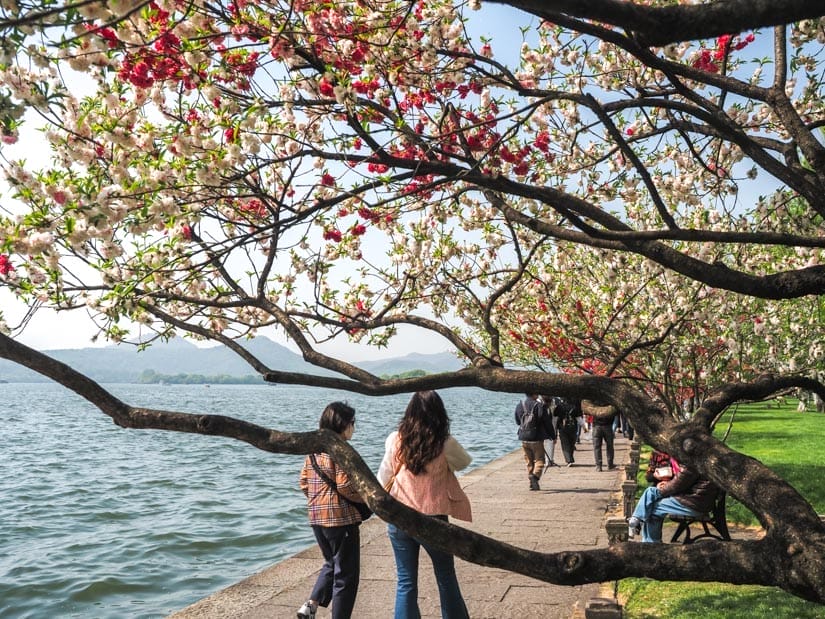

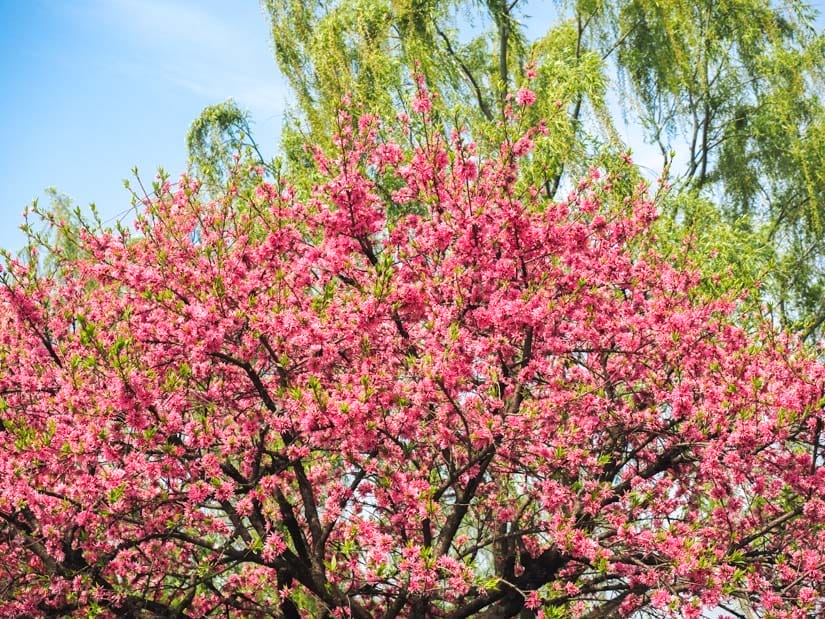
The crowds of Chinese tourists, mostly elderly, remained as I continued along. I still managed to set up my tripod a capture a selfie but it was impossible to avoid some crowds behind.

As I continued along, the crowds did thin out a little. I had occasional glimpses of scenes that I would even call serene, including some nice views of the pagodas and other structures in Baoshi Hill, on the north side of the lake.
There were multiple spots where different types of boats could be rented, from small paddle boats to large boats with drivers.


Arriving at Gushan Island, there were more cherry blossoms, pavilions, parks, and so on. I didn’t explore the island much but just kept going. Eventually the path brought me back the mainland.

Things I Skipped

Shortly after that, at the northwestern corner of the lake, is the start of another causeway, called the Su Causeway.
It’s the longest one on West Lake, stretching all the way from the north to the south side of the lake. It has more cherry blossoms, pavilions, arched bridges, and views.

For visitors who want to explore deeper, there’s also a huge park covering Baoshi Hill north of the lake. The park is filled with temples, pagodas, teahouses, hiking trails, and Yu Fei Mu, the tomb of a Song dynasty general.
You could probably spend half or even a full day exploring the park.
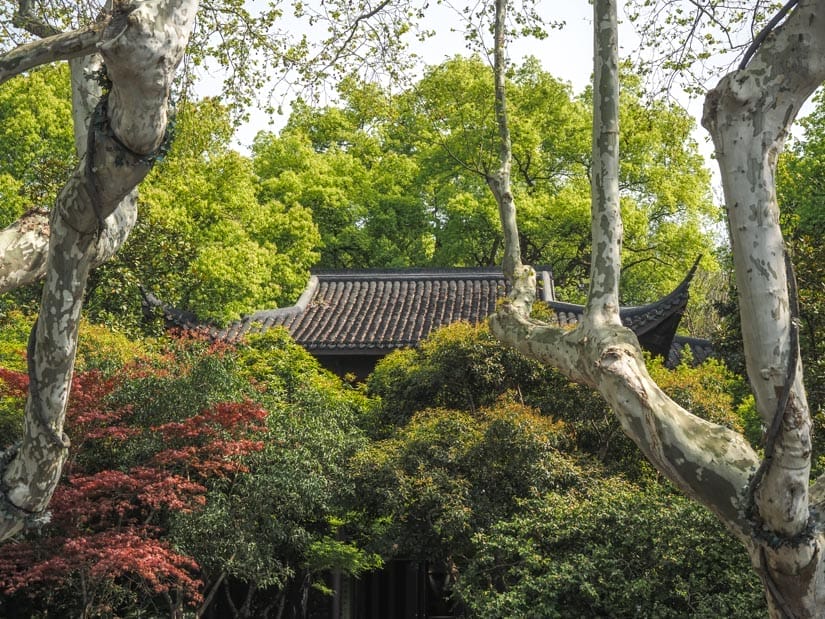
Yet another famous attraction in the region, up in the hills west of the lake (but a different direction than Longjing), is the expansive Lingyin Temple (灵隐寺), the oldest and most important temple in the region.
Many visitors also take boat rides across the lake, with options for rowboats (150 per hour) or larger boats which visit small islands in the middle of the lake.

I didn’t include any of the above in my day trip, but you may want to. I wanted to focus on the green tea growing region of Longjing instead.
Green Tea Restaurant

Around the start of Su Causeway, I ordered a Didi (China’s version of Uber) via my Alipay app to my next stop, which was an early lunch at Green Tea Restaurant (绿茶餐厅, here).
I also could have taken a bus, but that would have taken longer and I didn’t feel like figuring out which bus to take. Plus the Didi only cost like two US dollars.
I arrived shortly after the restaurant’s 10:30 AM opening time and was one of the first people there. This was intentional, as I’ve heard it can fill up at lunch time.
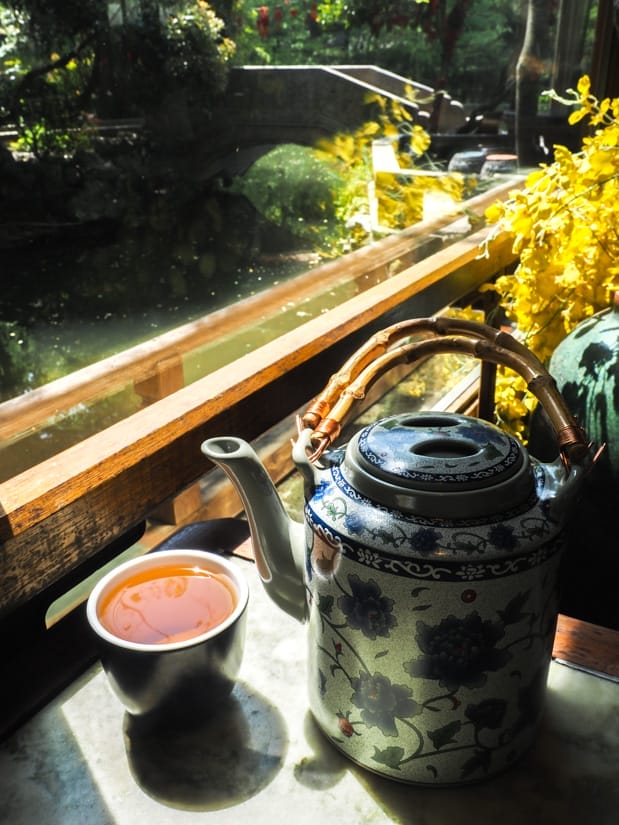
Green Tea Restaurant came highly recommended to me by members of tea groups on Facebook. Not only is it perfectly situated on the way to Longjing tea village, but it also happens to be right next to the China National Tea Museum, which as you’ll see below, was my next stop.
This restaurant was nothing short of phenomenal.

The restaurant is built around a small pond – I crossed a small bridge to enter it. Every dining room had a nice view of the pond, including several rooms on covered boats.
For my lunch, I enjoyed some Longjing tea, a local green called malantou with bits of tofu (香干马兰头), and golden soup steamed fish with pickled cabbage and chilis (金汤酸菜鱼).

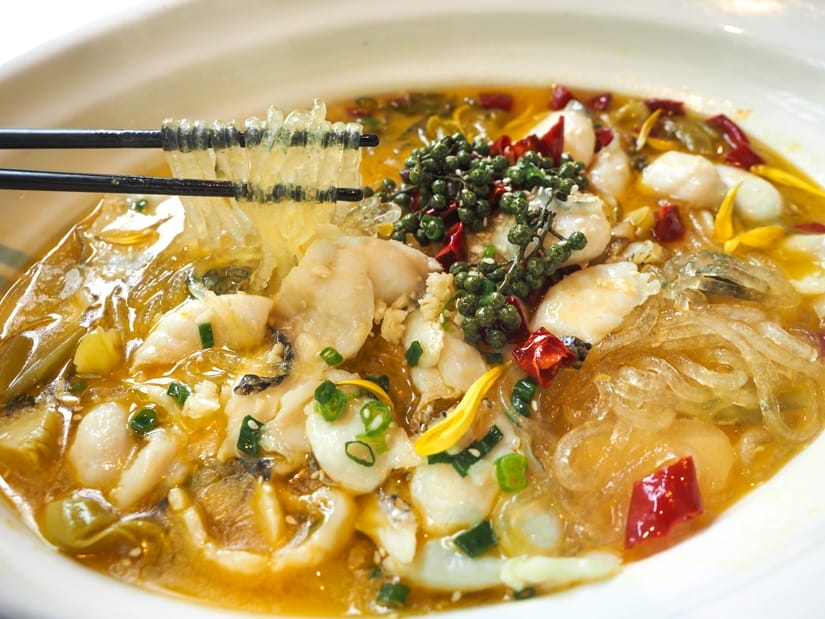
The fish dish came out on an enormous plate and was simply gorgeous. It was garnished Sichuan peppers and edible yellow flowers. This was the best meal I had on this trip in China.
For dessert, I had some cute steamed buns that looked exactly like apples.

China National Tea Museum

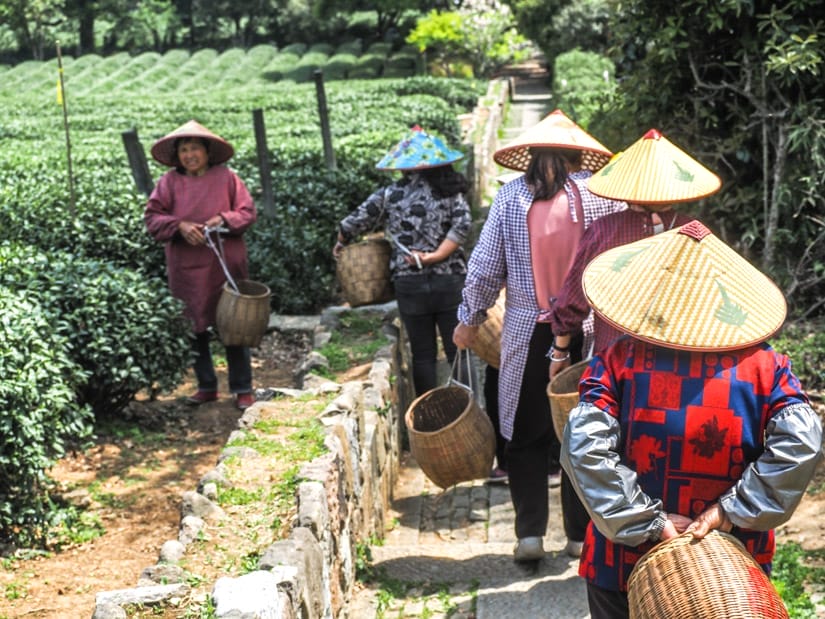
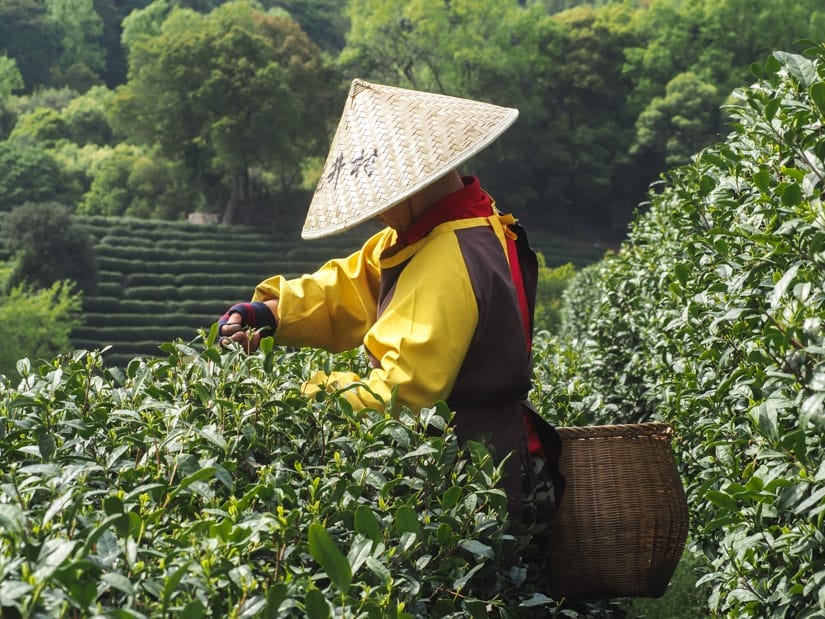
The China National Tea Museum (中国茶叶博物馆, official site, closed Tuesdays) is right next to Green Tea Restaurant. On the short walk to the museum, I passed some tea farms where workers were harvesting the tealeaves.
Arriving at the museum, I was surprised to find that entrance is totally free.

I made my way through several exhibit rooms, which covered topics such as the spread of tea from Yunnan to other parts of China and the world, types and characteristics of tea, tea culture, mentions of tea in ancient texts, tea ware, and other products made from the tea plant. There was English signage on the displays.
Next I explored the museum grounds, which are huge. I saw more workers harvesting tealeaves and spots where it’s possible to order tea and enjoy it beside a stream in the woods.

Longjing Temple

Next I walked back to the main road by Green Tea Restaurant and hopped in a taxi that happened to be waiting there.
I asked to be dropped at Longjing Temple (龙井寺, here), which is just before the start of Longjing village. I also could have also caught a bus or even walked but wanted to save my energy for exploring the village.

Longjing Temple has Longjing Spring (龙井泉), one of several famous famous springs in the area (Longjing literally means “dragon well”).
In my research, I never managed to figure out which of these is the one that gave Longjing its name, or which one is the “original”, and perhaps the others are copycats? If you know, please comment at the end of the article.
When the taxi dropped me off, I walked up some stairs through the forest to the temple. The temple grounds were serene, and I got the impression that tea is practically venerated here.
It took me a few minutes to find the actual well here, which was next to one of the temple buildings.

Note about finding these places: Before my trip to China, I had a lot of trouble planning the Longjing part, including figuring out the exact location, layout, and places to visit in Longjing village. There’s very little information in English online.
I even checked Mandarin articles, but most of them go on and on about the legends behind Longjing, with zero logistical information about actually visiting Longjing.
One YouTube video even showed a guy who tried to visit Longjing to buy tea but ended up in the wrong village and never actually made it to Longjing. It doesn’t help that the map app options for China are confusing.
GoogleMaps, which I normally rely on heavily for research, is outdated and often useless for China. BaiduMaps is best but it’s only in Mandarin. AppleMaps was my go-to map app once in China, but it only works well when you are physically in China, and it’s only available for iPhone users.
I’ve included GoogleMaps links in this article for those researching before they go. But when visiting, it will be better if you use AppleMaps (if you have iPhone), Amap, or BaiduMap (if you can read Mandarin). You may have to copy-paste Mandarin place names to the app to find them.
In my Longjing village guide, I cover everything I wish I had known before going there.
Longjing Tea Village

Next, I walked the rest of the way to Longjing Tea Village (龍井村 or Longjingcun – the village center is here). A few minutes before reaching the village entrance, I made a detour up a different road to the upper branch of China National Tea Museum (here).
This detour required a short but steep walk up a road, then more stairs and uphill walking inside the museum. Even as a tea person, in retrospect, I think it wasn’t worth the detour.
There were more museum displays here, but no tea fields like the main branch. I would say only go if you have the time and energy.

Back at the entrance to village, I found that the road was blocked to cars to prevent traffic jams in the popular rural area. By this point, I still couldn’t see any tea fields and was wondering where they all were. I wondered if I was in the wrong place.
But after five minutes’ walk into the village, I rounded a corner and suddenly found myself in an incredibly picturesque valley, with tea terraces rising up the hills all around me. This is Longjing Village!

I chose a random path leading up into the rice terraces. It led to a tea shop that seemed packed, then up further into the tea fields from there.
The path kept going up and up and the views got better and better. There were a lot of young Chinese visitors doing their selfie shoots in the fields.

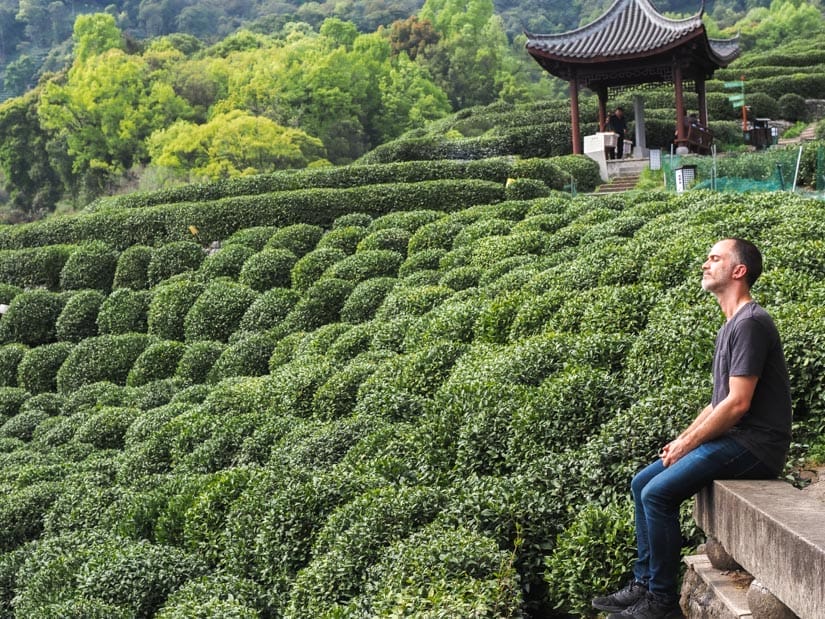

After I was satisfied with my photos, I returned to the main road. My next goals were to actually drink and buy some Longjing tea before leaving.
After wandering a bit, I managed to achieve both at West Lake Longjing Tea Shifeng Mountain Chaocha Center (西湖龙井狮峰山炒茶中心, here).

I chose this shop because I noticed a lot of locals were going in and actually buying tea there. I heard that some shops in Longjing rip off tourists or sell fake Longing tea. If many locals were going to this one, I figured that must be a good sign. I started by ordering a glass of Longting tea to taste.
There were different levels of quality and I went for a higher but pricier one. It wasn’t a fancy teahouse or anything, but at least I could see a bit of a view of some tea terraces while drinking my tea.
Like most places selling tea in town, there was also a guy frying tealeaves in a large pan on site. The smell was amazing.

After enjoying my tea, I purchased some tealeaves to take home. It wasn’t cheap, but buying China’s most famous tea at the place where it’s made was one of the main reasons I came to China.

Next, there was one more spot I wanted to see in the area before returning to central Hangzhou. This is a site called Laolongjing Yuchayuan (老龙井御茶园) or Shibake Yucha (十八棵御茶) and it’s at the very end of Longjing tea village.
This is the location of the famous 18 tea bushes (十八棵) in front of Hugong Temple (胡公廟), where the Qianlong Emperor first tasted the tea and gave it imperial status.

There was a small entrance fee here (10), which I paid for on a large screen before entering. The grounds are large, with several buildings, pavilions, a teahouse, and a stream.
There’s also a spring here, with water seeping into it from a carved dragon’s mount on the side. It took me a while to find it and I had to ask the guard to point me to it.
If you look up articles about Longjing and they mention the famous “dragon well”, some have images of this one, while some have images of the spring in Longjing Temple or yet other ones. Again, if you know which of all these well is the “real” Longjing well from the legend, or the difference between all of them, please comment at the end of the article.

Qinghefang and Huqing Yutang Museum of Chinese Medicine

Satisfied with my visit to Longjing tea village, I ordered a Didi for the drive back to central Hangzhou.
As per my request, the taxi dropped me at the entrance to Qinghefang Street (清河坊街), a popular tourist walking street east of West Lake.

Part of the reason I’d set a strong pace all day was because I wanted to make to Huqing Yutang Museum of Chinese Medicine (胡庆余堂中药博物馆) before it closed at 5 PM.
The museum was a five-minute walk down the pedestrian street. In the end, I made it just in time before the museum closed.

The museum is housed in a large, very traditional, working apothecary (Chinese medicine dispenser).
It’s super atmospheric inside, with all kinds of cool Chinese herbs and medicinal ingredients on display. The small museum is on the upper floors and has a nominal entrance fee.

Having checked off all my mosts for the day, I was now ready for a cold beer, which I had to wander for some time to find in a local shop. Then I wanted to catch the sunset at West Lake. It was about 15 minutes’ walk to the shore and all part of my plan for the day.
I loved the early evening atmosphere at the lakeside, with many locals taking a casual stroll or lounging at the lakeside waiting for the sunset.


For dinner, I returned to Qinghefang Street, where I had seen all kinds of temptations. I did a full lap up and down the street to scope out the offerings and decide what I wanted.
Now dark, the street had beautiful lanterns and a totally different vibe.


I was truly impressed at just how photogenic some of the shops are. After you spend a while in China, you start to take this for granted, as it’s the same in many of the country’s famous places and ancient cities.
No matter what the shops were selling, I just wanted to buy it because they were so beautiful inside!

In the end, I got an order of stinky tofu (臭豆腐) which was the best I’ve ever had.
Stinky tofu is very common and popular in Taiwan, where I lived for over a decade, but this one was very different and I have to say better than any in Taiwan – and also it barely stank (the ones in Taiwan truly reek)!

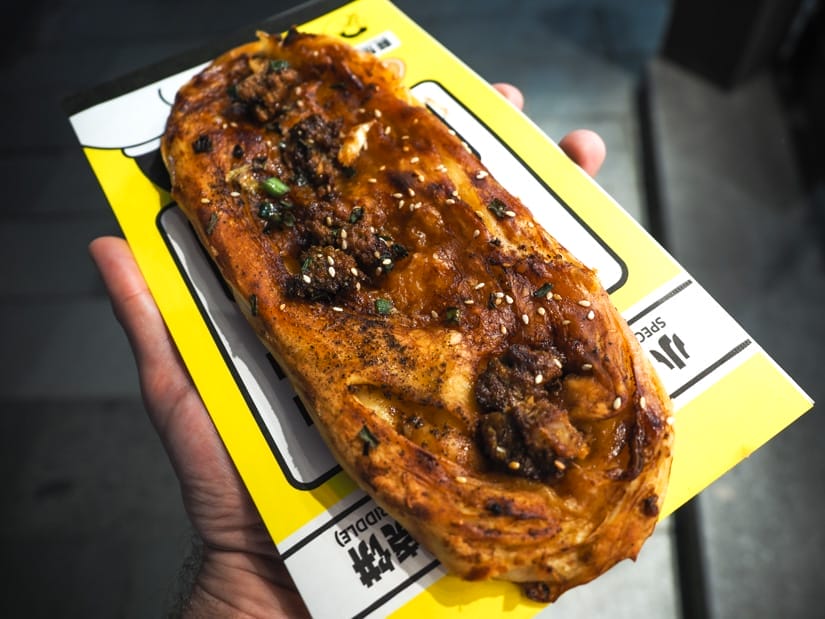
I also got some flaky pastries with beef sauce (牛肉烧饼) – another food I also know from Taiwan, but I’ve never seen it served with sauce and meat on top. This was also extremely good.
And finally, I finished with a Longjing tea soft serve ice cream.

It was now time to make my way back to Hangzhou East station for my HSR back to Shanghai. From Qinghefang Street, it was a 10-minute walk to Ding’an Road MRT station (定安路站), where I rode Line 1 back to the station.
Fully pooped after this tiring but highly rewarding day, I was back at my hotel in Shanghai before 10 PM.



I love this, i’m going to hangzhou and will definitely use your guide. Did you know how to speak Mandarin? i dont speak it so i might struggle making my way in Longjing
Yes, I can speak Mandarin, but I feel the biggest obstacle for planning my visit was lack of current information online and difficulty with map apps in China, not the language itself. In this guide, I tried to include all the details that I wish I could have found before my trip, so it should help a lot! And taking Didis, rather than trying to catch the bus, helped me a lot too. It’s a big day, so try to get an early start, and be prepared for a lot of walking.
Glad google led me here… planning a Hangzhou day trip soon!
Hi Nick, thank you for this very detailed guide. Instead of Longjing village, I read about Meijiawu. Is that similar to Longjing village?
I’m sorry, I haven’t been to Meijiawu so I can’t compare.
Brilliant stack of information! Thank you for sharing
Hi Nick, I see that you’re from Edmonton we are a couple living on Vancouver Island here. We are going to China this May. Thank you again for another informative article . I just finished reading the one on Longjing. So happy you mentioned Qinghefang street , could you tell me which restaurant you had diner there? I want to try stinky tofu.
I just walked around the street and tried foods that looked yummy. The stinky tofu I had was from a vendor called 黑色经典长沙臭豆腐(河坊街店). You won’t find it on GoogleMaps, but if you wait until you are in China, and paste it to a better map app like Amaps or AppleMaps, you should be able to find it. The vendor was at a corner where a small road met Qinghefang Street, roughly opposite the Huqing Yutang Museum of Chinese Medicine. You can also just check the photos of the black stinky tofu in this article, and then watch for that as you’re exploring the street. Good luck and have a great trip!
Thanks for sharing! Are reservations required for the China National Tea Museum? I tried to reserve on the WeChat app but it requires a China number.
I didn’t reserve. I just showed up and it was free to enter. It was not busy at all. But please note, this was about one year ago.
Thanks for sharing
I will use your itinerary next month
Thanks so much for your guide!! It really helped me make the most of my day trip. The Lingyin temple (and Feilai peak) unfortunately needed appointments in advance, but i might have saved myself another hike because it was SO HOT.
Zhongshan park in West lake was nicely shaded so the hike up was manageable and it felt nice to be a bit away from all the crowds.
For those who want to spend more time outside, I had a great time using hello ride to get around. I basically biked the whole way around the lake and to Feilai peak parking lot for not more than 10 yuan.