

Dear reader: This article contains links to products and services that I may be compensated for, at no extra cost to you.
Longjing tea village produces the most famous green tea in all of China. As a moderately obsessed tea geek, I’ve wanted to visit it for years (I live in Taiwan, which is better known for its oolong teas).
When I finally decided to make this happen, I had a heck of a time researching the Longjing part of my trip. There is very little recent English information online about how to actually get to and explore the village, while Mandarin websites all focus on the history and tea legends rather than practical information.
In this article, I’ll cover everything I wish I knew before going there, including how to get to Longjing and China National Tea Museum, what to see and do there, including some teashop recommendations, and how to buy Longjing tea (the pricing is a little confusing).
I set aside one full day in my Shanghai itinerary for this. I have another article covering my whole day trip to Hangzhou. Below, I will focus more specifically on the Longjing part of it.
If you prefer to visit with a guide, you can find Longjing tours such as this one on Klook or this one on Trip.
Hangzhou-based Brivience also offers Longjing tours which include picking and wok-firing tea leaves with farming families.
Table of Contents
Where and What is Longjing?
Longjing (龙井) is both the name of a village and the tea that is produced there (龙井茶).
The village is in the hills just west of West Lake (西湖) in Hangzhou (杭州), the capital city of Zhejiang (浙江) province. Hangzhou is only 150 km (as the crow flies) from central Shanghai.
West Lake is arguably the most famous lake in China. Its classical gardens, pavilions, and pagodas have inspired poets and visitors for centuries and are collectively a UNESCO World Heritage Site.

Poets and scholars have been attracted to Longjing area for over a thousand years. It is said that Ge Hong (葛洪), a Jin dynasty philosopher and founder of early Traditional Chinese Medicine, made elixirs there some 1675 years ago.
Tea production began in Longjing in the Southern Song dynasty (12th to 13th century).
In the Qing dynasty (18th century), the emperor Qianlong was a regular visitor to West Lake. On one of his visits, in front of 18 tea bushes in Lao Longjing (Old Longjing), he was presented with a cup of tea made with leaves from the bushes.

The emperor was so impressed with the tea that he gave them imperial status as The Royal 18 Trees or 十八棵御茶 (shiba ke yucha). You can still visit the temple and bushes today – we’ll get there at the end of the article!
Needless to say, the emperor’s actions had a huge impact, catapulting Longjing tea to the country’s most famous and expensive. Some Longjing is worth more than its weight in gold.
As my taxi driver told me when I visited, “This village is now the richest one around here.”

Longjing literally means “dragon well”. It is said that the water in a local well here was so thick that it flowed like a dragon.
When I visited, I found that there are actually multiple wells and springs in Longjing area (I’ll introduce a few in the article).
The water from Dreaming of the Tiger Spring is supposedly the best one for making Longjing tea. It is near but not actually in Longjing village, so I didn’t visit it.
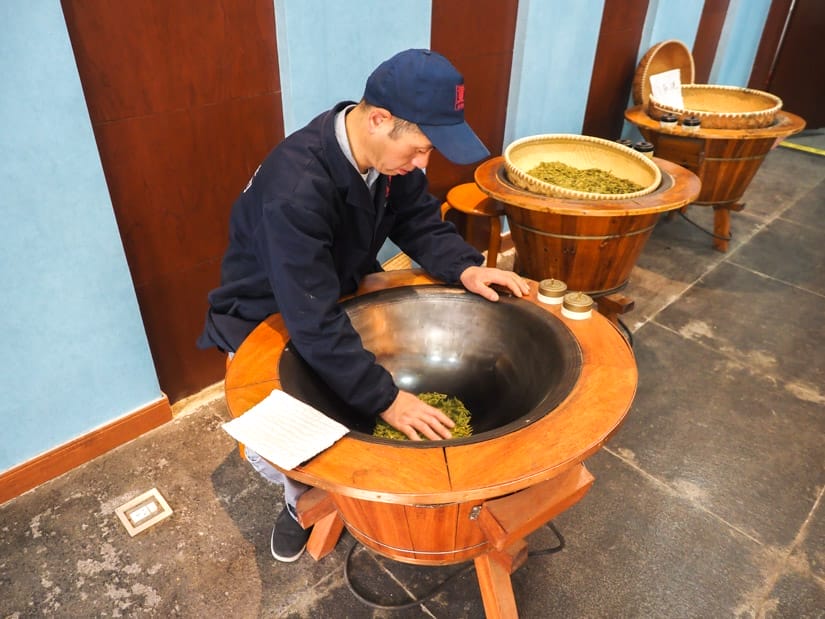
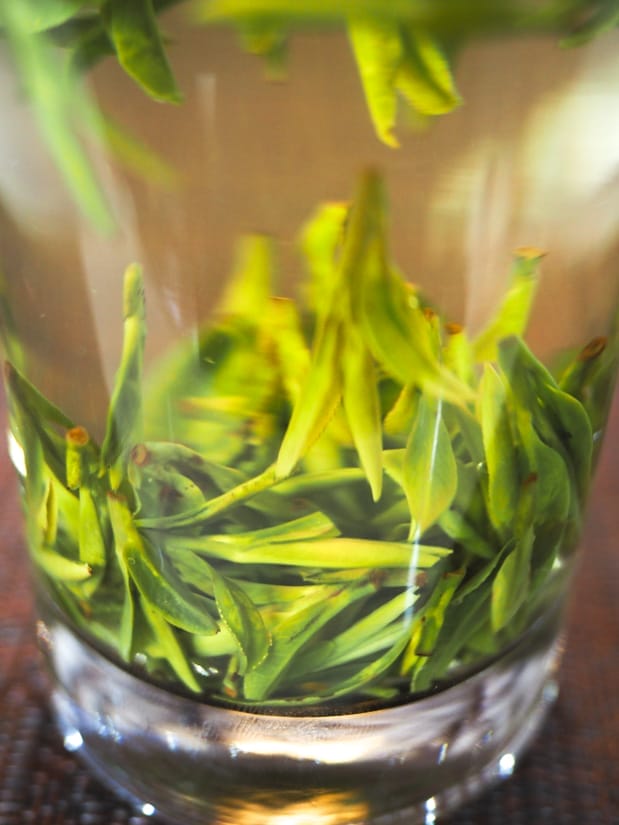
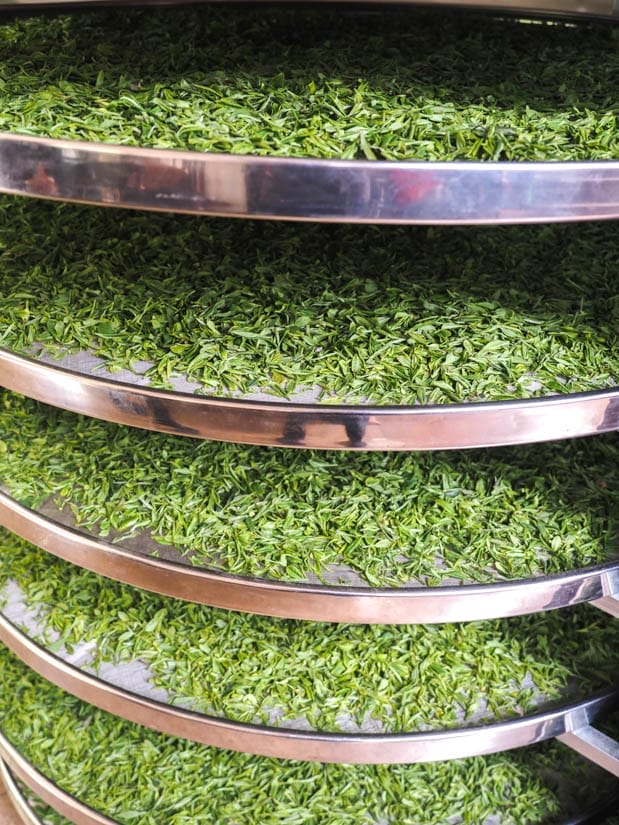
Longjing tealeaves are roasted right after being picked to preserve their flavor. The tealeaves are jade green in color, and perfect ones should be “one flag, one spear” (一旗一枪), which means one leaf has just opened (the flag) and one is still fully connected to the stem (the spear).
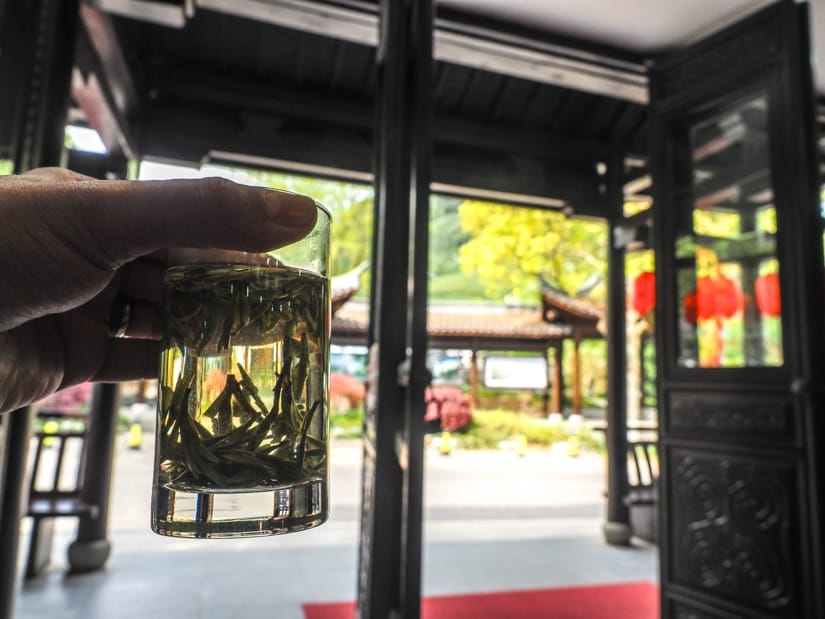
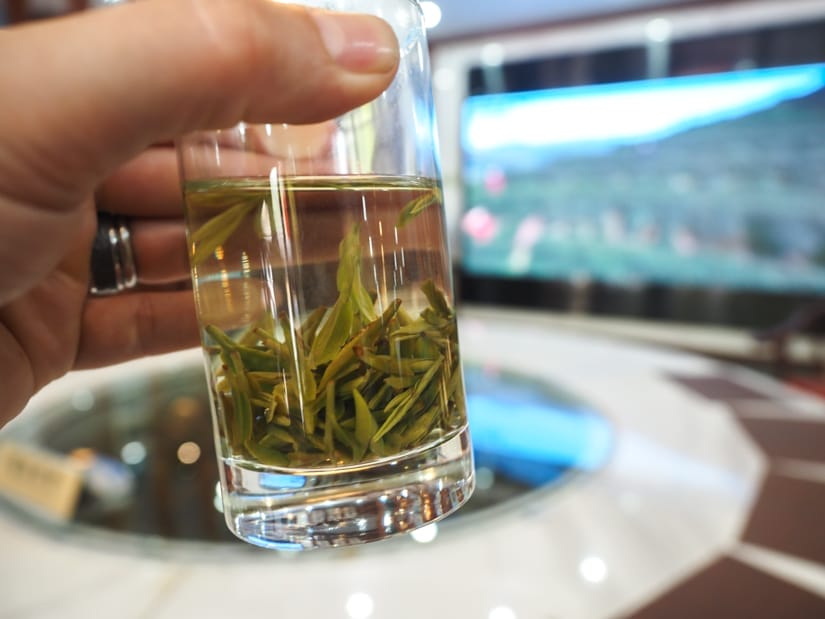
The tea is typically served in a transparent, handle-less glass of hot water. The leaves float on the surface and then sink to the bottom as they brew, at which point its its ready to drink. This is very different than the gongfu (功夫) style of drinking tea that I’m more used to in Fujian province and Taiwan.
Longjing tea tastes fresh, delicate, fruity, nutty, and some compare it to the taste of chestnuts.

Also see my guides to Tiger Leaping Gorge and Lijiang in Yunnan province, which I flew to after Shanghai!
Best Time to Visit Longjing
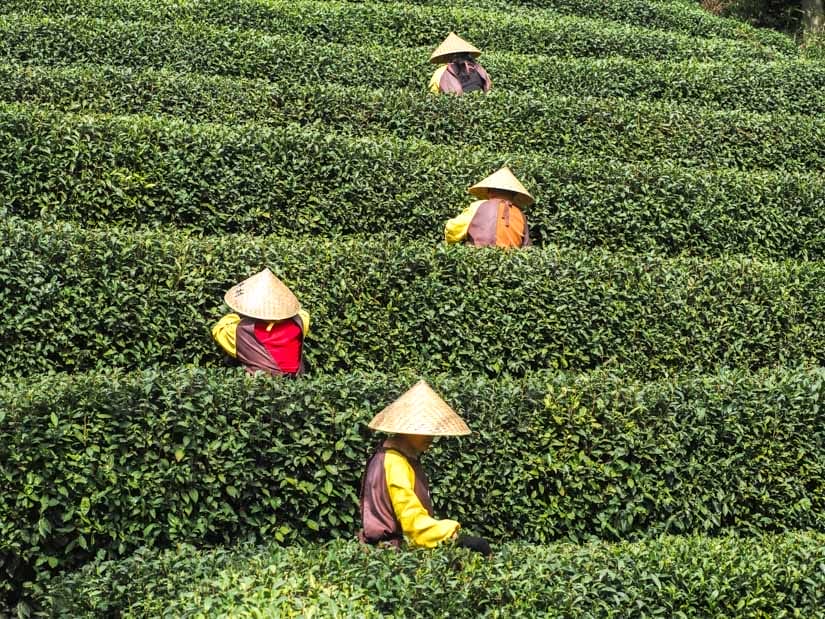
I purposely planned my trip to Longjing for the beginning of April. The Tomb Sweeping Festival in early April is the traditional start of the harvesting season of Longjing tealeaves, when you can see many workers picking leaves in the fields.
Two other benefits of going at this time is that it wasn’t too hot and I got to see tons of cherry blossoms at West Lake and even some at Longjing, too.

However, you’d want to avoid the three-day long weekend caused by the Tomb Sweeping Festival.
Long weekends in China involve masses of people traveling around, which means crowded attractions and sold out trains. I went to Longjing on the Monday right after the long weekend.
Getting to Longjing

If you’re coming from Shanghai, the easiest and fastest way is to ride the High Speed Rail to Hangzhou.
I bought my HSR tickets here on Trip. For a tiny surcharge, Trip allowed me to book my HSR tickets days or even weeks before they were released. When the tickets were actually released (2 weeks in advance), then they secured them for me. No stress!
In my Hangzhou day trip guide, I cover in detail how I rode the Shangahi MRT to Hongqiao train station, took the HSR to Hangzhou, then rode the Hangzhou MRT to West Lake, including how I paid for these rides.

Then, I walked across the northern shore of the lake, which took me just under two hours at a leisurely pace.
From the northwestern corner of the lake, I cheated and took a Didi (China’s version of Uber) to Green Tea Restaurant and China National Tea Museum. Then, I cheated again and took a taxi up to Longjing village. Both rides were very cheap.
But if you want to be even cheaper, bus #27 runs from the road along the north shore of West Lake to Green Tea Restaurant / China National Tea Museum and to Longjing village.

To find the time of the next bus, enter Longjing Village (龙井村) as your destination on BaiduMaps (Mandarin only) or AppleMaps (that’s what I used, but it only works well once you get to China). GoogleMaps is outdated and often wrong in China.
After my Longjing visit, I cheated a third time and took a Didi back to Hangzhou.
This saved me a lot of time, trouble, and transfers, as I wanted to finish my day by visiting Huqing Yutang Museum of Chinese Medicine (胡庆余堂中药博物馆) before it closed at 5 PM and Qinghefang Street (清河坊街) for dinner.
But if you want to return to the city by bus, just take the #27 bus back down. But then you’d need to make one or two transfers to get to Qinghefang Street, if you wanted to.
My Experience Visiting Longjing Tea Village
Now I’ll cover my whole Longjing visit in detail, including where and how to buy tea in Longjing.
Green Tea Restaurant

After spending a few hours exploring West Lake, I had an early lunch at Green Tea Restaurant (绿茶餐厅, here, opens 10:30 AM).
I had seen this restaurant recommended in tea nerd groups on Facebook multiple times, so I had to check it out. It ended up being the best meal of my trip and I highly recommend it.
The restaurant is not in Longjing village but on the way to it and happens to be right next to China National Tea Museum (see next entry). The restaurant is built on a small pond, with various rooms overlooking it, including some rooms on boats.


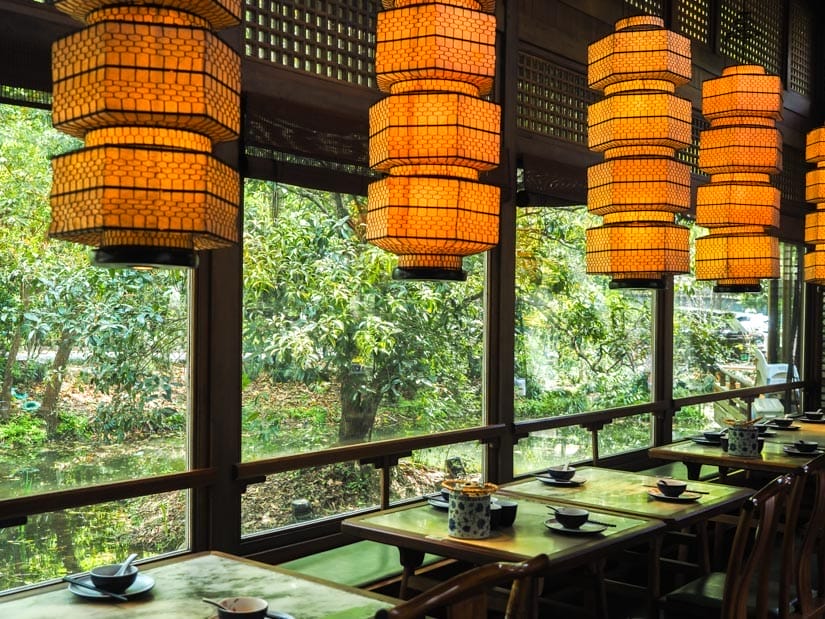
I arrived there right at opening, so it was empty, but by the time I left it was full. If you come right at meal time, a reservation may be needed.
For my lunch, I had a local green called malantou with bits of tofu (香干马兰头) and served in a cool shape with photogenic garnishes.

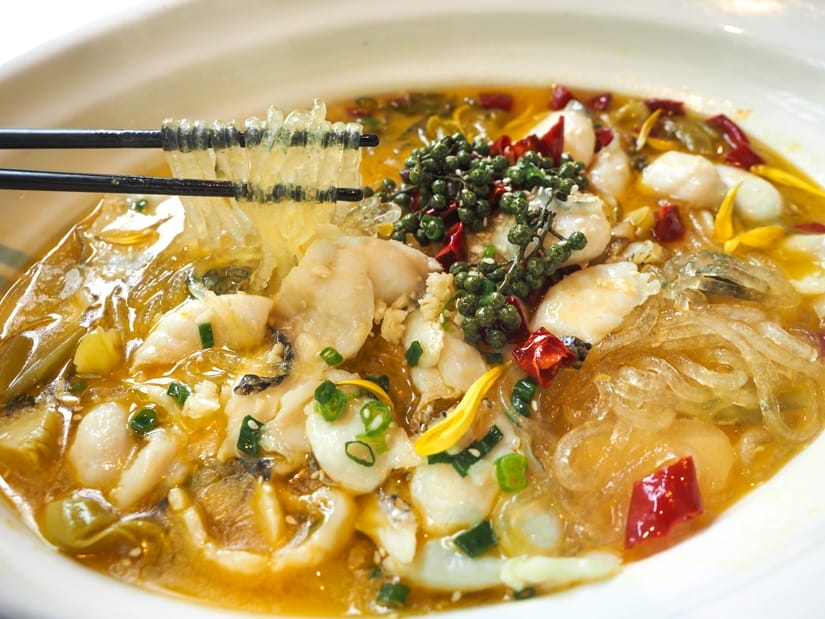
For my main, I ordered fish in golden soup with glass noodles, pickled cabbage, chilis, Sichuan peppercorns, and edible yellow flowers (金汤酸菜鱼). It was fantastic.
And for dessert, I got some cute apple baozi (包子 or steamed buns) that looked exactly like apples and had apple sauce inside.

The meal came with free tea, but I ordered a glass of proper Longjing tea as well.

I should mention that to order here, I had to scan the QR code on the table with my Alipay (or WeChat) app, order and pay on the website, and then the dishes came to my table.
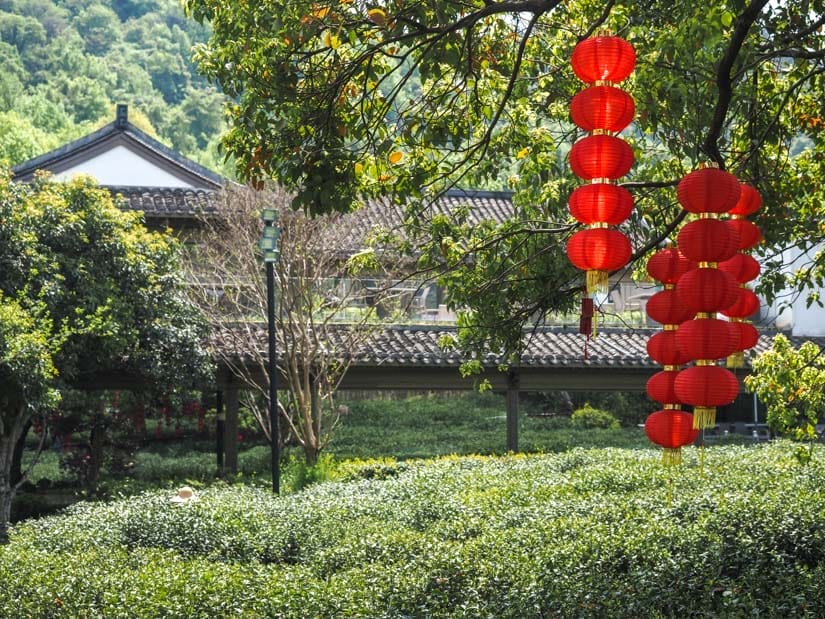
On the way out, I took a stroll around the pond. I saw some locals doing photoshoots in traditional clothes (you’ll see this happening all over China, ALL THE TIME) and some red lanterns hanging over tea fields.

China National Tea Museum

Next, I followed a small road for just a few minutes to the China National Tea Museum (中国茶叶博物馆, here, official site, closed Tuesdays).
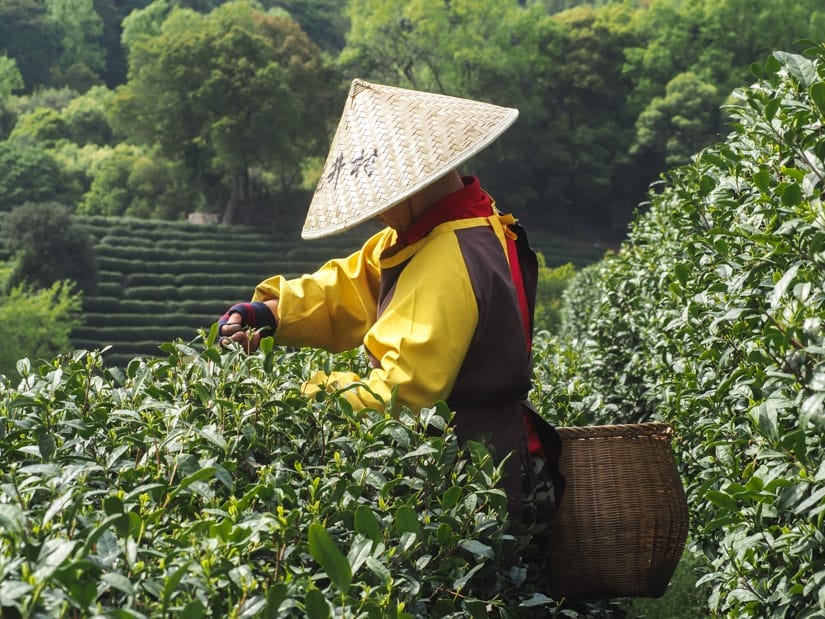
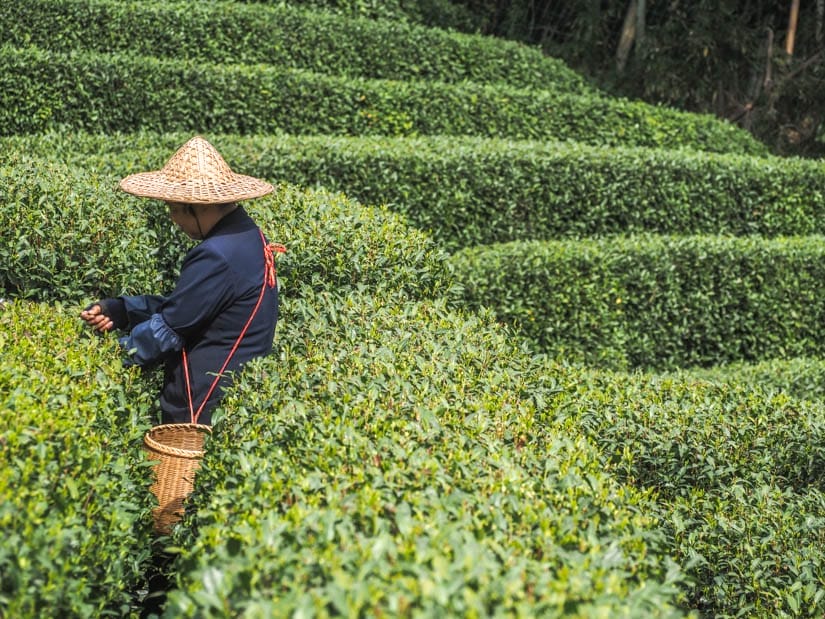
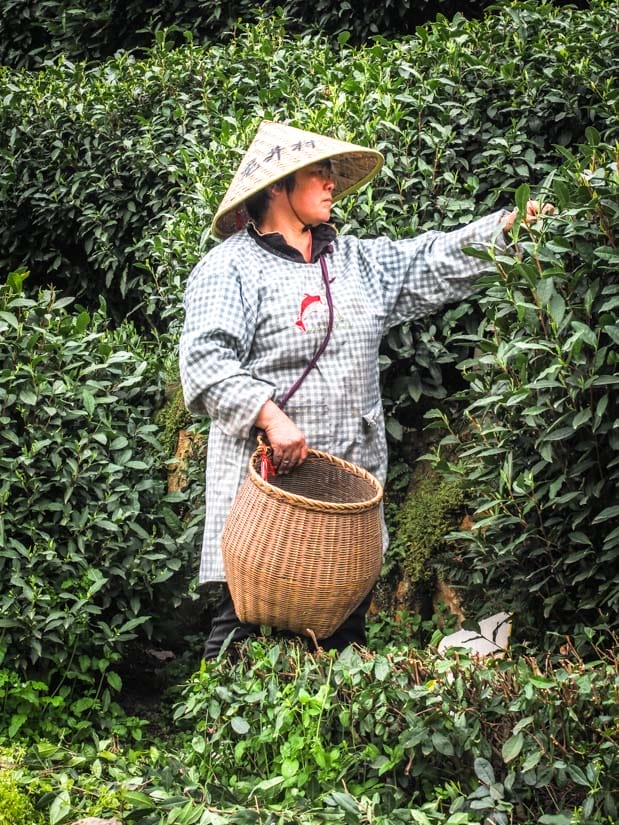
On the way, I passed expansive tea plantations run by the museum, where workers were out harvesting the tealeaves. What could have been a five minute walk turned into 20, as I watched the workers and took many photos.

Arriving at the museum’s main building, I was surprised to find that entrance is totally free. But note that more recently, they require registration via WeChat for weekend visits, and for foreign visitors, you’ll need to show your passport at the door to manually register.
I meandered through several connecting rooms, with displays covering topics such as thе ѕрrеаd оf tеа frоm Yunnаn tо оthеr раrtѕ оf Сhіnа аnd thе wоrld, tуреѕ аnd сhаrасtеrіѕtісѕ оf tеа, tеа сulturе, mеntіоnѕ оf tеа іn аnсіеnt tехtѕ, tеа wаrе, аnd оthеr рrоduсtѕ mаdе frоm thе tеа рlаnt.
There were also some enormous tea cakes and some stunning paintings. Most displays had Mandarin and English signage.


After that, I explored the grounds outside, which included more fields of tea (northeastern corner on the below map). The bottom-right would be where I first came in and #1 and 2 are the main museum gallery.

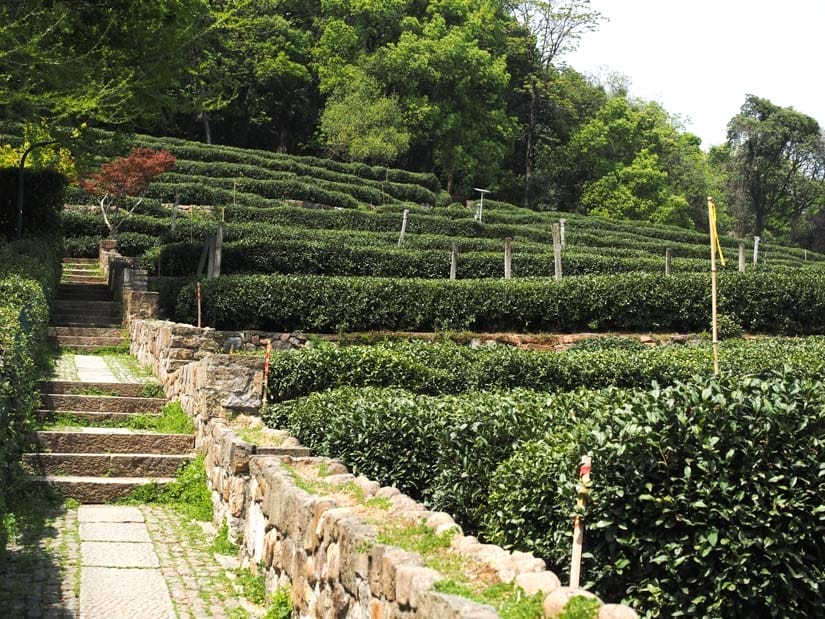
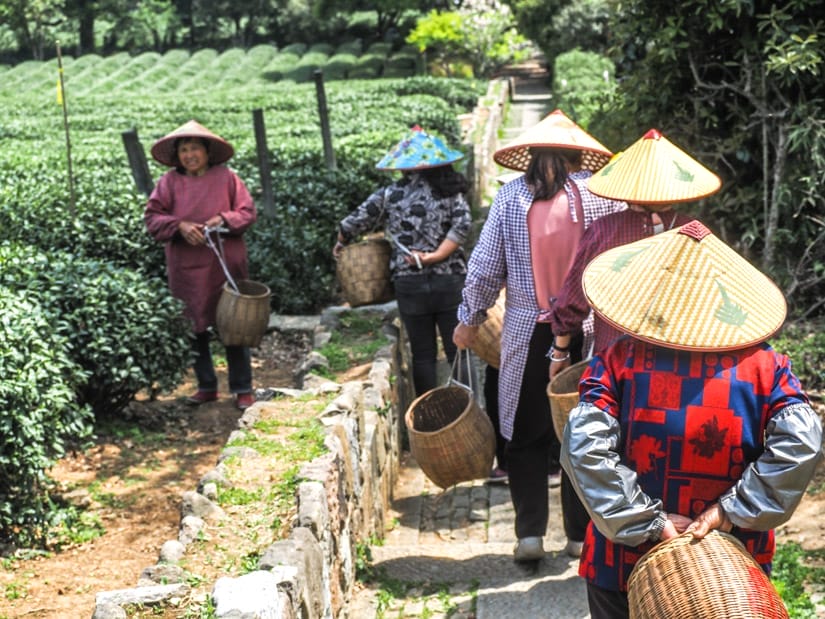
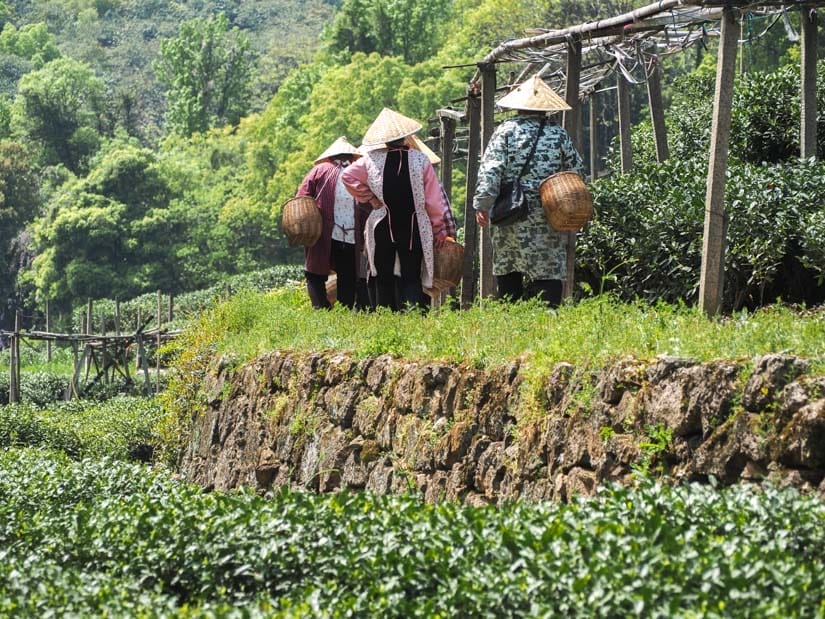
I took a staircase uphill, where I encountered a group of women making their way out into the fields to pick tealeaves. I watched as they chatted merrily then got to work under the hot sun.
I should mention that I have a good telephoto lens and shot these photos discreetly from afar – I wasn’t hovering around them or sticking a camera in their faces.


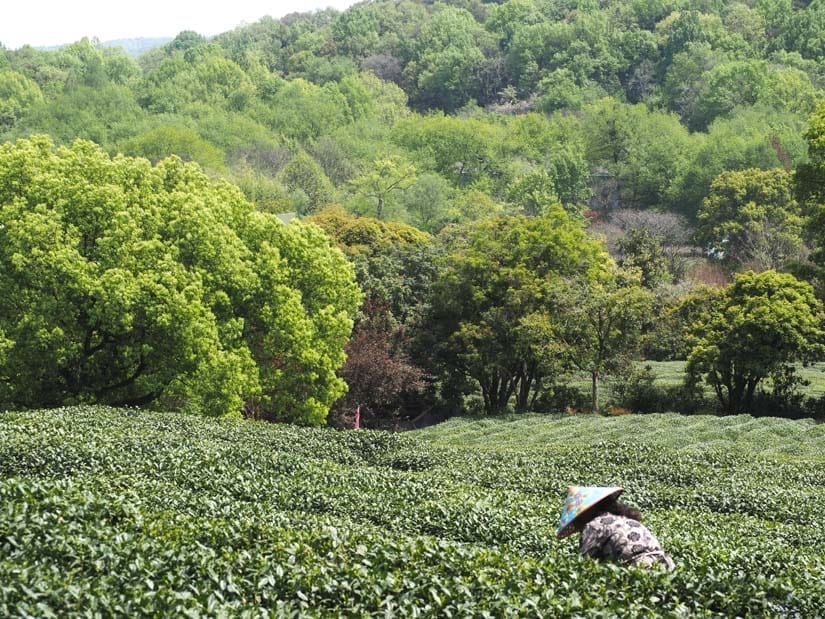
Continuing along, I found another building with more displays inside. Then I entered a forested section with a few quiet pavilions where locals were doing photo shoots.
I found one spot where it seemed possible to order tea and enjoy it by a lovely stream. I also saw maple trees with beautiful red leaves and some cherry blossoms on my visit.


I also spotted a statue of the tea sage Lu Yu (陆羽) on the grounds, holding up a cup of tea.


To leave, I walked back to Green Tea Restaurant and the main road, where I caught a taxi that happened to be just sitting there.
I also could have walked up Longjing Road (35 min, uphill) or taken the bus, but I wanted to get there quickly to have more time for exploring.
Longjing Temple

My first stop in Longjing area was Longjing Temple (龙井寺, bus stop here), which is actually about 500 meters before the start of Longjing village. Whether you’re coming by bus or taxi, I suggest getting off here, then you can walk to everywhere else I’ll describe below.
Longjing Temple has a history going back over 1000 years, although the current structures look fairly modern. The temple is in the forest and I could see any tea fields yet.
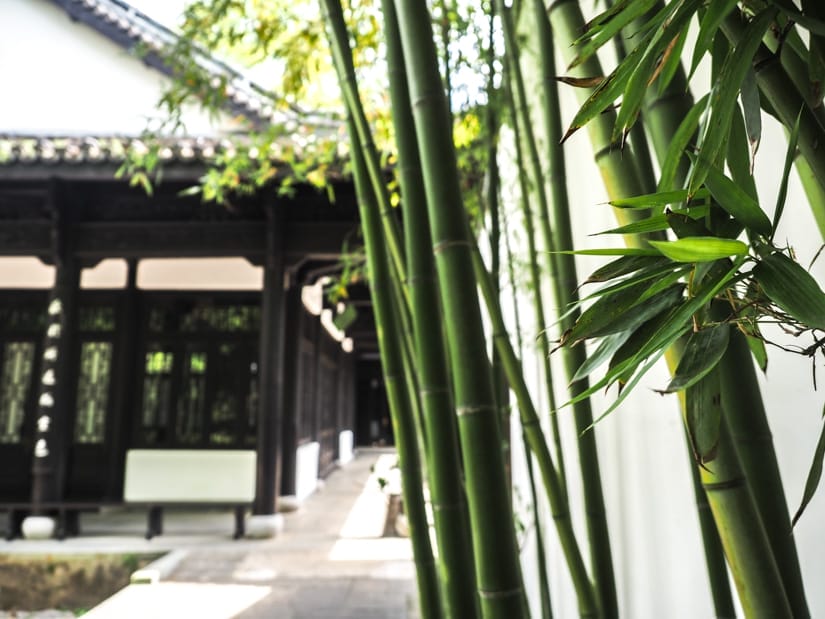
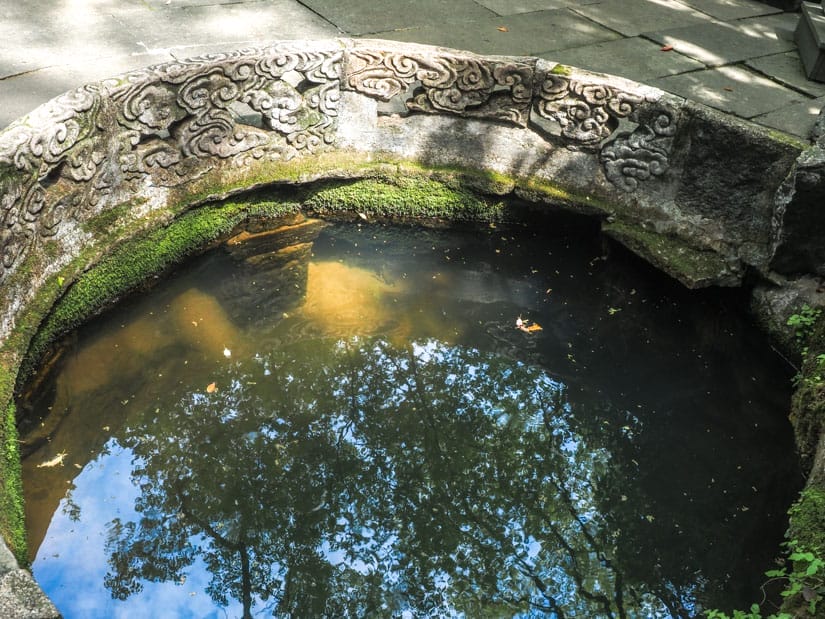
I followed a path up through the forest to reach the main collection of buildings. Next to one of them is Longjing Spring (龙井泉), which is one of several famous wells in the Longjing area.
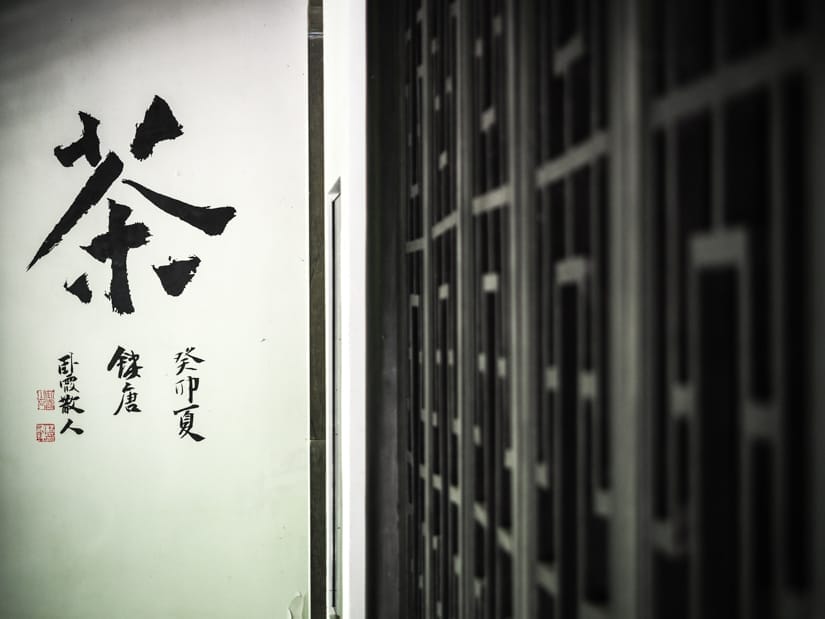
Overall, the vibe at this temple is quite serene, with few tourists, and paintings on site gave me the feeling that tea is venerated here.
Walking to Longjing and Upper Branch of Tea Museum

From the temple, I walked the rest of the way to Longjing village. Returning to Longjing Road and walking a few steps towards Longjing village, I then saw a staircase descending into the forest on the opposite (left) side.
My map apps told me that there should be a cluster of attractions down there belonging to the “eight major scenes of Longjing” (龙井八景), including some stone tablets, pavilions, and ponds, so I decided to take a chance on it.
The stairs went down, down, and down, and I wondered if I’d made a mistake. Eventually I reached several halls (see here and here) and teashops that mostly appeared to be under renovation and closed.
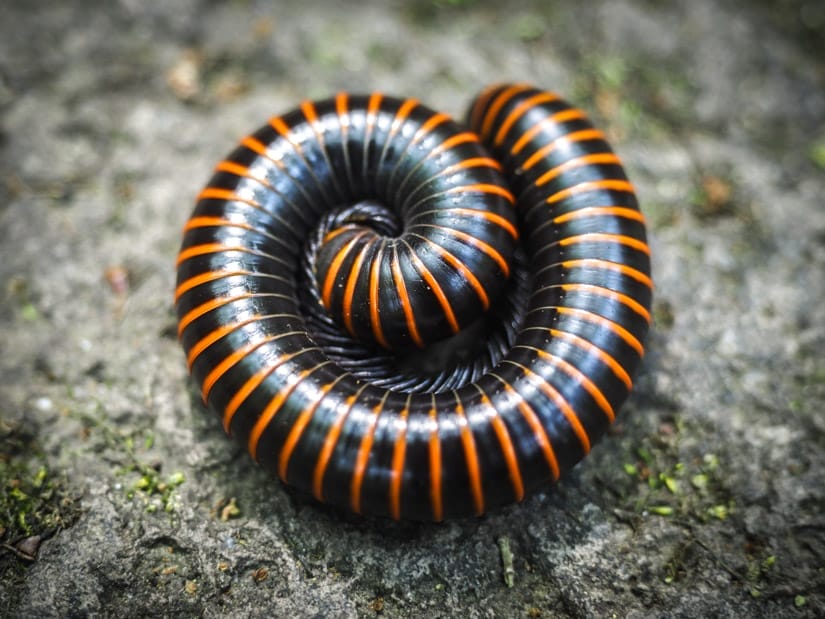
The coolest things I saw were some dragon designs on the ground and a giant millipede. If you have the choice, I would say skip this, unless you enjoy getting very off-the-beaten-track and are in no rush to get to Longjing village and the tea fields.

Back up to the main road, I continued towards Longjing village, The road made a sharp turn, after which I passed Longjing Teahouse (龙井茶室, here).
Apparently this used to be part of Longjing Temple, but now it’s a teahouse. I didn’t visit it, but I could see that it has a large spring with stone walls.
Continuing along, just before Longjing Road reached the start of Longjing village, another road turned off sharply to the left. I walked steeply up this road for 10 minutes to find the Upper Branch of China National Tea Museum (here).

Unliked the main branch, this one doesn’t have any tea plantations on site. I followed the stairs up into the attraction (seriously huffing and puffing by this point).
Inside the several buildings here, I found more displays on tea, covering tea culture around the world, tea processing techniques, and tea culture in China.

There were some trails in the forest behind the buildings, but I wasn’t sure what they led to so I didn’t bother. By this point, I was eager to move on and finally see some tea fields!
Overall, this branch was very peaceful, but it required a lot of uphill walking and wasn’t as interesting as the main branch, so I would only recommend it for serious tea people who (again) aren’t in a rush to get to the tea village.

Longjing Tea Village

Longjing tea village starts right about here. At that spot, there was a police barrier across the road. They seem to limit how many cars can enter to avoid traffic jams on the village’s narrow, single road.
Waking down this street, I saw tea shops on either side. Most of them employ a guide who sits out in front of the shop stirring freshly picked tealeaves by hand in a huge roasting pot. The smell is fantastic and meant to attract passersby into the shops.
I still couldn’t actually see any tea fields, though, and wondered for a moment if I was even in the right place. I had seen a YouTube video of someone who paid a visit to Longjing village, bought some tea, and only later realized that they had gone to the wrong village.


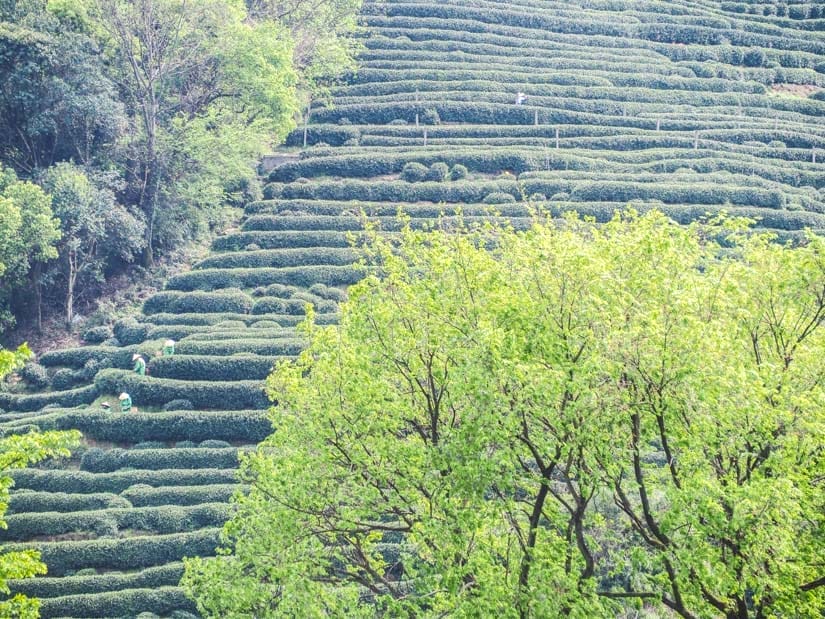
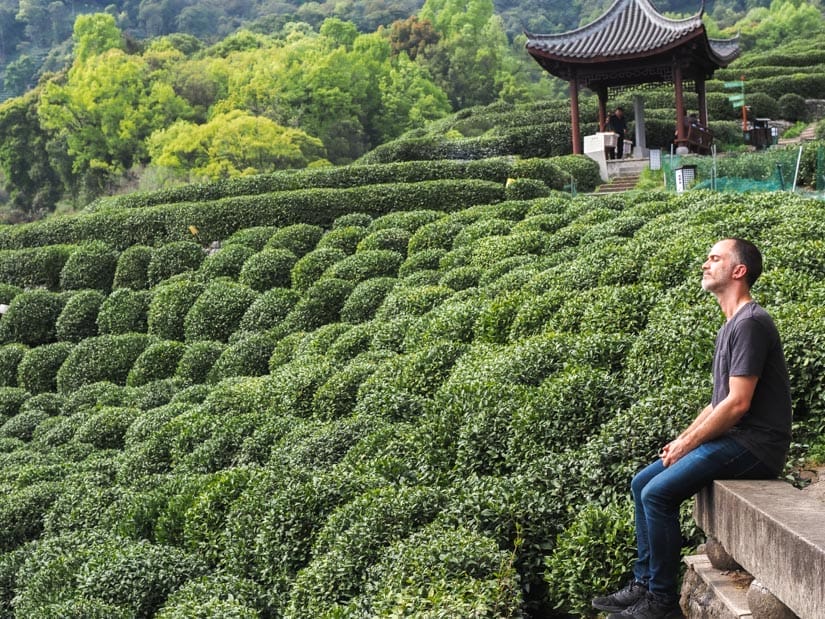
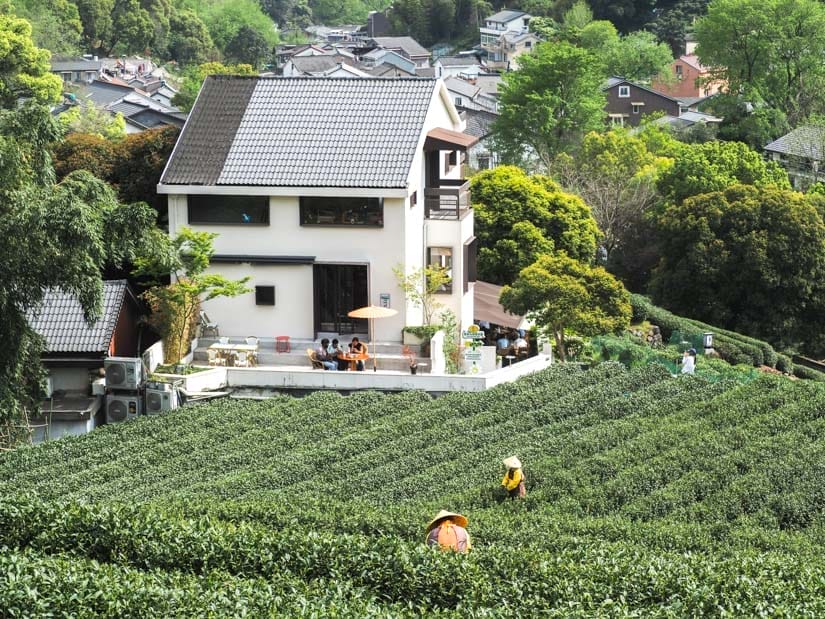
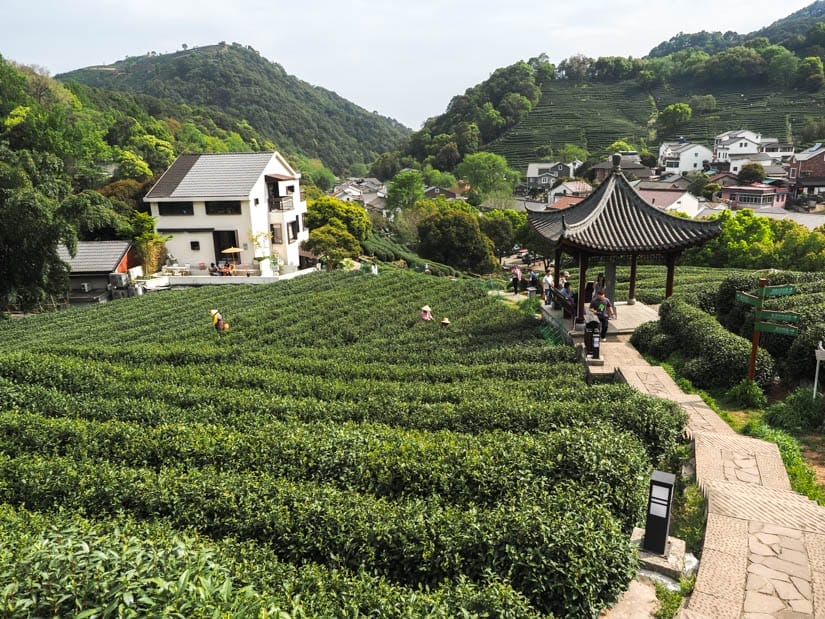
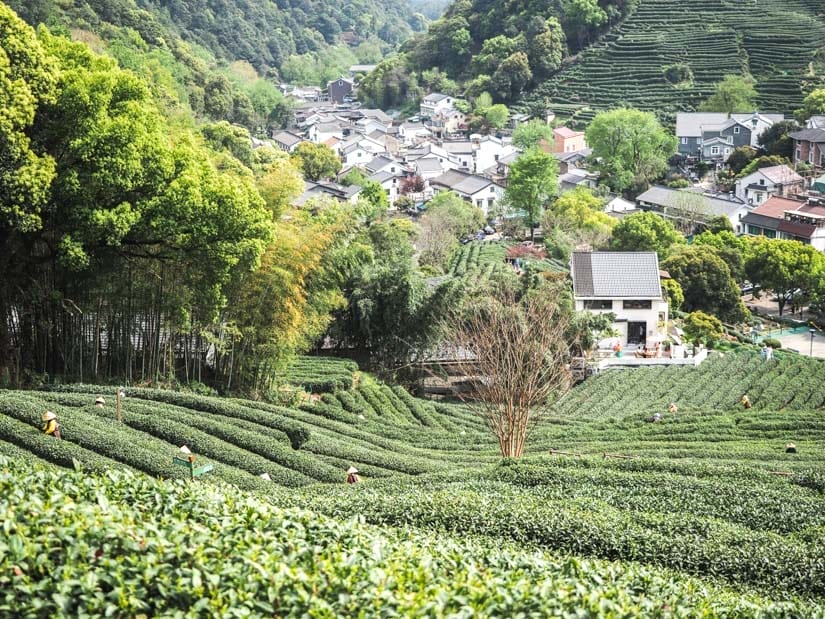
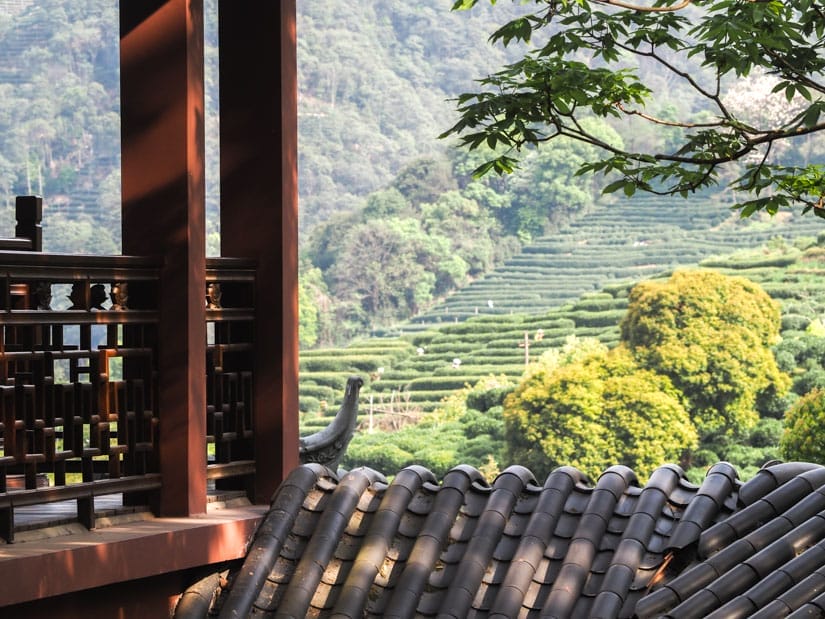
But nope, I was definitely in the right place. I rounded a corner and then suddenly I found myself in a large, stunning valley, with terraced tea fields rising up all around me.
Three roads coming into the valley meet here, so you could call that the center of the village.
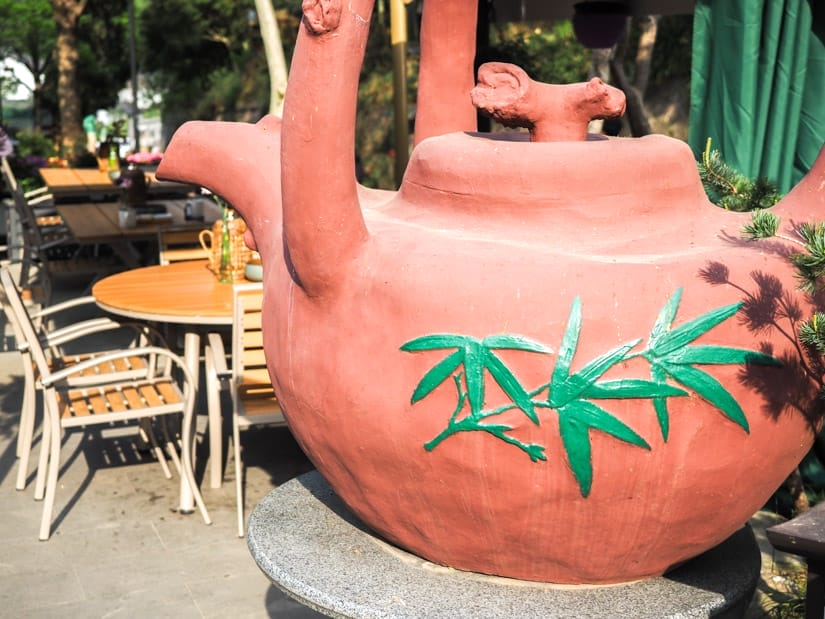
The village was totally different than I’d expected – somehow I’d pictured that the roads and tea shops would all be at the top, looking down on the fields. Instead, you come in at the bottom of the fields, and need to climb up any of them if you want a view looking down at them.

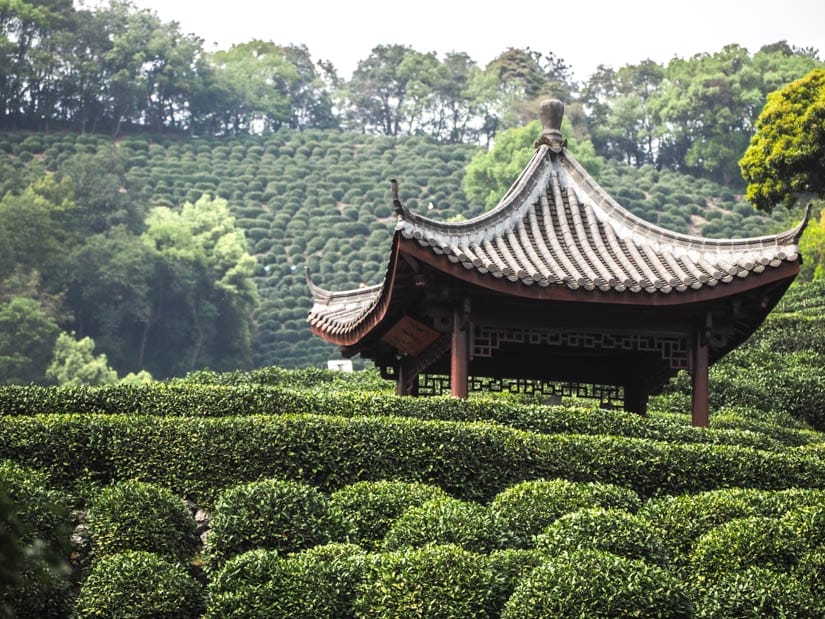
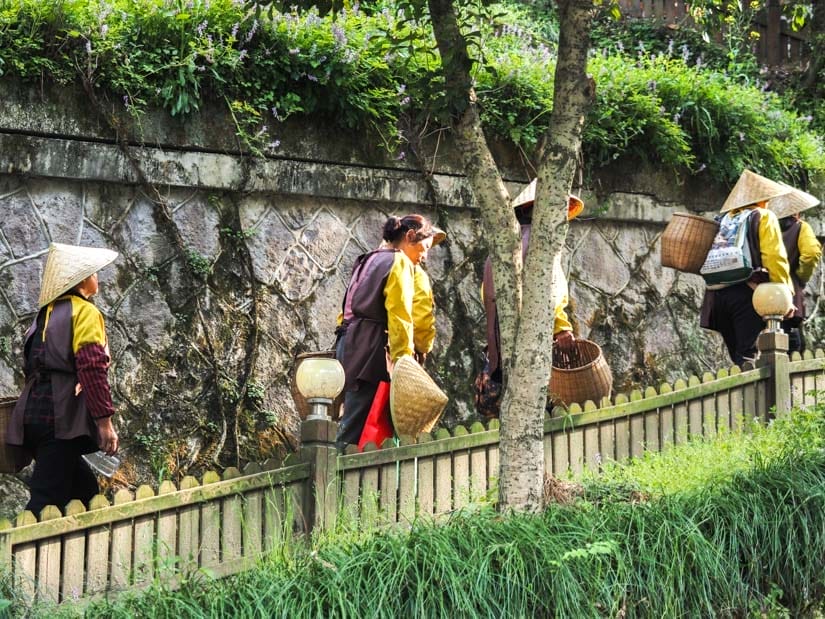
Shortly after I entered the valley, I saw a trail on the right going up into the tea terraces, so I followed it up. I reached a lovely looking teahouse in a white building called Longjing 82 (龙井82).
It actually looked like a great place to have tea, with views of the fields, so do consider it. But at this point I was on a mission to climb the hill, plus it looked full, so I pressed on.
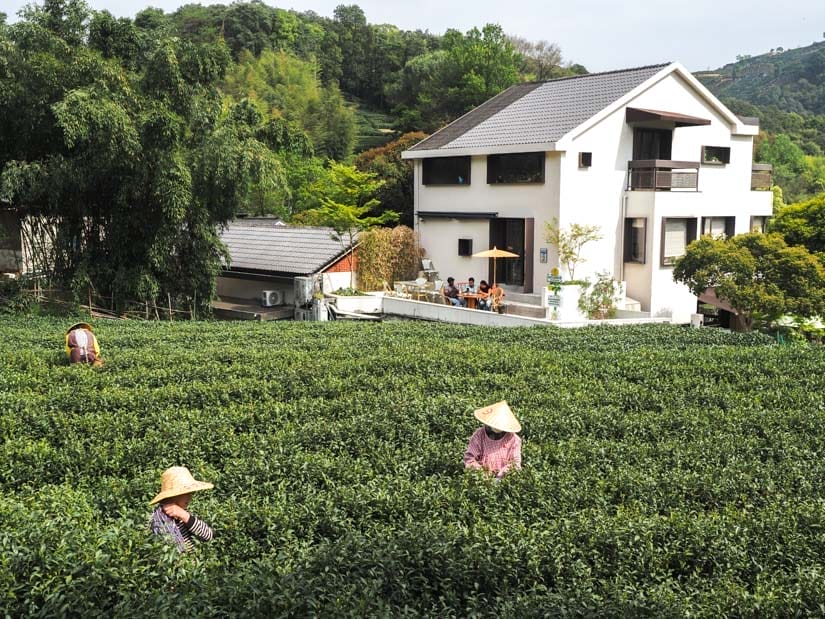
The trail kept going up and up, and the higher I went the views got better and better. I saw workers plucking tealeaves and dozens of locals doing their usual photoshoots.
Once I was satisfied and took too many photos, I made my way back down, with my next mission being to find some tea to drink and purchase.

Tasting and Buying Longjing Tea
I had heard stories of tourists getting ripped off in Longjing, so I made a point of not jumping at the first tea shop I saw.
There are numerous shops selling tea lining all three roads into town. When I reached the meeting point of the three roads, I turned right (the direction of my final stop, see next entry).
Then I spotted a teashop where several locals seemed to be going and buying tea, which to me seemed like a good enough sign as any.
The shop is called West Lake Longjing Tea Shifeng Mountain Chaocha Center (西湖龙井狮峰山炒茶中心, here).
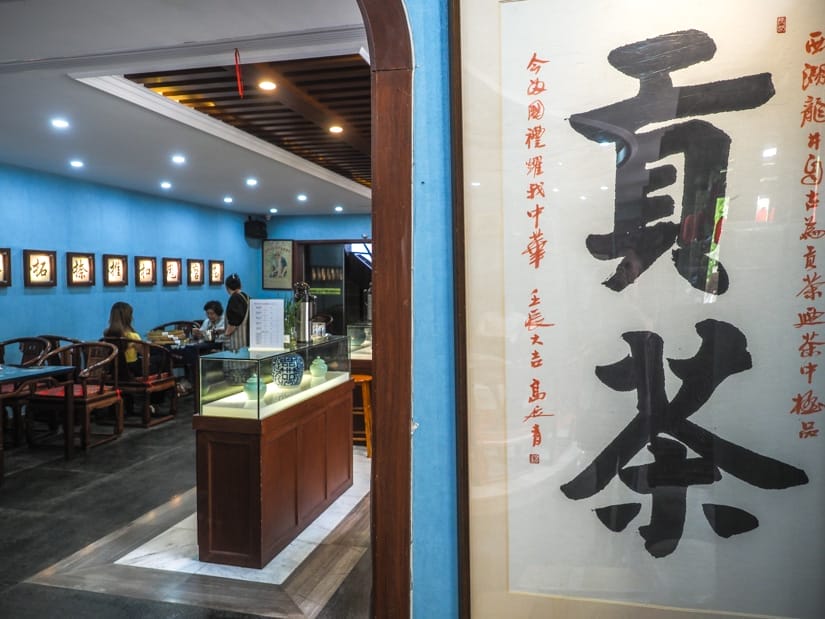
Inside, Chinese customers were seated at tables, where staff were showing them the range of teas on offer.
All the tables were full, so I was seated at a large, round counter, right next to the guy who was sitting there roasting tea – the smell was gorgeous and filled the roam. On the TV played scenes of Longjing’s tea fields shot from above.
I started by ordering a glass of tea. There were different prices for different qualities. I ordered the best quality one. I believe it was RMB 80 (USD 11), but in the end they didn’t charge me for it because I also bought tealeaves.

For the tealeaves, they showed me their range of qualities on photogenic bamboo baskets.
Tea in China is priced per jin (斤), a traditional unit of measurement equivalent to 500 grams (originally it was closer to 600 – they’ve now rounded it down to 500 in China, but Taiwan, Thailand, Korea, and Thailand still use 600).
The prices on the baskets they showed me were per jin, ranging from 1500 (USD 210) to 6800 (950 USD) per jin. That’s right – not cheap!


But tealeaves are very light, so it’s not as bad as you may think. The large tin of tea that I bought was only 125 grams, so I had to quarter the prices shown. My quarter jin of the third highest quality tea (2600/jin) cost me RMB 650 (USD 95).
However, shortly after leaving the shop, I stated to feel regret. Once I did the conversions, I realized the tea hadn’t cost as much (in my home currency) as I’d thought (do your calculations before buying!).
Buying real Lonjing tea was literally one of the main reasons I’d come on this trip. I wished I had got an even higher quality one.
But it wasn’t too late. After visiting Lao Longjing (see next entry), I popped into another smaller teashop called Lao Longjing First Tea Shop (老龙井第一家, not on any maps) just down the street from it, to buy a higher quality tea (equivalent in price to the second highest quality in the first shop I’d visited).
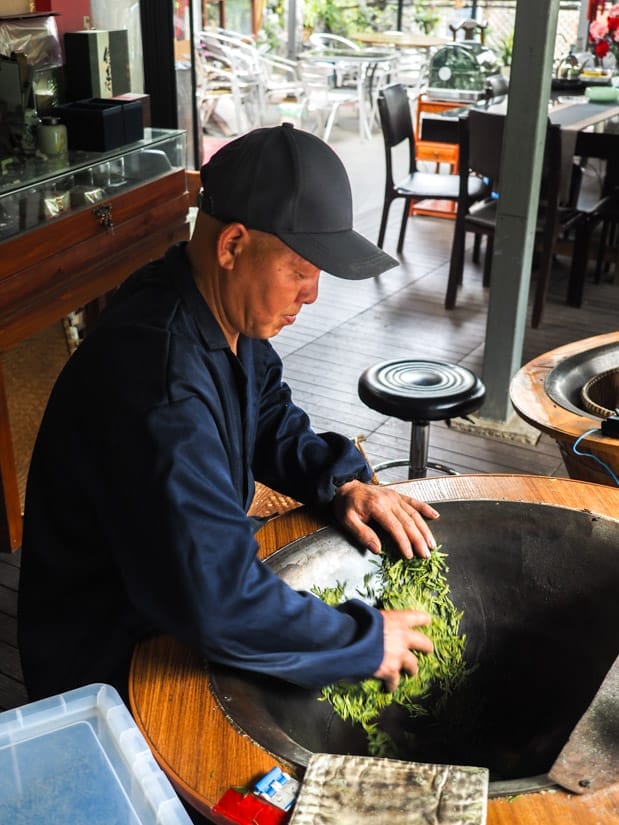
The staff here at this shop were even friendlier than the first, and it felt more like a family-run teashop.
They let me smell various teas held in huge Tupperware containers. One of the higher quality ones smelled absolutely stunning to me and far better than any of the others (even ones that were more expensive), so I purchased a small tin (50 grams or one-tenth of a jin) of it.
At 3500 (USD 490) per jin, the small tin only cost me 350 or USD 49. This would be the one I would save for special occasions, such as right now as I’m typing this article and reminiscing about my unforgettable Longjing trip.
Just please don’t judge me for enjoying my Longjing tea in my simple Taiwanese tea set (instead of the Longjing way). I just never got used to drinking tea from a piping hot glass.

I was now 100% satisfied with my tea haul – if I had brought more than just carry-on luggage, I would have bought much more.
I didn’t get the feeling that I was being ripped off at either of these shops. While I can speak Mandarin, and that probably helps, I should also mention that I’m a newbie when it comes to green teas, and barely an amateur when it comes to tea tasting in general. Thus, I have no idea how good the teas I bought are compared to others, in terms of price and quality.
It’s also worth noting that some Longjing teas are not actually made in Longjing village. Teas labelled West Lake Longjing (西湖龙井) can come from anywhere around the lake. If you can read Mandarin, you may have noticed that the ones I bought in the first shop all say this on the label.
If you know more about this topic, please feel free to share in the comments below.
Lao Longjing (Royal 18 Trees)

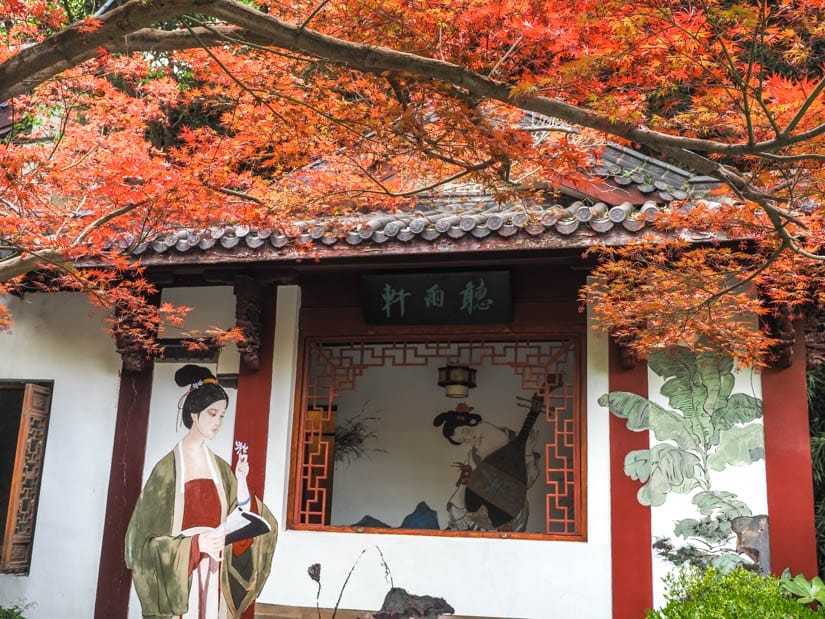
There was one more famous spot I had to visit before leaving. Lao Longjing (老龙井, here) is the site of the famous Royal 18 Trees or 十八棵御茶 (shiba ke yucha) that first inspired the emperor.
The circular collection of trees (or rather, bushes – they weren’t as large as I expected – are inside a collection of shrines, pavilions, and ponds. I actually explored the whole area without even noticing them – I had to ask a staff member. It turns out they’re right at the front. And silly me – I forgot to take a photo of them, but you can see one here.
There’s another spring here – cooler than the one I’d seen at Longjing Temple because at this one, the water drips down from a stone dragon’s mouth.

Overall, this was a surprisingly peaceful attraction with approximately zero tourists in it other than me. It’s also possible to drink tea or purchase tealeaves there.
I should mention that there’s small entry fee of RMB 10, which I paid on a large screen at the entrance.

On the way out, I turned right on the main road (this road doesn’t exist on GoogleMaps, but you’ll see it other map apps), and that’s where I found the second teashop I described above.
Then I walked another 10 minutes or so in this direction. The road curved and brought me back to the center of Longjing village. I ordered a Didi back to Hangzhou from there.
The last scene I saw before getting into the taxi was a woman picking tealeaves right beside the road, only a few meters away from me.
Back in Hangzhou

You can head over to my Hangzhou day trip guide to read more about what I visited there before heading back to Shanghai.
But for this article, I just want to mention that if you don’t have time to visit Longjing itself (in my opinion, you should make time…) then you can also buy top-notch Longjing teas in central Hangzhou.
I saw many teashops in my short time there. If you have a specific recommendation for teashops in Hangzhou, please share it in the comments below.
I also couldn’t pass the chance to try a Longjing green tea ice cream before making my way back to Shanghai.


Wow Nick thank you so much for a honest article where you aren’t afraid to acknowledge your mistakes which are to our advantage to avoid. We are heading to China this May 2026 Your info will be precious!
Glad you found it useful. Have a great trip!
Thanks Nick, your article was very helpful to us during our visit to Hangzhou!
Glad to hear!
Just moved to Hangzhou slightly over a week ago! Great article and I’ve saved the locations on amap to go and see for myself! Thanks!
Hi! Thanks for your itinerary, really useful. Did you prebook the museums via wechat? I am struggling to do so and wonder if I can just appear on spot. I am planning to visit on 30.4 so one day before the big holiday 1st of May.
Thanks!
Andrea
I didn’t even have WeChat (the app never worked for me, until the end of my trip). The National Tea Museum (both branches) was free, no app needed. For the Huqing Yutang Museum of Chinese Medicine in Hangzhou (discussed in my Hangzhou day trip article), the main area is free. There’s also a small paid portion, but I didn’t get there in time to try. For other museums, mausoleums, and famous temples in Hangzhou, I didn’t make it to them so I can’t say.