

Dear reader: This article contains links to products and services that I may be compensated for, at no extra cost to you.
Tiger Leaping Gorge is one of the deepest in the world – hiking it was an absolute must on my Yunnan itinerary.
After spending three days in Shanghai, then flying to Lijiang, where I spent another three days, I did the Tiger Leaping Gorge trek on the way to Shangri-La and Yubeng.
Because China is changing so quickly and there hasn’t been much information published post-COVID, I found that A LOT of the information about Tiger Leaping Gorge in guidebooks and online was totally wrong or outdated.
Therefore, I’m writing this article to share the most current information about how to get from Lijiang to Tiger Leaping Gorge, how to send your luggage to the end of the trail, the new trailhead for the two-day hiking route, why I chose to sleep at Halfway Guesthouse (see on Trip / Booking / Klook), and how to take the bus to Shangri-La or back to Lijiang after.
I did this trek in mid-2025, but I’ve made several updates to it going into 2026 based on many comments and updates from readers. After reading, I highly suggest you check the comments at the end, as several readers have left very detailed reports of their recent experiences in the gorge.
Table of Contents
Tiger Leaping Gorge Hike Quick Intro

Tiger Leaping Gorge (虎跳峡 or Hǔtiào Xiá) is a dramatic canyon on the Jinsha River (金沙江), which is an upper stretch of the Yangtze River (长江).
Technically in Shangri-La county, it lies 60 kilometers north of Lijiang and 80 kilometers south of Shangri-La city.


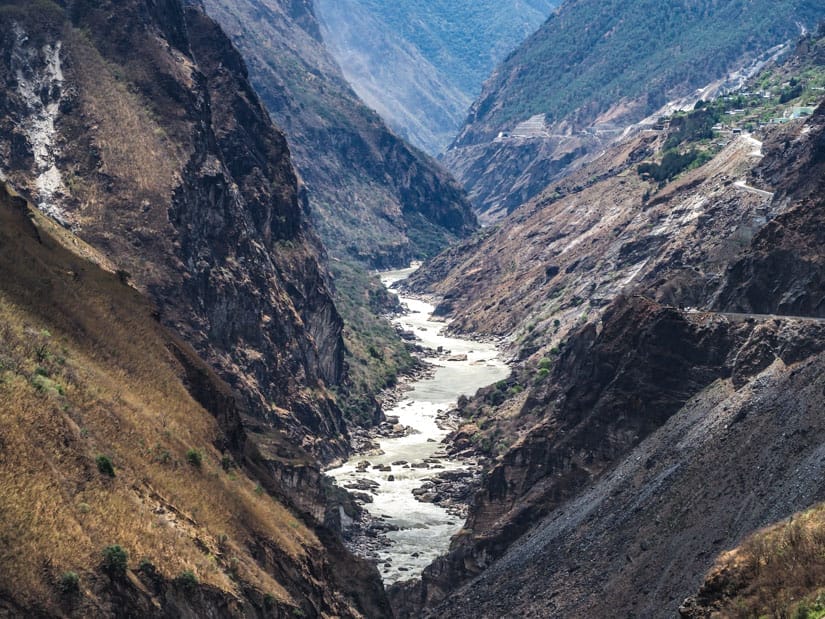
The river flows in a northeastern direction (you’ll be trekking downstream), carving out a 15-kilometer canyon that is 3790 meters from river to the highest peaks flanking it.

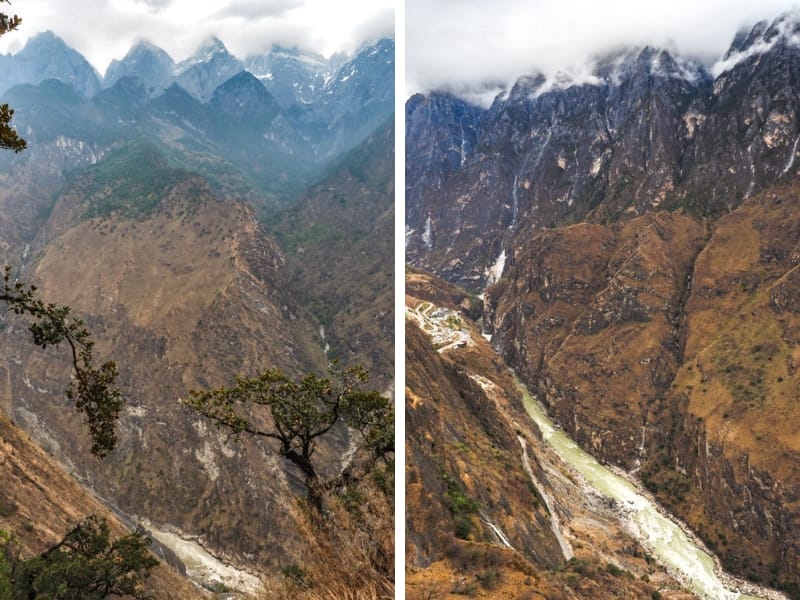
Notable mountains around it include Jade Dragon Snow Mountain to the east (玉龙雪山, 5596m), which I visited in my Lijiang itinerary, and Haba Snow Mountain (哈巴雪山, 5396m) to the west.

The gorge is named after a legend that a tiger escaped hunters by leaping across the river at its narrowest point (25 m). There’s actually two claimed spots where this happened – I’ll introduce both in the article below.

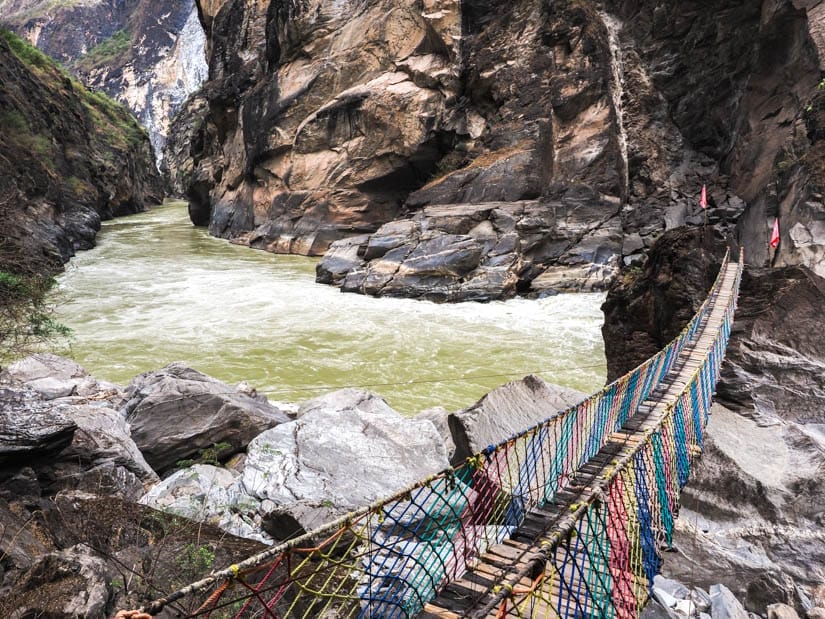
Tiger Leaping Gorge and the hiking trail through it are well-known across China and even abroad. It has been popular among trekkers for decades.
Most of the trekkers I met in the gorge were Chinese, but there was a sprinkling of foreign visitors, too.
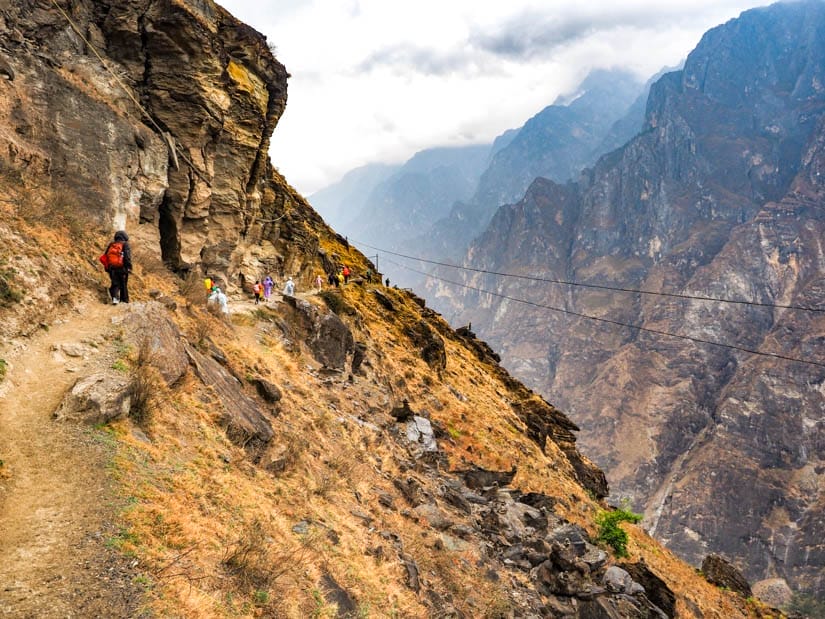
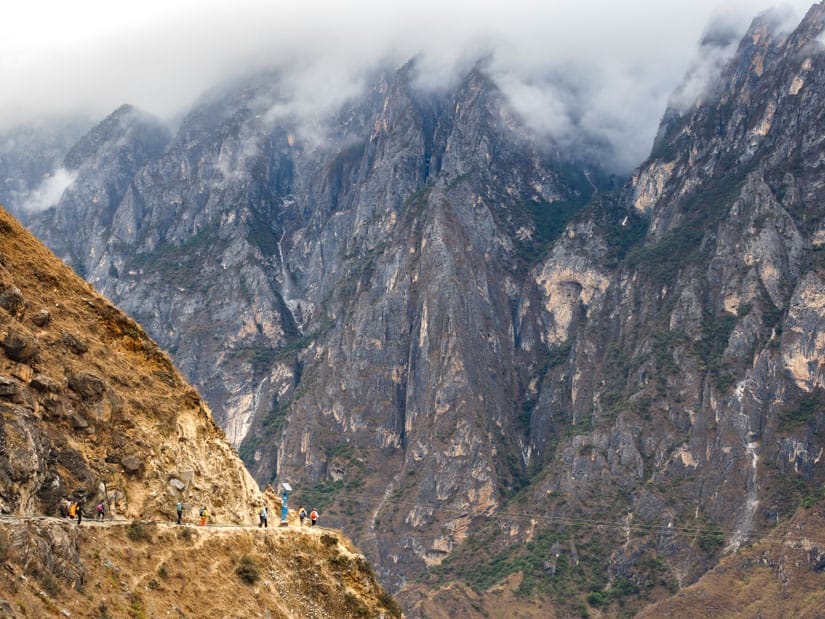

The gorge is divided into three sections: Upper (starting point, in the southwest), Middle (ending point for most trekkers), and Lower (in the northeast, also called Walnut Grove – most trekkers don’t go that far).

For the typical two-day trek which I’ll be guiding you along, I took a bus from Lijiang to the trailhead at the Upper Section and had my driver drop my luggage at the Middle Section (where I would end my trek).
The trail traditionally started at a village called Qiaotou, but as I will describe in the article, the bus I took from Lijiang skipped Qiaotou and dropped me at a new starting point a little further into the gorge.
This has changed yet again since I did the hike – I’ll give you all the specifics in the article below.

I then hiked to and spend the night at the stunning Halfway Guesthouse (see on Trip / Booking / Klook). I recommend using Trip for your hotels in China, since that is the most common one there, plus the prices tend to be lower.
From trailhead to guesthouse on Day 1, the hike took me six hours (including one hour lunch stop). With the recent changes, which I’ll get to below, you may only have to do about five hours of trekking on Day 1.

The next day, I did the short and comparatively easy hike from there to Jiantang Village or “Middle Gorge” (2 hours), then a very tough side hike down to Tiger Leaping Stone at the riverside (2 hours return), for a total of four hours of hiking on Day 2. (2026 update: This side hike has since been totally closed but recent readers have described a new way to get down to the river).
Finally, I retrieved my luggage (I explain the new luggage pick-up location at the end of the article) and caught the bus to Shangri-La.

Read all the reasons why I chose a Holafly eSIM for China or order one here. It worked throughout my hike in Tiger Leaping Gorge. Get 5% off with the code NICKKEMBEL at checkout!
Getting from Lijiang to Tiger Leaping Gorge
The information in this section is crucial, as all of the information I had found for getting from Lijiang to Tiger Leaping Gorge before my trip was wrong.
If you’re traveling from Shangri-la to Tiger Leaping Gorge, see the comments at the end of this article – one reader describes how they did it.
How to Buy the Bus Ticket

In the Lonely Planet China I was using (16th edition, published 2021, which was likely researched in 2020), the information was very outdated for this part of my trip.
For example, it said there was a special shuttle for trekkers which would pick you up from any guesthouse in Lijiang, take you to the trailhead, and forward your luggage to the end of the trek.
Update: The 17th edition of Lonely Planet China (2025) was published shortly after my 2025 trip, although it was likely researched in 2024. Now that I’ve looked at, I’m sorry to report that it still has multiple errors, including the non-existent shuttle. It doesn’t even mention the actual bus (which I will describe below) and it wrongly describes where your luggage will be sent to at the end of the trek.
I stayed in two different guesthouses in Lijiang, and neither of them had heard of this shuttle.
In the end, I simply walked to Lijiang Bus Station (here, called 丽江汽车客运站 on some map apps) – it was a 15-minute walk from Zhongyi Market at the southern entrance of Lijiang Ancient Town.
At the ticket counter, I asked for a ticket to Tiger Leaping Gorge trailhead (虎跳峡登山口) for two days later. I also stated that I wanted my luggage to be dropped off at Middle Gorge (虎跳峡中峡).
They simply charged me for a single ticket to Middle Gorge (the end of the trek) and told me that I would need to inform the driver that I would get off at the trailhead and my luggage should be dropped off at Middle Gorge.
They also offered me a second option: to purchase a ticket to the trailhead only, which would have been cheaper, then pay the driver RMB 20 to take my luggage to the end – I didn’t choose this option, but according to recent travelers, this now seems to be the most common way.
I should note that I can speak Mandarin. If you cannot, and you want to do exactly the same as me, then I suggest you just show them the following Mandarin sentences:
我要去虎跳峽,我想在虎跳峡登山口下车,但请帮我把行李搬到虎跳峡中峡。(I want to go to Tiger Leaping Gorge. I want to get off the bus at Tiger Leaping Gorge Trailhead, but please take my luggage to Middle Gorge).
Enough people have now used my guide and shown the above Mandarin that the bus station staff are used to seeing it. They will likely tell you to inform and pay the driver the next day, and just sell you the ticket to the trailhead.
Notes: A few readers also mention in the comments that the ticket seller spoke some basic English, but this could vary by the person/day.
Next, they will likely ask you how many passengers and which date and time you want to go – just use your favorite translation app if needed.
As of the most recent update (early 2026), there are usually two or three departing buses per day, at 8:30 (less common), 9:00, and 9:30 AM. My one-way ticket to Middle Gorge cost RMB 40 (USD 6). I had to show my passport to buy the ticket.
Note: One reader notes in the comments that in winter, the first two buses only go to the gorge entrance. So if you plan to send your luggage to the end of the trek, only the 9:30 AM bus will be possible.
If your ticket is to Middle Gorge (meaning you’ve paid for your luggage to be taken to the end of the gorge), then it will say 中峡 (Middle Gorge) somewhere on it – most likely 丽江 –虎跳峽中峽 (Lijiang to Tiger Leaping Gorge Middle Gorge).
Riding the Bus
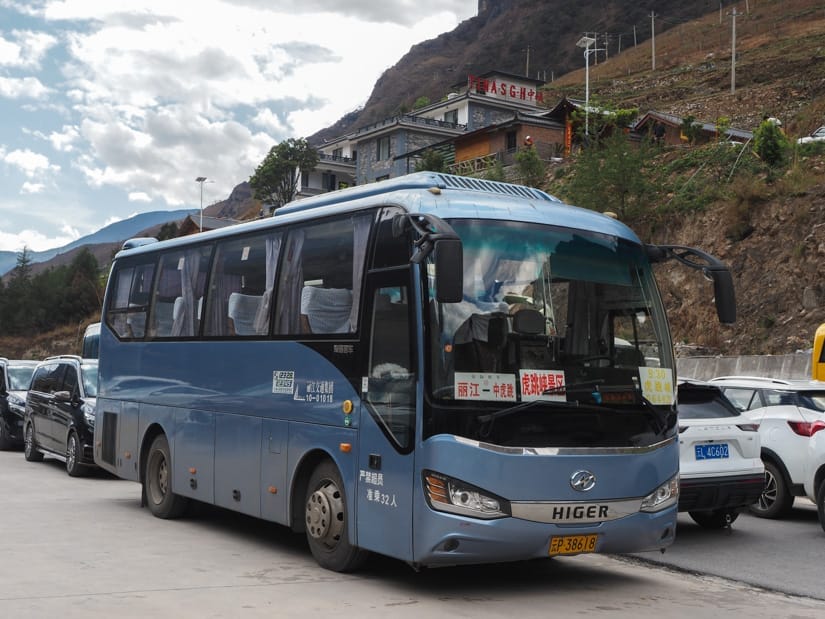
The next day when I boarded the bus, I mentioned again to the driver that I wanted to get off at the trailhead but he should take my luggage Middle Gorge.
Just show the Mandarin sentence I typed above to the driver. If you only paid to the trailhead, you’ll need to pay the driver more for taking your luggage to the end. If you already paid for a ticket to Middle Gorge (中峽, AKA the end of the trek), you shouldn’t have to pay the driver more.
The drivers are all very familiar with this situation.
Arriving at the Gorge
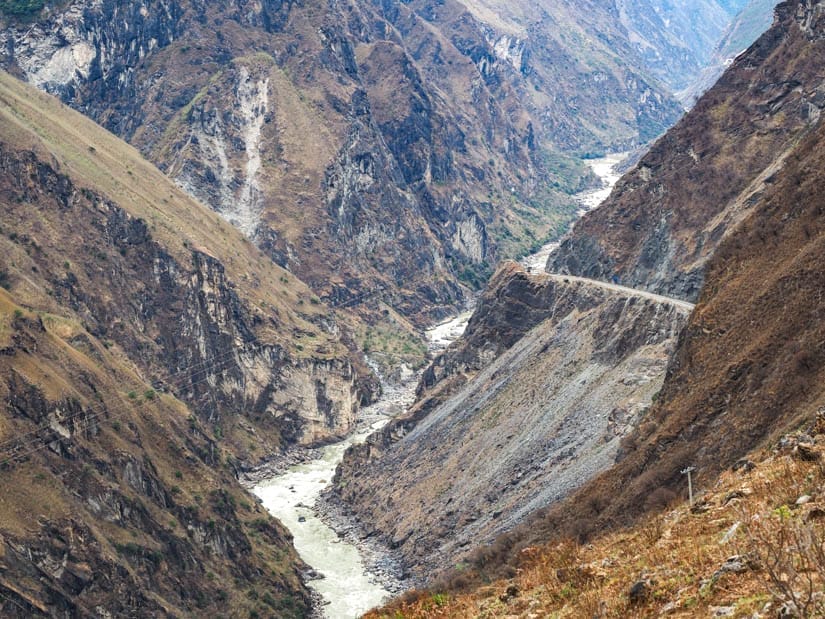
The bus ride to Tiger Leaping Gorge took two hours. As for where to get off the bus and the trailhead location, my Lonely Planet was again outdated here, while the newer edition just doesn’t even mention the bus.
The guidebook described that I would need to get off the bus at Qiaotou village (here), pay the park entrance fee, and walk up a road past a school to find the trailhead. The trail would then supposedly ascend to Naxi Family Guesthouse in Nuoyu village (诺余), where I planned to have lunch.
Maybe it was like this in the past, but the bus I took did not even go to Qiaotou village.
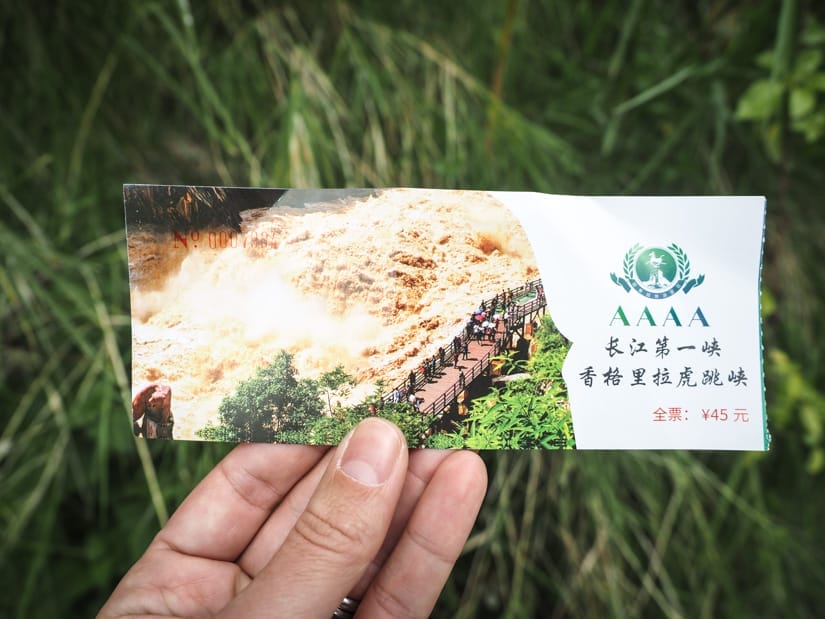
Instead of turning left to Qiaotou village, we turned right to the Tiger Leaping Gorge Scenic Area Ticket Office (here), where a park staff member boarded the bus and charged everyone (including me) the park entrance fee (RMB 45).
Several commenters at the end of this article have noted that if you’re doing the hike, they didn’t have to buy the park entrance ticket. The ticket is only for those who are driving through the gorge and visiting some scenic spots along the road. I don’t know why they made me pay for it – maybe they didn’t realize I was hiking, and I didn’t realize at the time that hikers don’t need to pay it.
However, an even more recent reader said she still had to, just like me. So the enforcement seems to be very random!
Most of the passengers (all locals – I was the only foreigner on the bus) got off the bus here, and there were taxi drivers waiting to take them to their hotels in the area. I seemed to be the only person on my bus that was doing the full hike.
The driver insisted that I just hang on, as he’d be taking me to another trailhead. I trusted him and waited.
Note: If you want, you can get off the bus here at the Visitor’s Center and take a taxi up to Naxi Guesthouse, to skip the first hour or so of the hike, which is uphill. There will be drivers waiting! One reader says they paid RMB 25 for the ride.
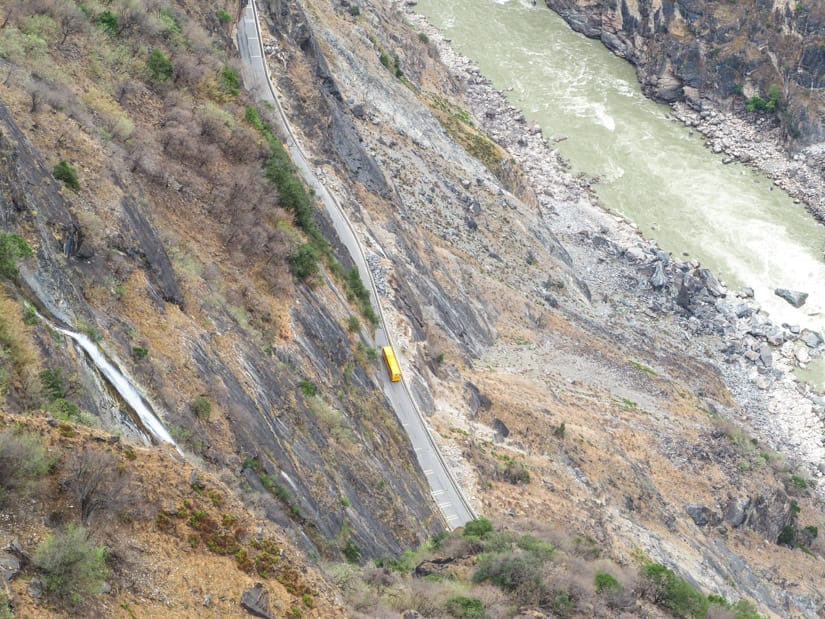
After the short stop, the bus started driving up the vehicle road which runs through the gorge (also called the Lower Road, while the hike above is the Upper Road).
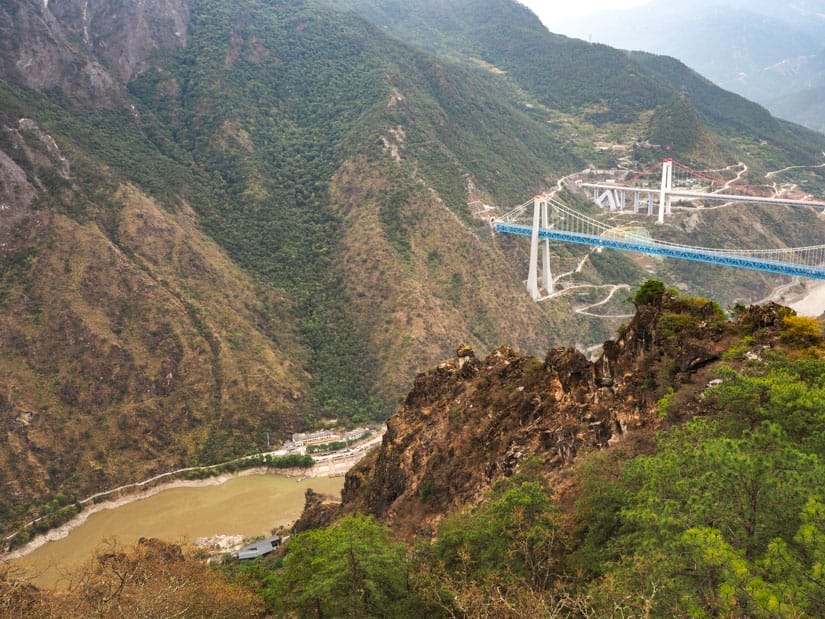
Five minutes in, just after a distinctive tall blue bridge across the river (see photo above), the driver let me off here, from where I would follow a steep car road uphill to Nuoyu Village (where I’d have lunch) and the start of the trek.
Note: Recent readers commented that the bus driver even had a laminated placard of possible drop off points in Tiger Leaping Gorge. The one I’m describing and recommending here is Drop Off Point A. Other stops include the narrow section of rapids on the river (Point B), the intersection for Tea Horse Guesthouse (Point C), the intersection for Halfway Guesthouse (Point D) and Middle Gorge (the end of the trek). If you get off at Points C or D, I’m not sure how far of a hike it will be to the guesthouses, but there may also be taxis available. But please note, if you go directly to Points B or C and from there to your guesthouse, you’ll be missing big parts of the trek.
The reader also mentioned that this placard had a QR code you can scan to be taken to the WeChat mini program for purchasing bus tickets from Middle Gorge (the end of your trek) to Shangri-La, but this link should also get you to it.

My Experience Hiking Tiger Leaping Gorge
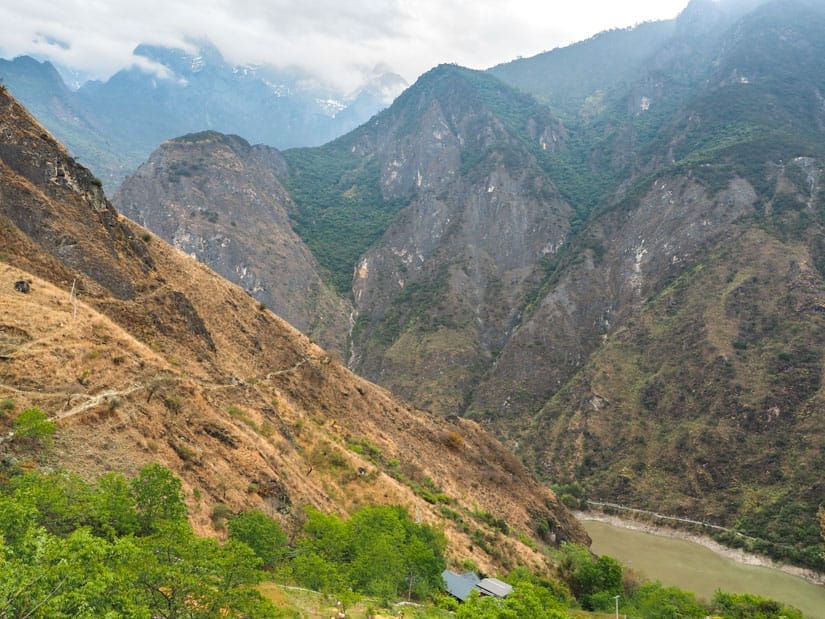
I’ll now cover every step of my route on the two-day trek through Tiger Leaping Gorge.
Trailhead to Nuoyu Village
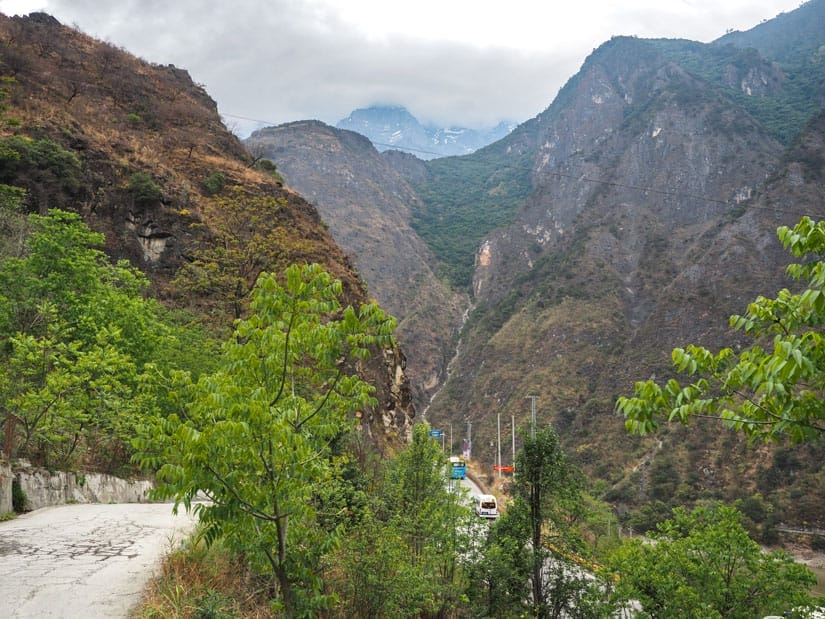
According to one reader, the place where you should get dropped off the bus even has a name: 乡村公路. As I mentioned above, it may also be referred to as Drop Off Point A.
Some people have described the hike from this bus stop up to the main trail as “the ugly part”, but I actually quite enjoyed it!
As soon as I got off the bus, there was a driver waiting at the bus stop asked me if I wanted a ride up to Nuoyu (Naxi Guesthouse), but I insisted on walking up, because I just wanted to. Readers who took the taxi ride up said they paid RMB 20, but some drivers try to ask for as much as 60.
Despite the poor, overcast weather and occasional drops of rain, I set off in a high mood.

The small car road wound its way steeply uphill, with views looking down on the gorge behind me quickly growing more dramatic.


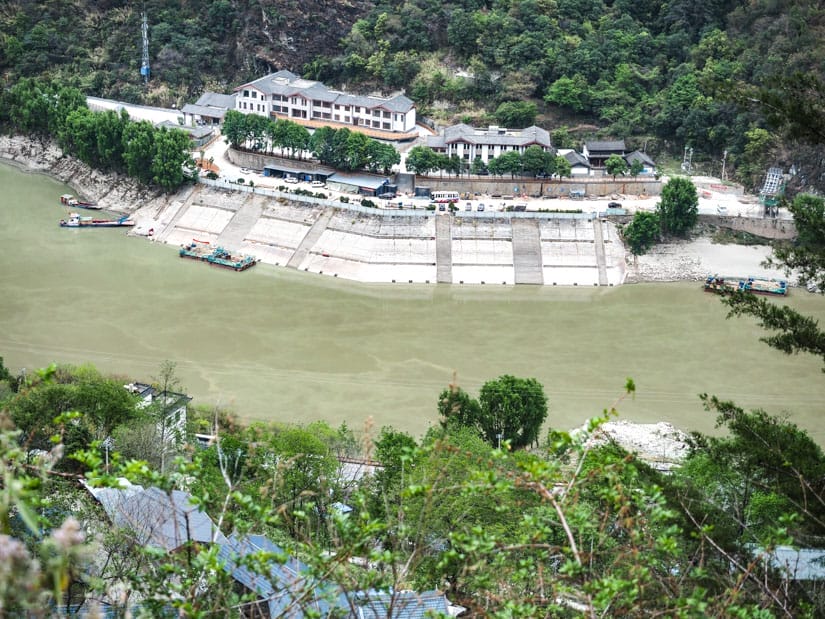
Within a short time, I had reached the height of the tall blue bridge and then continued to ascend far above it. I now have a silly number photos of that bridge, because the view looking down on it kept getting better the higher I went.


Signs along the way pointed towards Naxi Family Guesthouse (纳西雅阁客栈), where I planned to have lunch.

I passed several small farms, a camel (??), and some cool traditional gravestones. The scenery of course continued to get better and better.
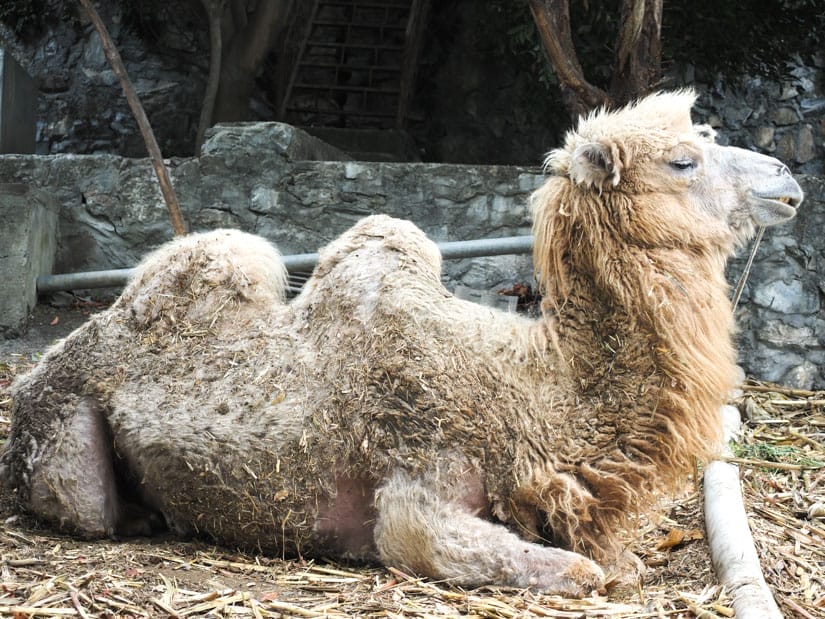
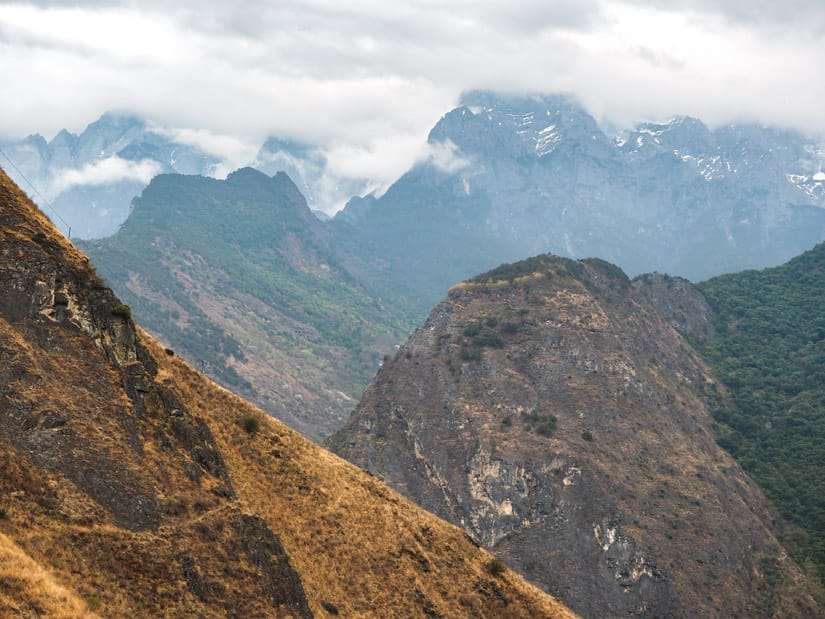
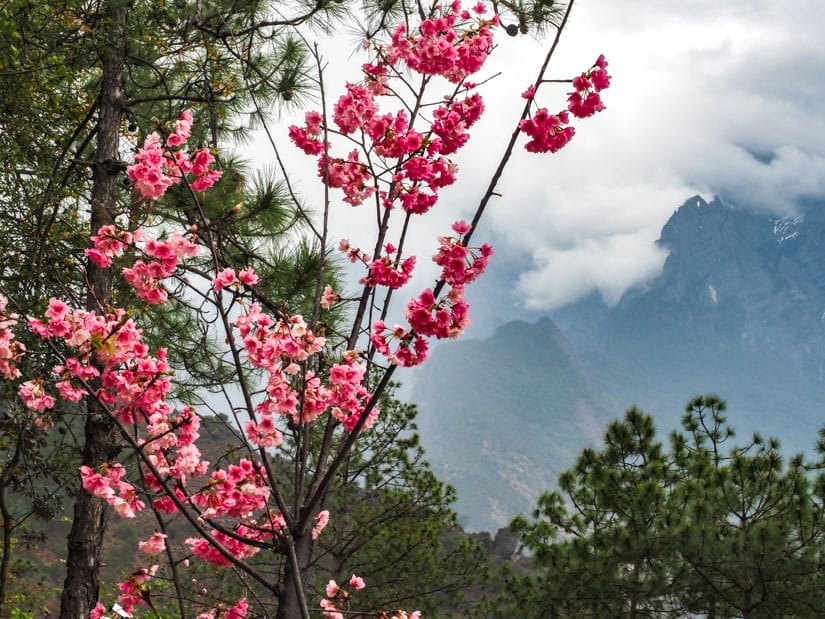
Finally, I reached an intersection in Nuoyu village (more like a couple farmhouses than a village) where I could go right to the 28 Turns (the main trail I’d soon be taking) or left to Naxi Guesthouse, which was visible just a few steps away.

I reached Naxi Guesthouse (not marked on GoogleMaps) almost exactly one hour after I’d got off the bus. As of 2026, you may be getting a taxi up to this spot, or you may be getting a taxi to the bottom and hiking up like I did.
You can have lunch here if you need it, or just skip to the next section of my article and start your hike. Also note, this would be a good last minute spot to buy last minute supplies like water, snacks, sunscreen, hiking poles, or a rain poncho before you start your hike.
In the guesthouse, I enjoyed a lunch of homemade chicken soup, cucumbers fried with egg, mint tea, and also purchased a couple bottles of water.
In total it cost me RMB 60 (USD 8) – pricier than in the city most likely, but still a bargain compared to back home.

Nuoyu to 28 Turns

The owner of Naxi Guesthouse told me that it would take me 4-5 hours to hike from there to my hotel, Halfway House in Bendiwan village, or 3 hours if I hiked very quickly (I hike at average speed, and in the end, it would take me 4 hours).
From Naxi Guesthouse, I returned towards the intersection I’d just come from, but instead of taking the car road, I bypassed the intersection by taking a nicer walking path above it – the guesthouse owner pointed me to it as I was leaving.
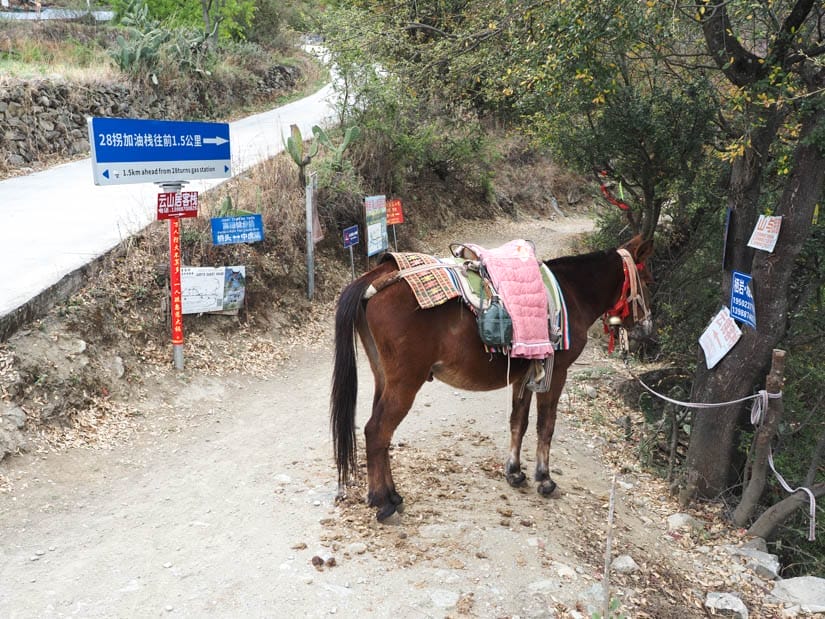
After I few steps, I found myself at what felt like the actual start of the hiking trail. Several horses waited here for potential clients like me. As I passed, one of the horse guides said, “Ha-lo! Hor-sa?”
While I’d love to support these local villagers, to be totally honest, you couldn’t pay me enough to ride on one of those up poop-dropping machines up the precarious, cliffside trail to come.
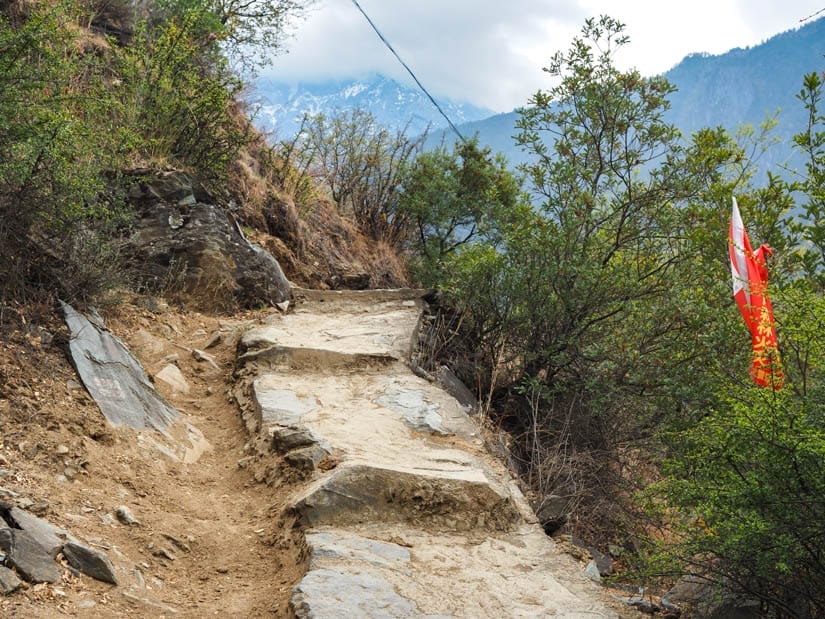
On a related note, this would be a good time to mention that I highly recommend getting some kind of travel insurance for your trip. While Tiger Leaping Gorge isn’t particularly dangerous as long as you hike carefully, things can go wrong on any kind of trek.
If you’re a frequent traveler like me, I recommend the Nomad Insurance offered by SafetyWing. Click here to read about the differences between their Essential Insurance, which would cover any potential trip delays or hospital visits, and their Complete Insurance, with even more comprehensive coverage.
Anyways, as I started along the trail, I turned back to see views of Nuoyu village and that same blue bridge.


Within minutes, I reached the start of the 28 Turns (28道拐, here). This is a notorious section of the trail which goes steeply uphill.
There are of course 28 sharp bends in the trail along the way. As expected, it was gruelling.
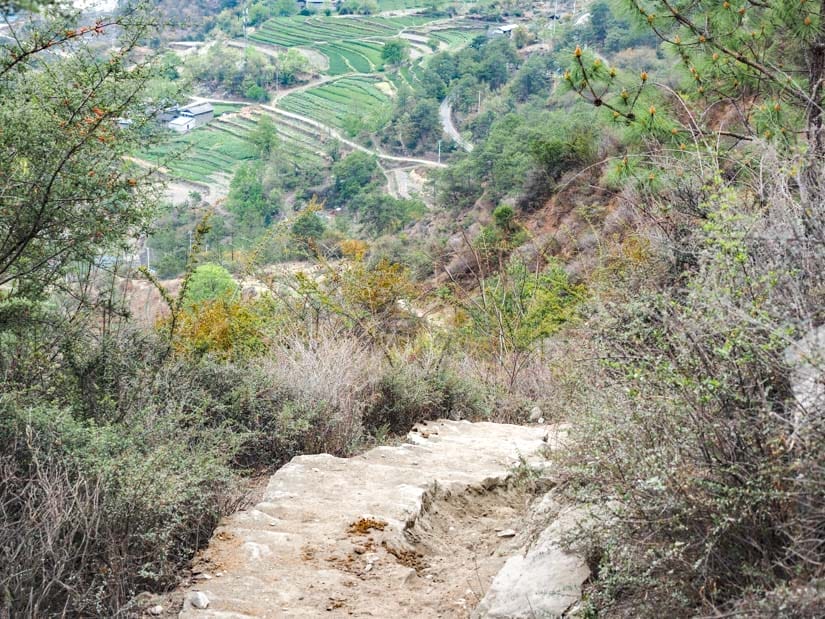
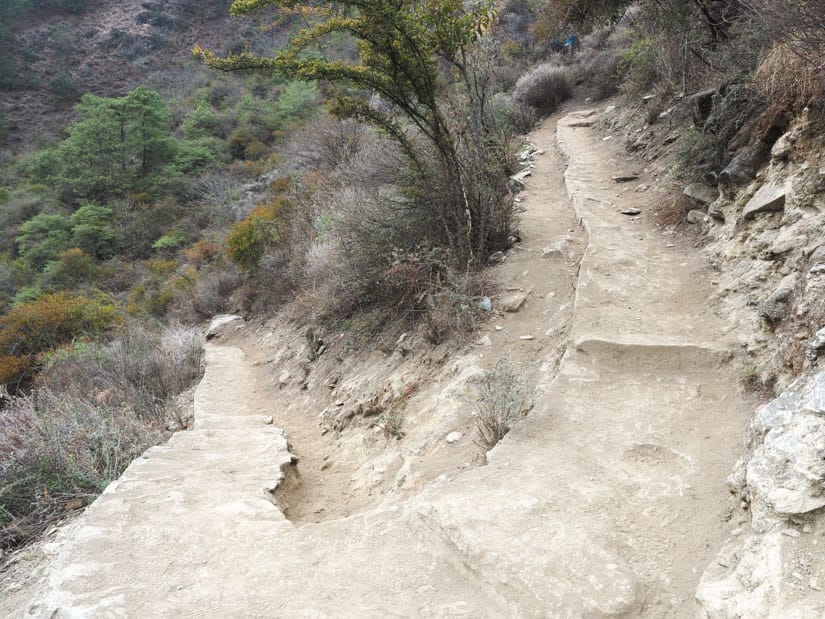
Nearing the top, I passed a café with a view and a cute name: 加油站 (jia you zhan). Literally “add oil station”, this means “gas station” in Mandarin.
However, “add oil” (加油) in Mandarin is also used as words of encouragement to passing trekkers, along the likes of “good job, keep going!” in English. So rather than a literal gas station, this is a stop where you can fuel up on energy.

Just above the “gas station”, I reached a sharp corner with a particularly stunning view. Looking backwards, I got what I thought would be my last view of the blue bridge (there would still be one more later – honestly, I was tired of seeing it).
But also, this was the first time I could actually see down the valley in the direction I’d be walking.
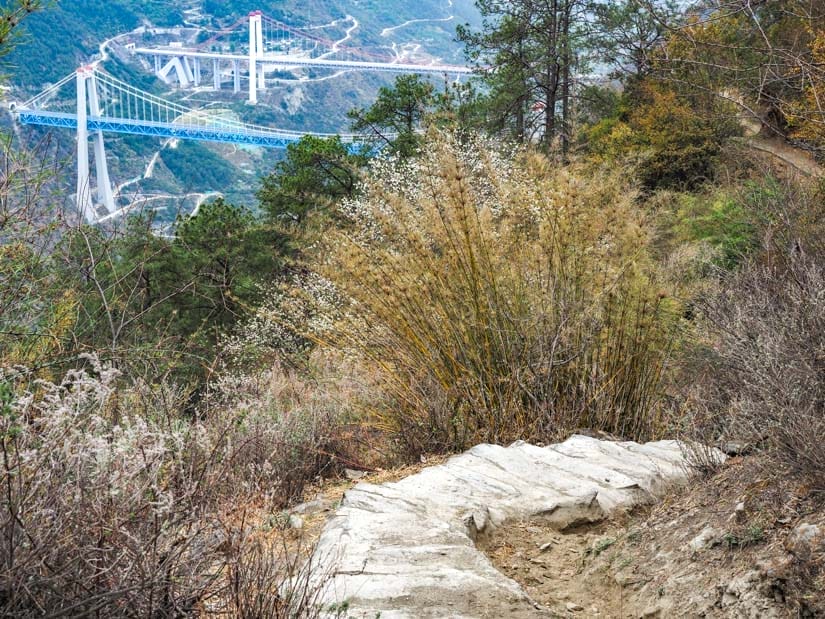


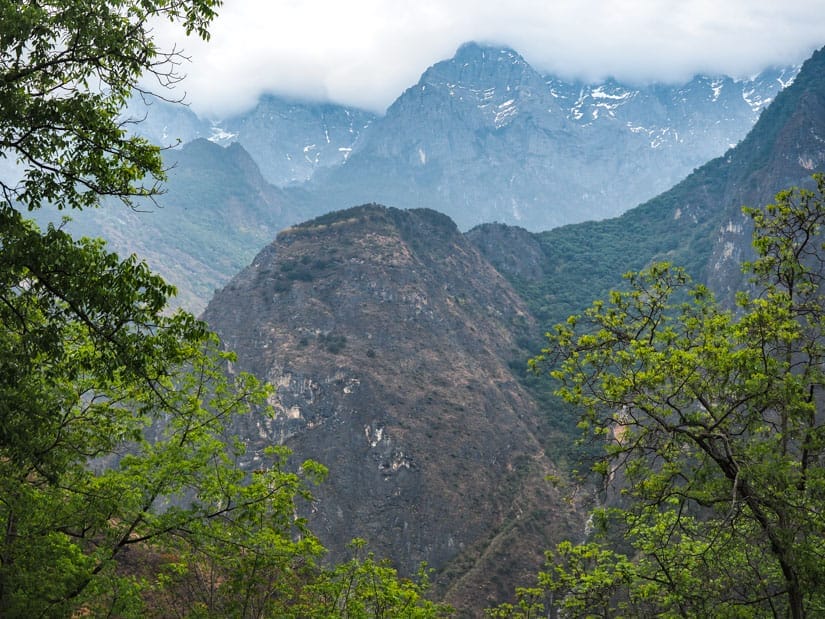
The large mountain dominating my views around this part of the trail was Jade Dragon Snow Mountain, which I had just visited from Lijiang the day before.

Having left my lunch spot at 1:00 PM, I reached the top of the 28 bends at 1:40. But that was a tough 40 minutes of hiking!
At least I thought it was the top – after a false peak, the trail just kept going upwards even more. It wasn’t very clear at what point I’d finally finished the 28 Turns, and it really felt like there were more than 28 of them!

28 Turns to Tiger Leaping Rock and Bendiwan

Around 2:30, I finally reached what I believe was the highest point of the whole trek, marked by a Chinese flag. An elderly couple ran a tiny shop there with instant noodles, chocolate bars, and drinks.
And yes, every vendor on the trail, even the tiniest ones like these, takes WeChat and AliPay.


The flag was planted out on a point which I assume offered an epic view looking both up and down the valley, but the couple was trying to charge RMB 10 to step out onto it.
Now 10 yuan isn’t much, but I’m not a fan of locals asking for money for views that should be part of the trail, not to mention there were so many other viewpoints before and after it, so I skipped this one.
Also, looking back from here, I got what would finally be my last view of the blue bridge for the day. It was hard to believed I’d hiked from the riverside all the way up to this height in only a couple hours.
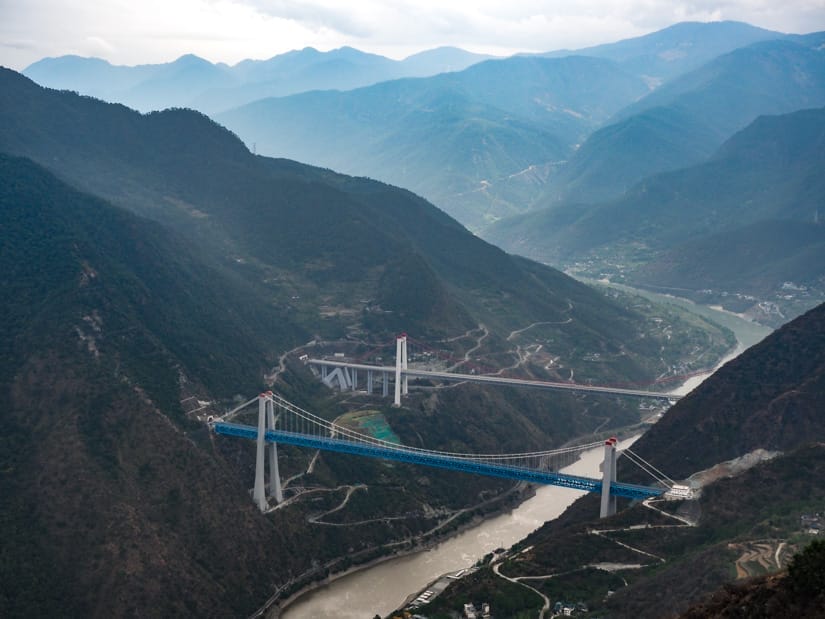
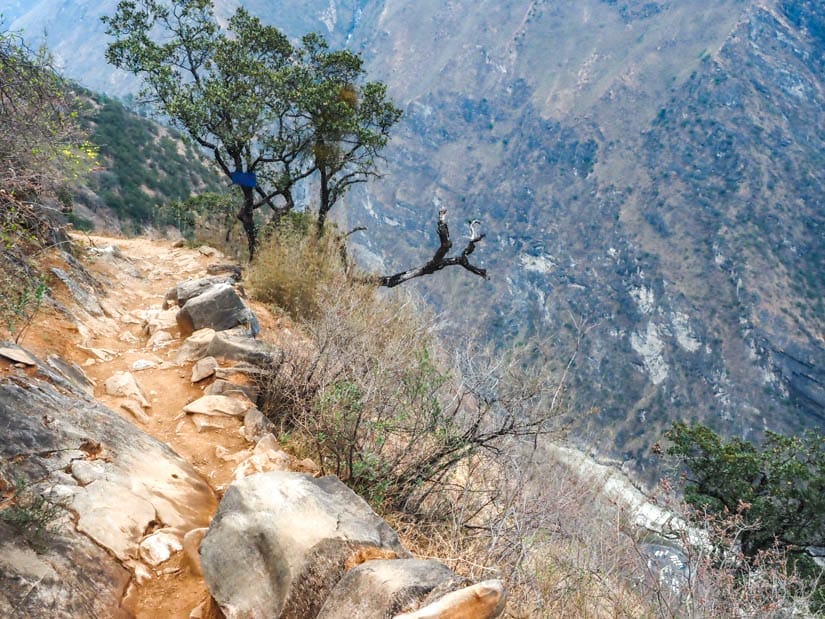
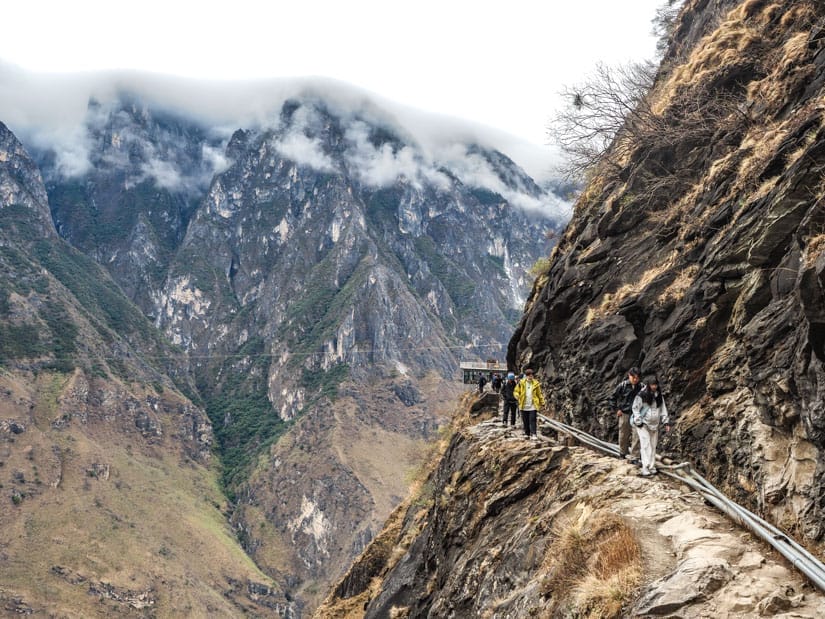
From there, the narrow trail went along a rather precarious cliff for some time, with stunning views to my right. On the plus side, the trail was mostly flat here.
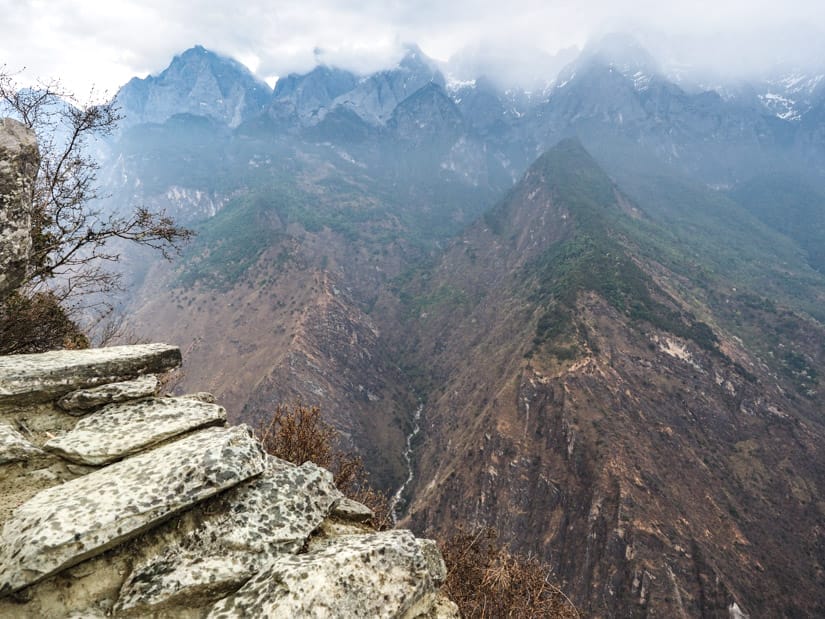
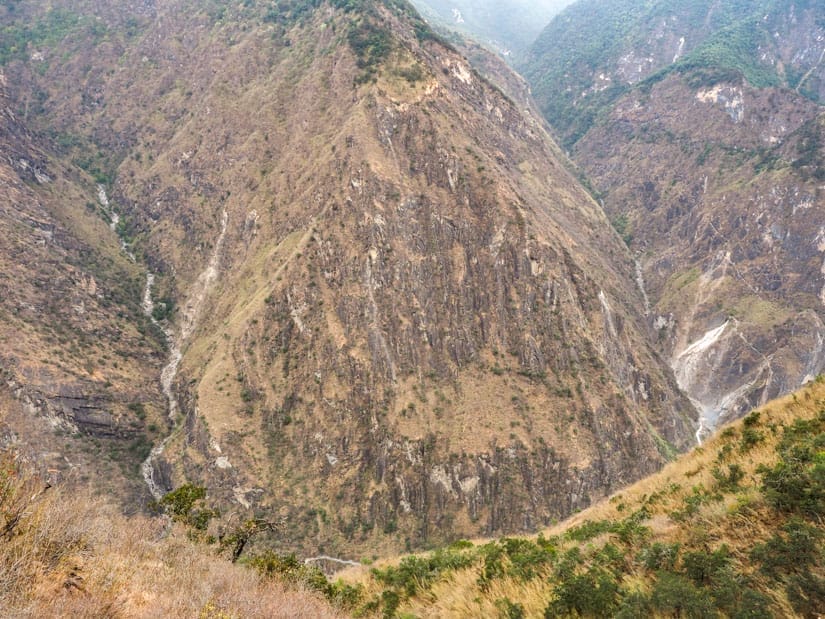
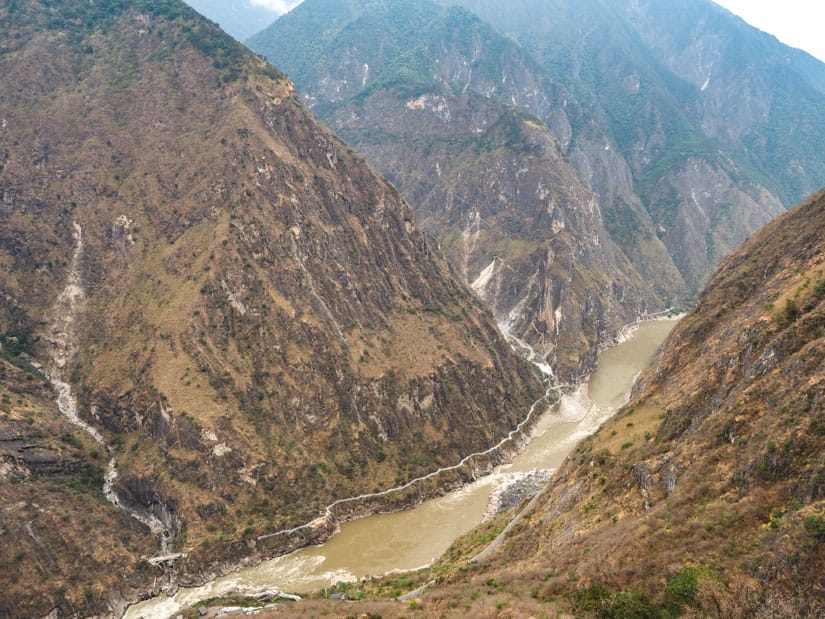
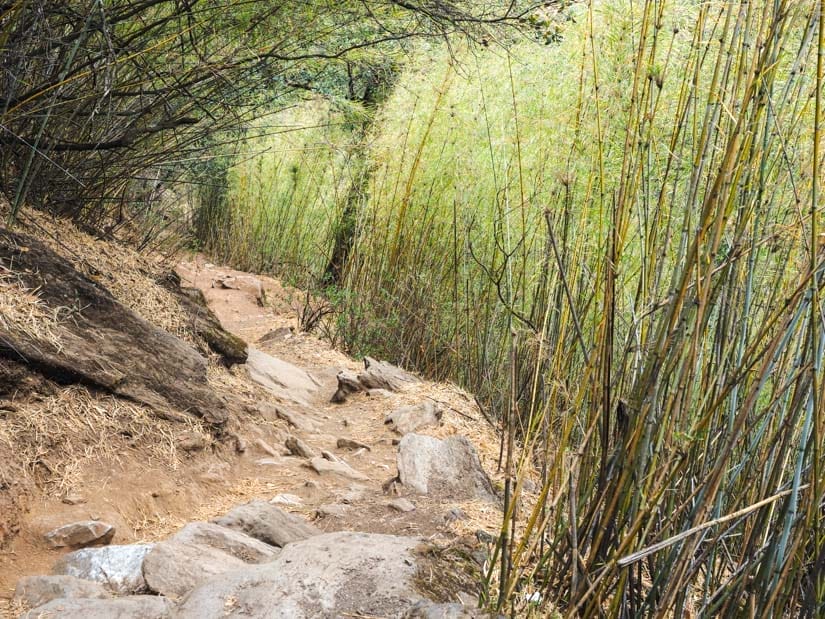
Then the trail finally started going downhill through some forest, including a section with bamboo. Gorge views were limited, not to mention it started raining.
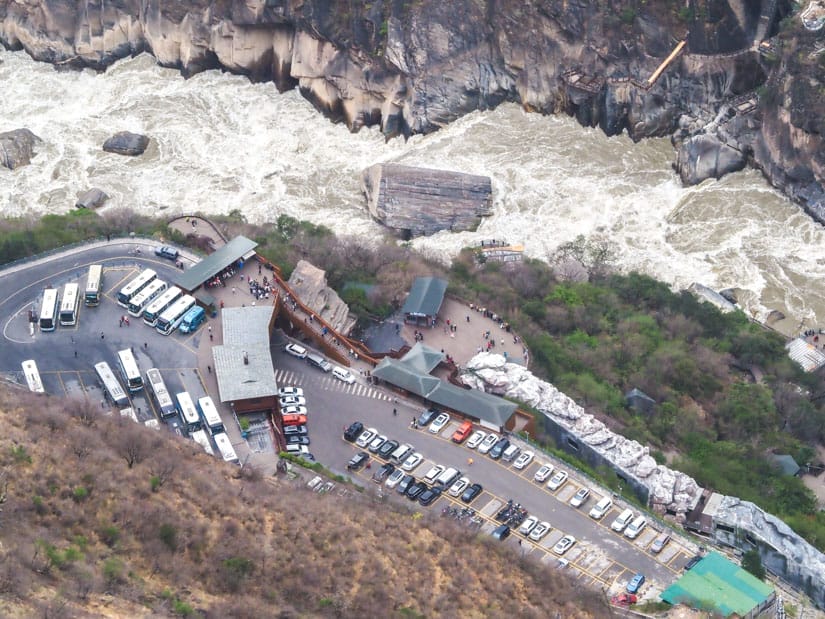
At some point, I got a view looking down at Tiger Leaping Rock (here on the Lower Road through the gorge). This is the first of two claimed spots where the Tiger Leaped from one side of the river to the other via a huge stone, thus it is known as Upper Tiger Leaping Rock (上虎跳).
This is the most popular tourist attraction in the gorge for those who are just driving through and not hiking it.
From far above, I could see a parking lot filled with tour buses and cars, and tourists on a large platform looking out at the huge stone in the river.
Not long after the Tiger Leaping Stone viewpoint, I encountered a tiger statue along the trail. A sign said I should pay RMB 5 to take a photo with it, but no one was around to collect the money.
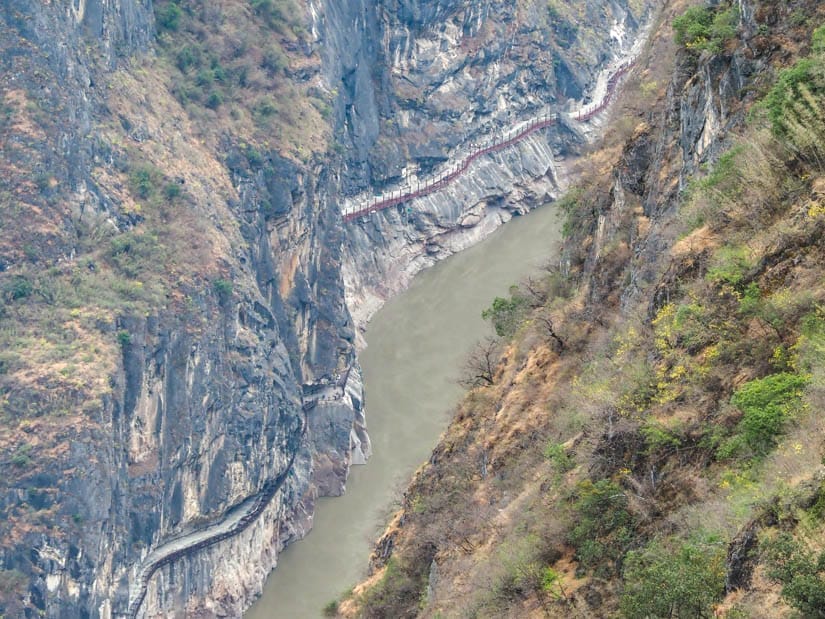
Looking down on the gorge, it was particularly narrow at this point. There was a trail carved into the cliffs on the opposite side, which I assume is mainly for locals.

Around 3:30, or 2.5 hours after I’d left my lunch stop, I reached Tea Horse Guesthouse (茶马客栈, here, see on Trip / Booking / Agoda) in Yacha village (牙叉).


Many hikers spend the night here, and I was very tempted to, especially since it is closer to the actual mid-point of the hike, whereas my hotel (Halfway Guesthouse) is closer to the end.
However, in the end I went with Halfway House, because it looked a smidge nicer to me. And I didn’t mind hiking longer on Day 1 so that I could have a shorter hike on Day 2, and more energy for the steep side trail I’d be doing at the end.
And so I pressed on past Tea Horse, following a paved vehicle road out of Yacha village. This eventually turned into a dirt road and then narrow walking path again. There were more people (both trekkers and villagers selling things) along the trail here.
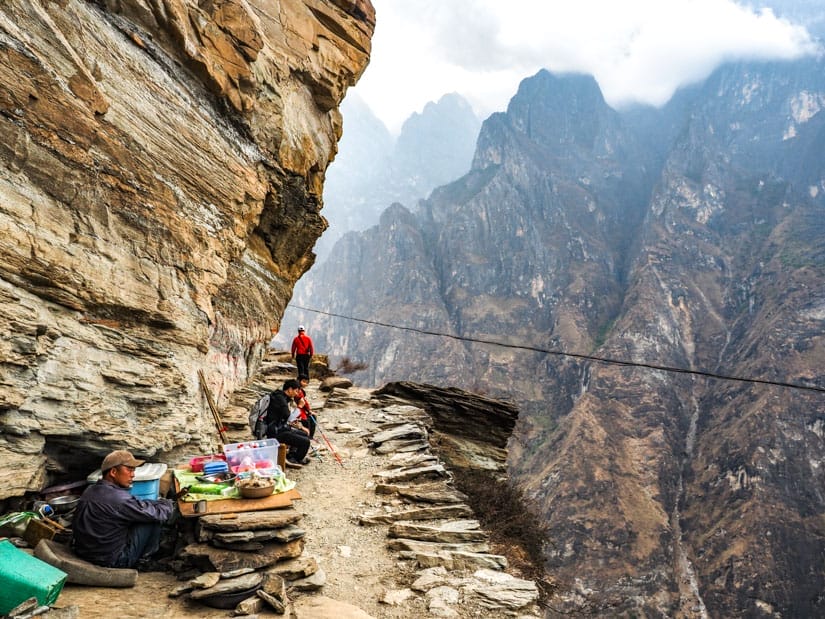
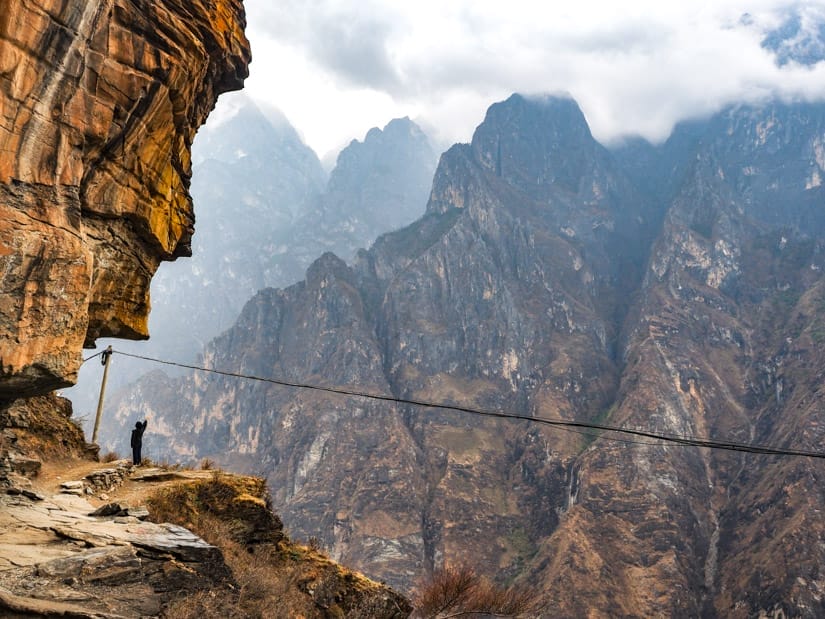

I passed some pretty cliffs, random goats, and another forest section before Bendiwan village (本地湾), the location of my guesthouse, came into view.
I had to cross most of the town, the final slog of my day, to reach Halfway House at the end of it. I finally reached the guesthouse at 5 PM – six hours after I’d got off the bus or four hours after I’d left my lunch stop.


Staying at Halfway House

I was thoroughly exhausted as I finally stepped foot in Halfway Guesthouse (see on Trip / Booking / Klook). The entrance at Halfway leads into a large courtyard surrounded by the rooms.
A staircase on the side of the courtyard leads up to the guesthouse’s large lookout platform.
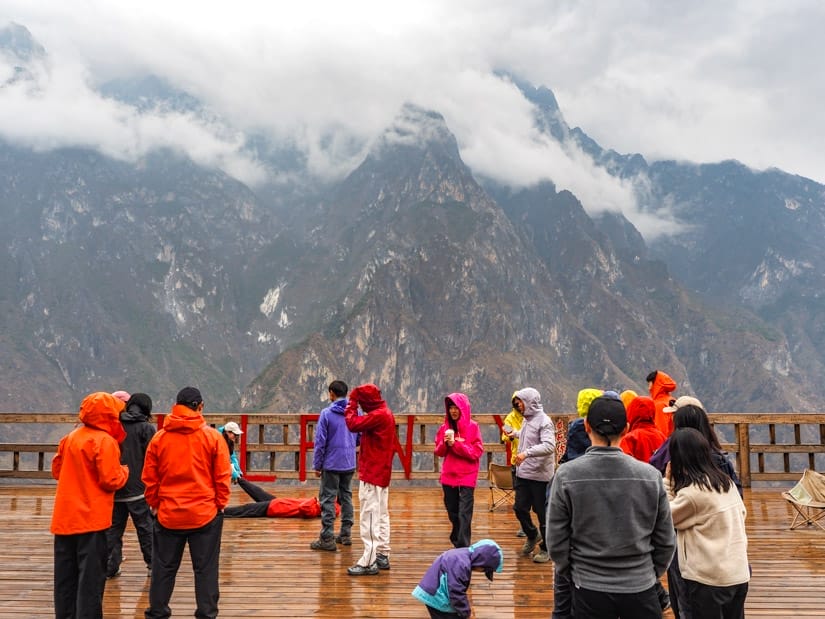
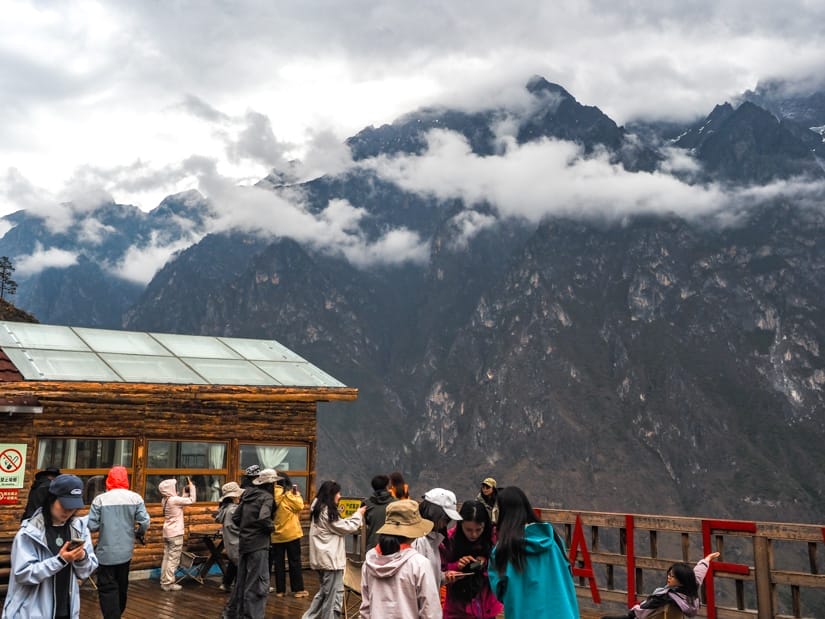
I found the check-in window and restaurant at the side of the courtyard. At the front, staircases led down to the best (gorge-facing) rooms.
I had paid extra for one of the better rooms here, which came with a small balcony and epic gorge view.

After checking in to my room, I went up to the lookout balcony and café, which has the bad-ass name “Tigerbucks.”
The café is in fact gorgeous, with huge floor to ceiling windows facing the gorge and a variety of cozy chairs and tables.
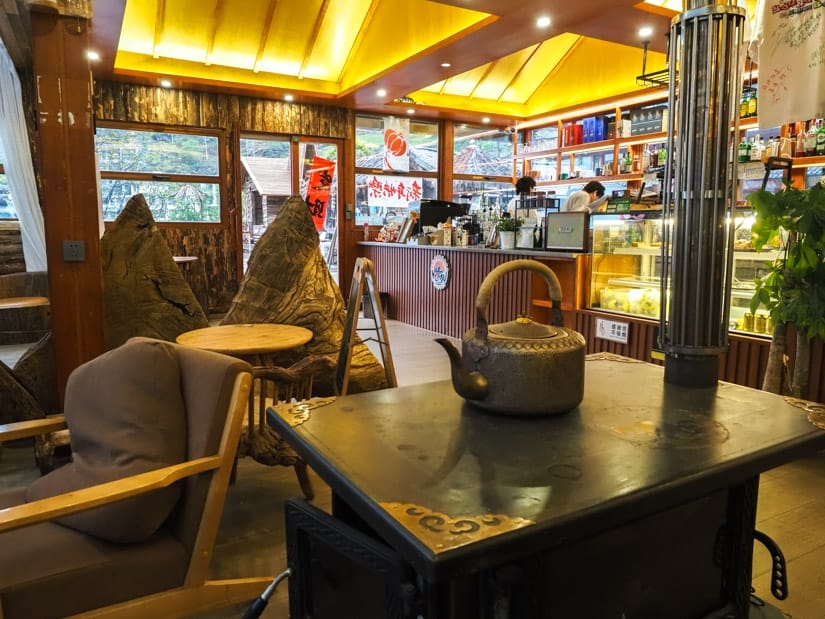

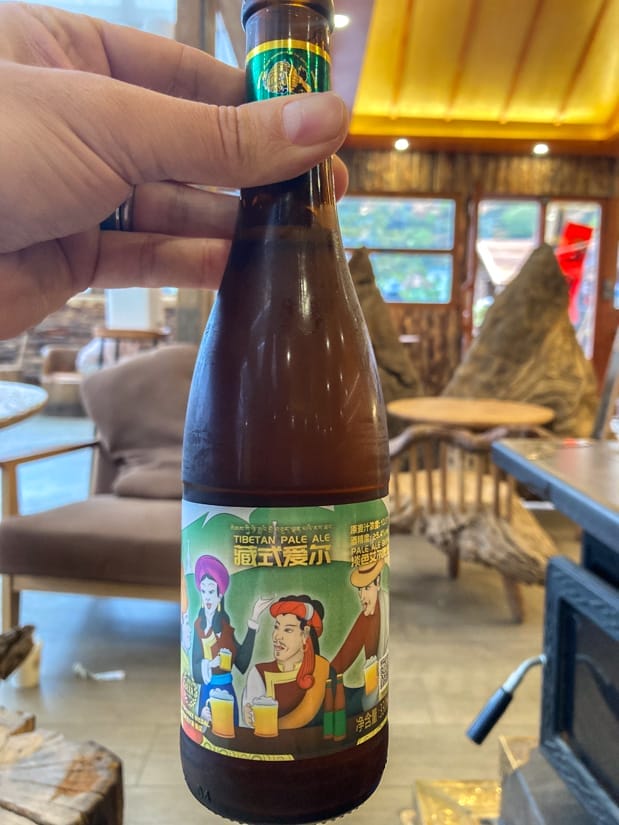
A completely unexpected surprise was the fantastic array of regional craft beers on offer here, for a very reasonable RMB 20 (under USD 3) per bottle.
I got to try a Tibetan pale ale from Shangri-la Brewery, beers from Anhui and Heilongjiang provinces (the latter had Russian writing on it), plus they had others from Laos, Belgium, and more.
With a satisfying buzz, I next made my way to the restaurant, where I splurged on a feast of a whole river fish fried Sichuan-style with copious dried peppers and Sichuan peppercorns. On the side, I had an order of fried green beans and eggplant.
Just after ordering my meal, I started to notice some commotion at the front windows of the restaurant.
When I looked out, I saw that the setting sun was lighting up a few of the peaks of Jade Dragon Snow Mountain directly across the gorge – this came after a full day of hiking in crappy weather with no direct sunshine whatsoever.

I wasn’t the only person to notice or get excited. Literally every person in the nearly-full restaurant bolted outside and up to the lookout balcony, which was now packed with guests.
Everyone was snapping photos and I did the same. We were rewarded with the most stunning views of the towering peaks – snow-capped mountains that had been hidden by clouds all day long.

This was a shared moment of awe and achievement among the 100+ guests crammed on the balcony at that moment.
Those Chinese craft beers may have had something to do with it, but I was moved to tears.
Bendiwan to Jiantang Village (End of Trail)

Halfway House may be roughly in the middle of Tiger Leaping Gorge. But since I would be ending my hike at Middle Gorge, which most people do, Halfway House is well over halfway to the end.
I left Halfway at 9: 30 AM and it only took me about 2 hours to hike to Jiantang village (建塘村), also known as Middle Gorge (中峽). Most of this walk was flat and much easier than the day before.
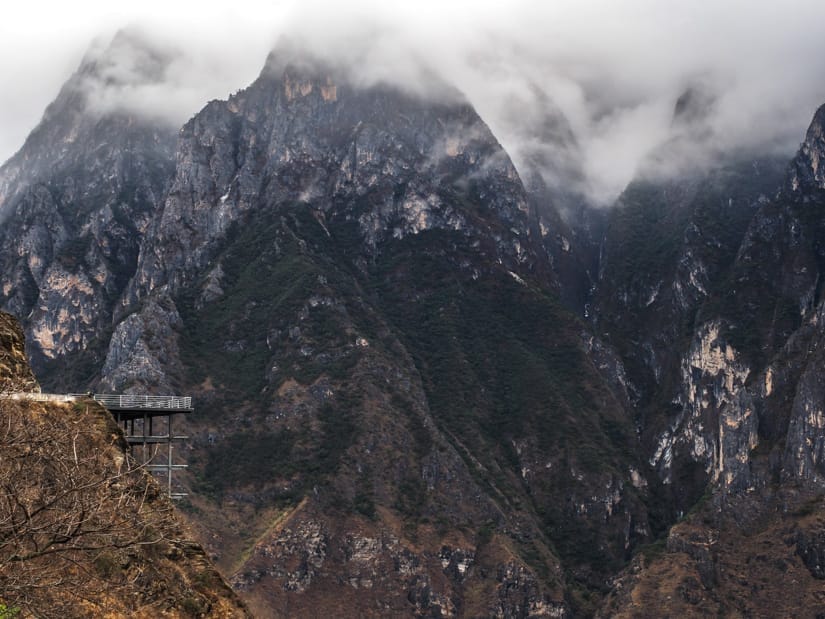
This was however a particularly gorgeous part of the hike, despite the rain that persisted through the morning.
This section was also far more crowded than the day before – I’m not sure if it’s just a more popular section, or everyone happened to leave the hotels around a similar time.
Leaving the village, the trail hugged the steep cliffs for much of it. Just after the end of town, I passed some lookout platforms then the path took a sharp turn.
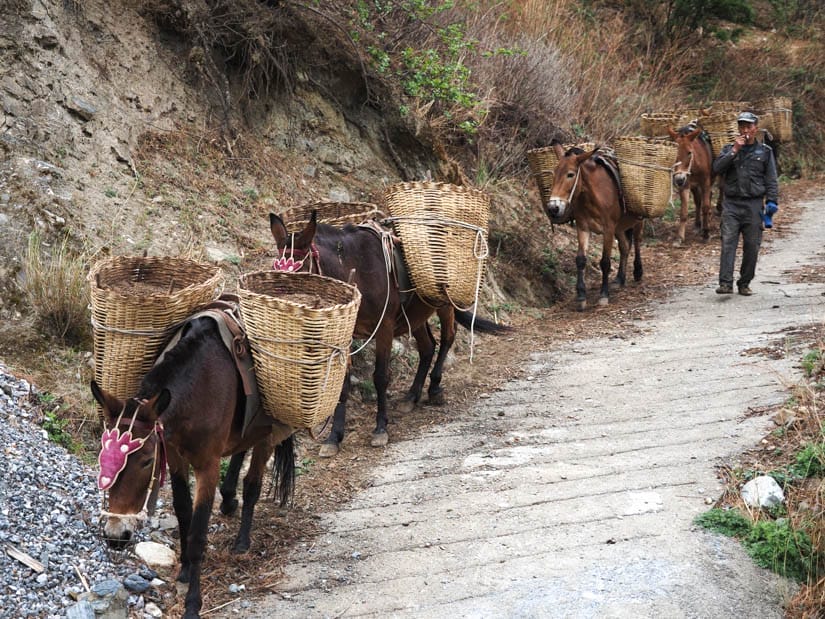
I also passed some local villagers with horses and a few interesting local houses.
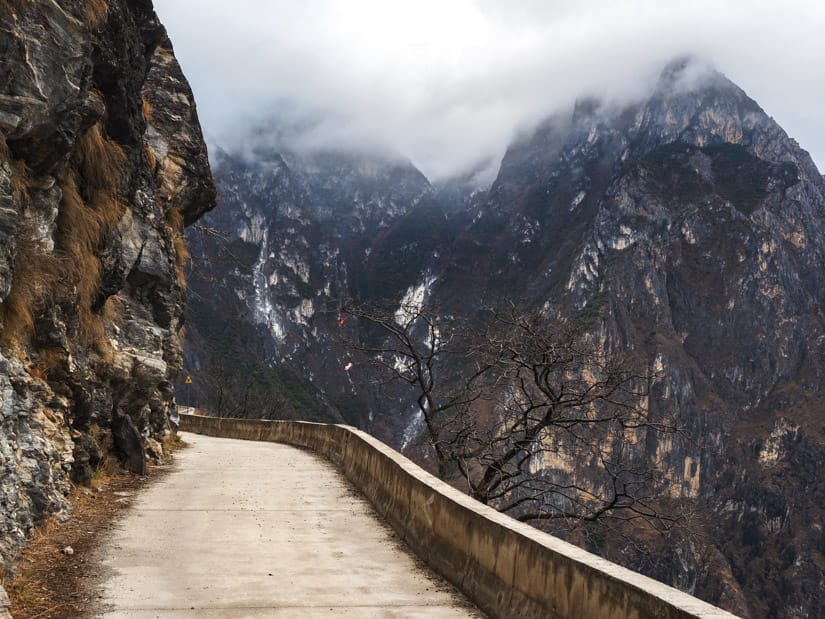


At this point, I got my first view of the incredibly scenic Jiantang Village in the distance. The village hangs from the top of a particularly steep and narrow section of the gorge, where I would soon hike down to the second Tiger Leaping Stone (visible in below photo).

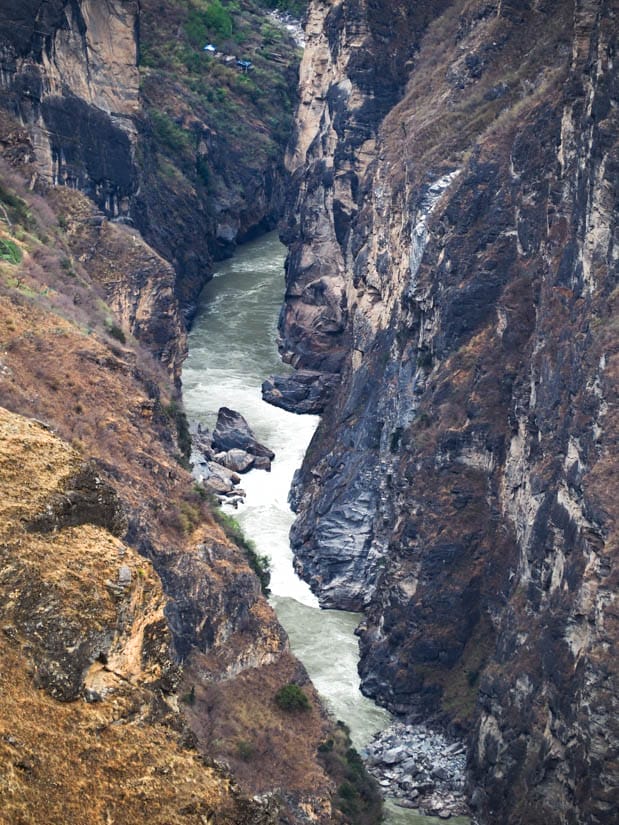
Before reaching Jiantang village, the trail veered to the left and Longdong Water Waterfall (龙洞水瀑布, here) came into view across a small valley.
Following the narrow trail towards it, with increasing numbers of trekkers, we had to cross a section where a small landslide had just happened. Some small rocks were even still falling down.

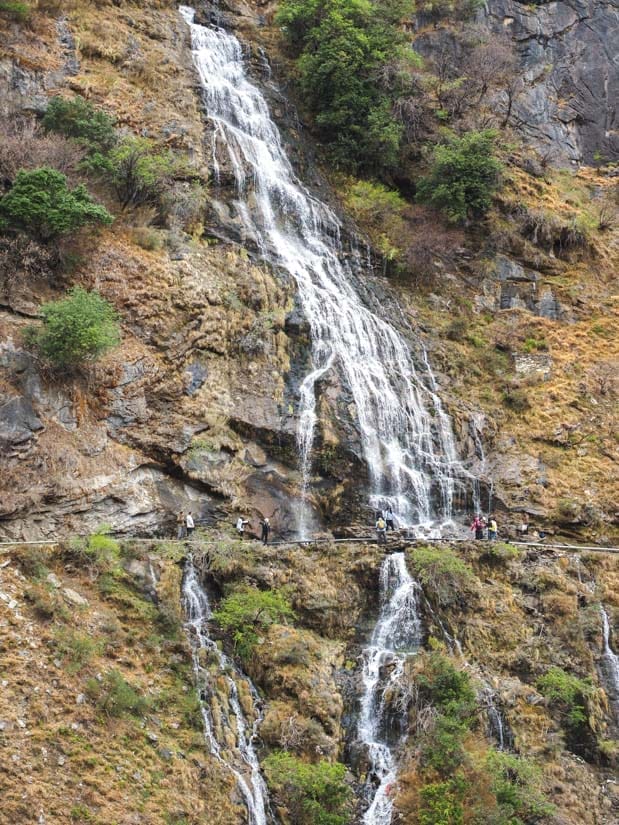
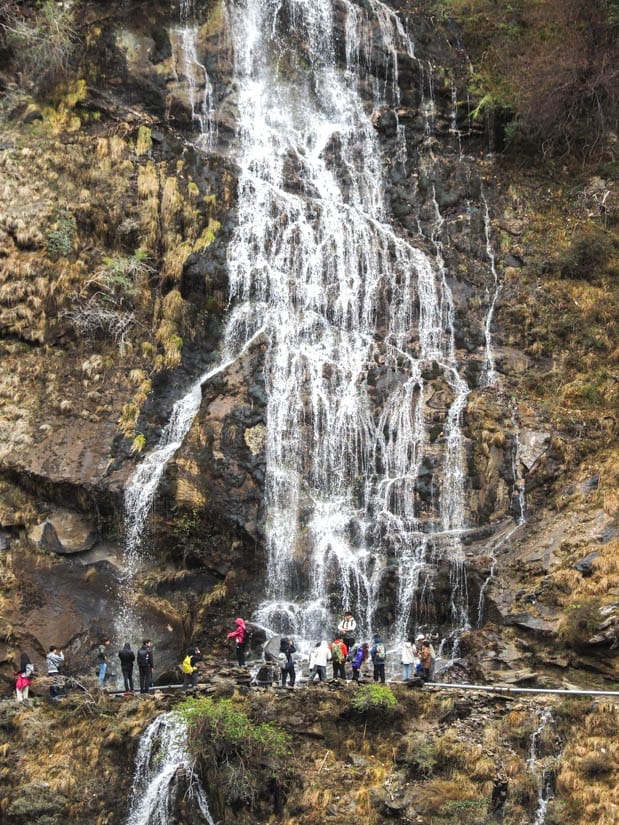
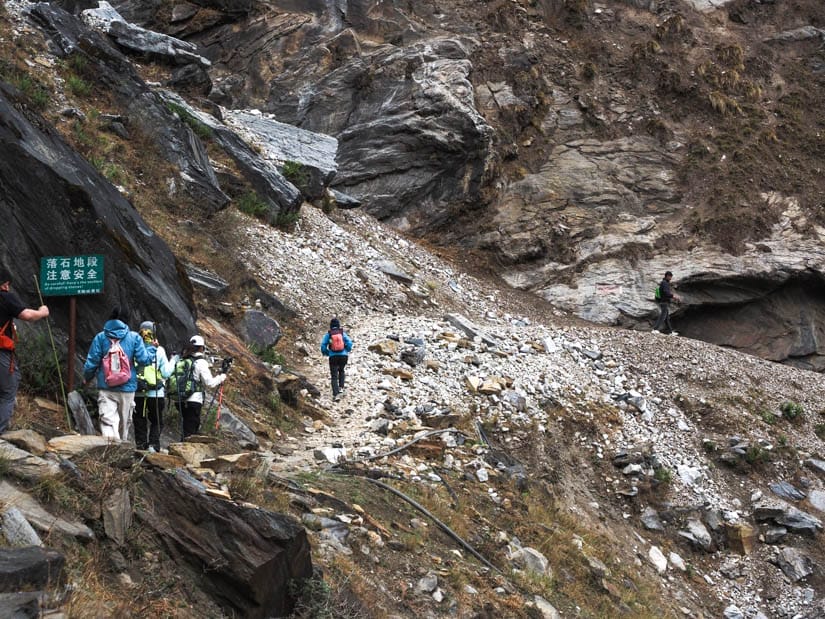
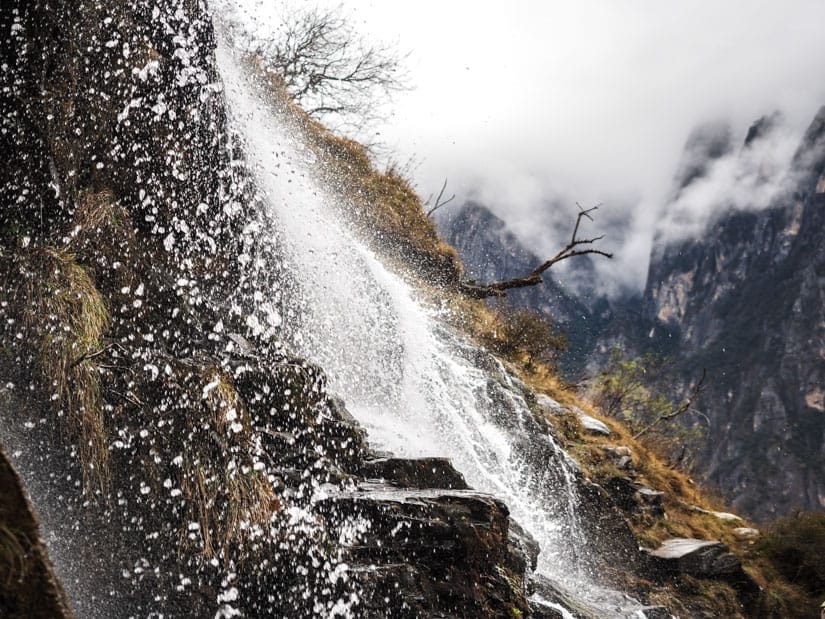
After crossing the landslide as quickly as I could, which was terrifying, I reached the waterfall, where many trekkers were taking photos.

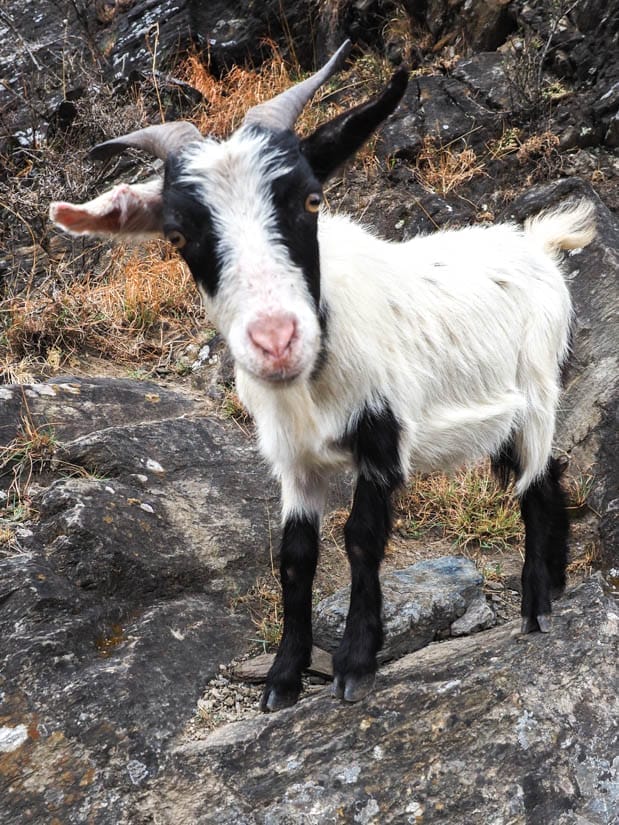
Moving along, I encountered more goats, more impressive views, and more vendors along the trail.
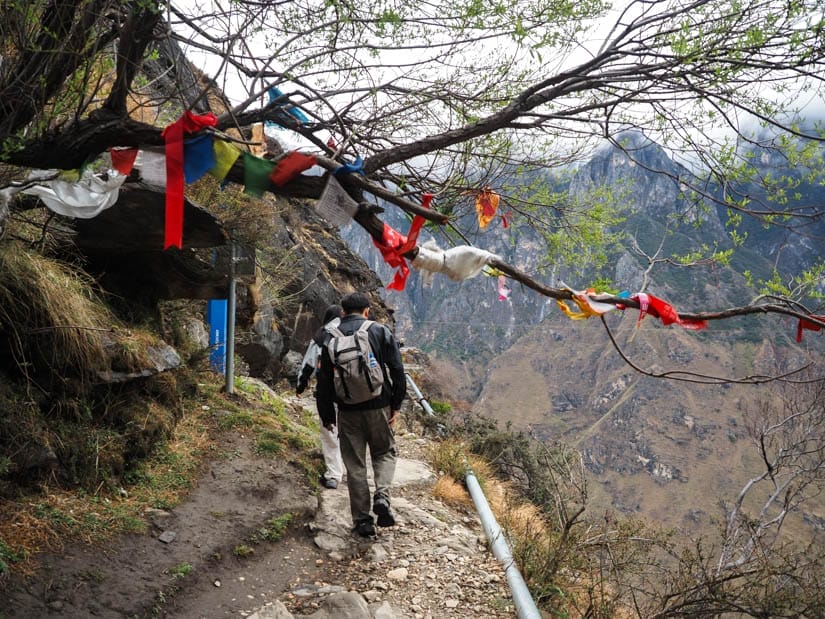
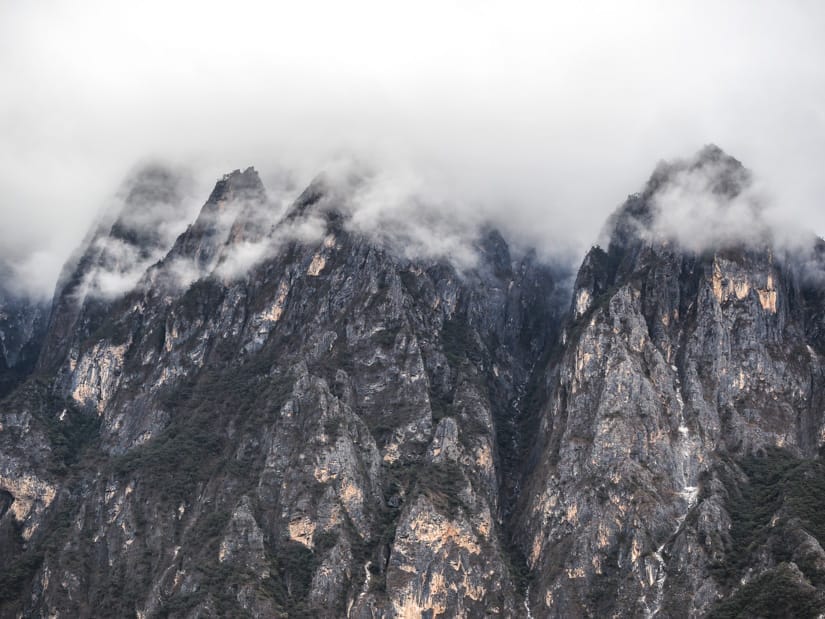

Near the finish, there was one final steep ascent and then a descent to the the Middle Gorge trailhead in Jiantang village, which is marked by Tina’s Guesthouse (中峡国际青年旅舍).
This is the end of the hike for most people, myself included.
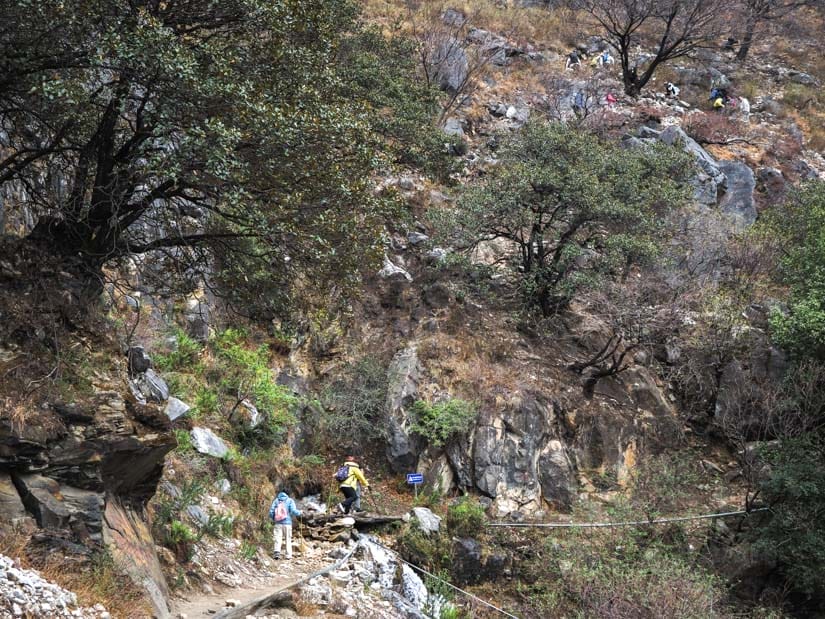


From the point where the trail meets the highway (here), I had to walk up a short but steep driveway to the entrance of Tina’s (not marked on GoogleMaps).
Lunch, Luggage Confusion, and Buying Bus Ticket

In the Lonely Planet, it says that Tina’s Guesthouse (see on Trip) is the main guesthouse in Middle Gorge and the place that the bus will take your luggage to.
This is incorrect, and I’m sure the guesthouse is tired of trekkers like me showing up and asking about their luggage. They’ll have to put up with it for a while, as the new Lonely Planet just published in 2025 still says this.
When I arrived at Tina’s, I just wanted to confirm my luggage was there before anything else. When I asked about it, the staff member just pointed outside and told me to get it there. I had no idea what this meant or where he was pointing at. He used grunts instead of words.
I had to really press him (and another staff member) to get a better explanation (and I can speak Mandarin…) I finally understood that my luggage was not at Tina’s. It was actually at a totally different building at the bottom of their driveway and across the street – we’ll get there at the end of the article.
However, I still had two other reasons to stop at Tina’s. First, I wanted to have lunch. And second, I needed to buy a bus ticket to Shangri-La. You can also buy a ticket to Lijiang if you’re going back there.
Note: You can also your bus tickets from the new building where your luggage is stored, as we’ll get to below. And, as I mentioned at the start of the article, the bus driver on the bus from Lijiang to Tiger Leaping Gorge may also have a laminated placard with a QR code for the WeChat mini program to buy this bus ticket, or you can try this link.
The staff member at Tina’s told me there were buses to Shangri-La at 12:00, 1:40, 3:30, 4:30m and 9 PM. The time was now 12:00 PM, so I bought a ticket for 3:30 PM (RMB 55), giving me plenty of time for lunch and the side hike to Tiger Leaping Stone (Note: this hike is now closed).
When I tried to ask the staff members (four of them in total!) how long the hike should take, they had no idea. Considering this is a very popular hike, to a stone that the whole gorge is named after, and it starts near their hotel, I was shocked that the staff could be this uninformed.

I gave up on asking and ordered a lunch of egg drop soup and more eggs fried with tomatoes.
Overall, my impression of Tina’s Guesthouse is that their staff has no idea what’s going on or how to answer extremely basic questions from visitors – questions that they probably get asked every day. The restaurant also lacks a view.
If you’re considering staying here, thing twice about it. I’ll recommend a better hotel in town below.
Note: one commenter on this article mentions that the staff at Tina’s were friendly and helpful, so maybe I just got them on a bad day!
Anyways, long story short, if you need lunch, then sure, you could still stop at Tina’s. But if you just need a bus ticket and/or need to pick up your luggage, skip Tina’s, and proceed to the new building I’ll describe further below, and you’ll be able to buy your bus tickets there too. But first:
Side Hike to Tiger Leaping Stone (currently closed)
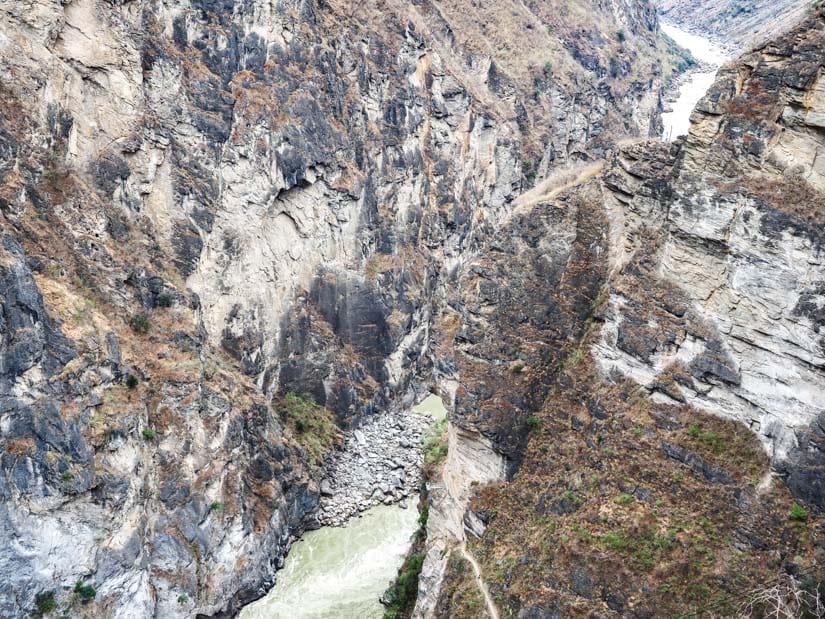
Update: According to several readers (see comments at the end), this hike is now totally closed and they’ve even removed some of the ladders. One reader suggests someone might have died on the trail and that’s why. I’ll still leave this section up in case it reopens again.
However, one commenter shared a possible alternative way to hike down to the river which is still open starting around Tibet Guesthouse (Zhuoma Inn or 卓玛客栈, here, 30 minutes walk up the highway from Tina’s). Another commenter also describes what may be the same spot, or possibly another, with a link to the location on Amaps. Yet another (most recent) commenter said you just need to continue past Tina’s to Woody Guesthouse to find the path to the river, and it takes 2.5 to 3 hours (return) from Tina’s to the river.
Please scroll to the end of my article to read the most recent updates from travelers, and please add your own experiences if anything has changed!
As I mentioned earlier in the article, there are two claimed spots in Tiger Leaping Gorge where, legend has it, a tiger leaped across the gorge via a huge boulder in the middle of the river.
The second Tiger Leaping Stone (虎跳石) is here, at the bottom of the cliffs upon which Jiantang Village rests.
It seems rather convenient that the gorge has two possible “Tiger Leaping Stones”. The first one in the upper gorge is accessible by car, so it’s there for all the tour bus groups.
The second one, in Middle Gorge, requires a very steep descent (and then return ascent), so it’s for the hikers.
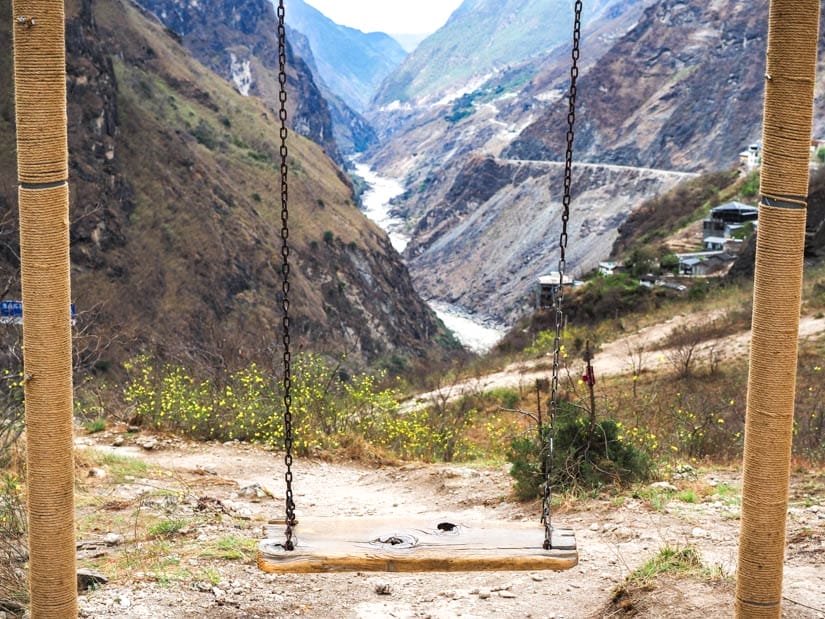
Even though the trailhead to Tiger Leaping Stone is only about 15 minutes’ walk from Tina’s, it took me a while to actually find it. There are no signs pointing to it, and of course the staff at Tina’s couldn’t tell me.
I walked along the highway to find the trailhead right about here. Some locals at the gate charged me RMB 15 to enter, because the trail goes through private land.

From the gate the trail descends extremely steeply down into the gorge. The trail was so steep in parts that I had to use my hands or ropes and ladders that were in place. I dreaded coming back up.
As I descended, I got breathtaking views of the rushing river and Tiger Leaping Stone below. There were also several small stalls selling drinks.


Reaching the bottom, I found that there were not one but several boulders in the river. A couple of them were free to visit, with a small bridge connecting them.
Several hikers were standing out on the rocks, with the rushing river beside them. The raw power of the river at this extremely narrow section was truly awesome.


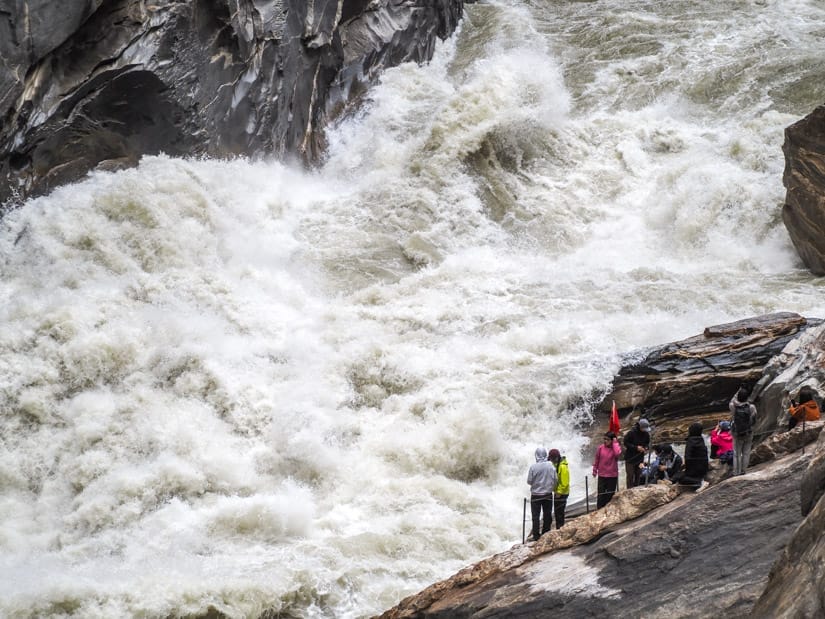
But the boulder which I believe is “The One”, of course had another entrance fee (RMB 10). I really wanted to walk onto it, just so I could say I had, so I coughed up the money this time.
A rickety bridge led out to the stone, from which I enjoyed an amazing view looking up and down the river. Maybe I even stepped on the same spot that the legendary tiger had!


The return journey up the cliffs was just as brutal as I had imagined. Worth the effort – yes – but that didn’t make it any easier to get back up to the top.
Note: If you plan to hike to Walnut Grove, there’s a trail that follows river downstream to it. That may be tough to imagine looking at the above photo, but I saw the trail carved into the cliffs.
There’s an additional fee if you go that way, since it crosses into someone else’s private land. This was explained to me by the woman who had collected my fee to hike down to Tiger Leaping Stone.
Collecting My Luggage and Bus to Shangri-La

After finishing my hike and returning, I entered the new rock building along the main highway where supposedly my luggage should be. The building is pretty unmissable – its exterior is designed to look like jagged cliffs (see photo above).
The building houses several businesses, including a small convenience store, hip café with awesome views, and cool-looking hotel called Moye Snow Mountain Cliff Hotel (墨野·雪山悬崖酒店, here, see on Trip / Booking / Agoda). Choose here if you have to spend the night in this town!
When I entered the building’s open air courtyard and asked random people about luggage, someone pointed me to a side room, where I found racks filled with suitacses and backpacks, including my own.
2026 Update: Recent visitors have indicated that there is now a new bus station building to the left of the rock building, and that’s where your luggage will now be waiting for you! You can now buy your bus tickets here – one reader says the building is marked 客运票代售 (passenger ticket sales) on some map apps, and there’s a sign over one door that says 行李房 (luggage room).
Surprisingly, there was no door to the room, nor was there anyone watching it. Literally anyone could walk in and grab any bag. But this is also a testament to just how safe China is. Just don’t leave any valuables in your luggage, just in case.

I had a little extra time to kill. I went up to the café on the second floor of the rock building which was actually surprisingly cool.
Called 棲崖咖啡廳 (or “Cliff Café”), the interior looks like something out of Shanghai, with super high ceilings, minimalist design, hipster coffee drinks, plus you get amazing gorge views out the huge windows.
When the time came, my bus to Shangri-La stopped right in the parking lot of the rock-shaped building. The bus to Shangri-La took 2 hours and 20 minutes, with absolutely epic views along the way (sit on the right side if you can).
I got off at the second last stop, the East Gate of Dukezong (the Tibetan heart of the city, where I would be staying), rather the final stop, the bus station, which is in the north of the city. To continue along my journey, see my guides to Shangri-La and Yubeng!


Thanks for detailed description of the route with so many gorgeous photos packed with useful information. It is really a painstaking job to piece up the info in a logical sequence. Thanks once again.
This is extremely useful – I’m hiking this next week! Appreciate it!
Thanks for this, i will do the hiking tomorrow, a lit bit scaried about the luggage stuff, but i appreciate your tips
Hello Nick,
Thank you for the detailed information.
May I know did you have to book your accommodation in advance or you just walk-in?
I’m not a very spontaneous traveler – I travel for work (writing these articles), so my trips tend to be packed and I plan out everything weeks or months in advance, with specific hotels I very much want to stay at. So I’m sorry I can’t say whether it would be possible to just show up and get a room. It will likely depend on what day/season you go, too. Many of the guests are locals, so it will be more likely to sell out on weekends and holidays. Good luck with your trip!
I just finished Tiger Leaping Gorge. I want to tank you for the info on this post, it helped me a lot to get there and plan my trekking. I’d like to point out, though, that the luggage store place doesn’t belong to Moye Hotel, but actually is shared betwen Moye and Tina’s – and pehaps all the accomodations nearby. It turns out that Moye is closer to the lugagge store, but that’s it. So, technically, it’s correct saying the lugagge will be dropped off either in Moye or Tina’s. Once again, thank you for all the info provided. Cheers!
Thank for you for mentioning this. I’ve made a small edit to clarify it!
This is very detailed and helpful, thank you.
We are considering TLG next year with our 4 year old. She’s hiked her whole life, so very capable for her age, but wondering about the steep drop off – how much of the track is narrow and has an exposed edge? Too risky for a kid?
There are definitely some sections where the path is quite narrow and has a steep drop-off on the side, not to mention you sometimes have to pass horses/donkeys (always stay on the inside when you do, and they will pass on the drop-off side). However, I never felt unsafe. With a four-year-old, I think the hike would definitely take a little longer than the times I’ve listed here, so you’d need to account for that. And for those narrower sections with drop off (which are only a very small percentage of the total hike), you’d want to watch her carefully or walk hand in hand. If she has enough experience to handle the hike, I think it would be fine.
My friend and I just completed this hike a few days ago and found your post very useful so thank you! The new hotel was under renovation so we had lunch at Tina’s and found the lady there to be very polite and smiley. She booked the bus back for us and chatted when she could.
Glad you found my post useful, and also that the staff at Tina’s were friendly/helpful!
Thanks a lot Nick for all the details that eased our hike A LOT !!
We stayed at the Tea Horse GH that we preferred compared to Half Way that s becoming something a bit too big for our taste.
Also, on the way back, the traditional path to see the river was closed !!!! Don t know why….
Anyway to go by the river side we went down, walking along the highway for about 30 min. When you reach Château of Woody guest house (on your right), turn right, there s a sign ! You walk 5 min on a paved road and then it s a path. Carefully it s super stiff ! But we reached the river and we were alone !!!! A hard way back up awaits you afterwards !
(We had lunch at Tina, it s was below average….)
Thank you for sharing your experience and the info about the side trail to the river. I’ve added a note to the article about it!
Thanks a lot for taking the time to write the detailed trekking info. It is really helpful. I am planning to hike in early Feb ’26. Is there any other article or help regarding hiking til Walnut Grove!! Also, is there a reason why you didn’t go that far!! Thank you again.
Sorry, I don’t have any info or link for that part since I didn’t do it. To me, it just seemed like most people finish their hike at Jiantang Village (Tina’s Guesthouse). That’s where you can get your luggage forwarded to and catch the bus onward to Shangri-La, which is what I wanted to do. To proceed to Walnut Grove, all I know is that you’ll have to start by hiking the extremely steep trail down to the river, and then there’s a path from there. Also, you’ll have to pay a fee to take that trail down, and then another one to head to Walnut Grove, as the trails pass through private lands. I think it’s also possible (and easier) if you just walk along the highway past Tina’s for 30 minutes, and you’ll reach another road or trail to access Walnut Grove – that way may be easier. The second last (2022 I think) China Lonely Planet has a little info about the Walnut Grove extension. Good luck with your planning!
Hello and thank you for your detailed explanation. I would like to add, that the lower part as of now (Nov 2025 is completly closed) – I tried to hike there anyway, but some ladders have been removed so no chance.
Generally there is a lot of “development” going on in the area, so I expect that the way will be opened at some point, but in the chinese, paved, very safe style.
That’s really too bad, but thanks for letting me know. I’ve added a update to the article about it.
Just want to update on the hike that I did a few days ago. Boarded the bus at Lijiang and while in transit the driver yells out apparently asking everyone where they are getting off. I obviously couldn’t understand anything but the kind students in front of me spoke a little English and translated. Luckily they were doing the hike too from the same place.
At the drop off point everyone is getting off and I was trying to explain about forwarding my luggage. I was pretty anxious about where my luggage was going to go.
I called my brother who speaks Chinese and he had a 10 minute conversation with the driver and other bus passengers explaining what I wanted to do lol. Although it seems like the luggage forwarding and holding is pretty common so hopefully if you just use a translation app it will be understood eventually. Paid for the entry ticket, got the drivers wechat and paid for the next bus ticket to shangri la. He sent me a message with the licence plate of the bus I should catch tomorrow.
Then me and the students get into a small van which goes up to Naxi guesthouse which is where I wanted to start from. That cost 25rmb.
Starting from there in my opinion is ideal, unless you have a lot of time and want to burn calories I can’t see any good reason to walk up the road to Naxi.
From Naxi the hike is tough with the uphill and shortness of breath from the altitude. I stayed at comeinn which was nice enough. I didn’t eat anything until the next day I went to halfway for some photos in the morning. Then onto middle gorge. Went to that rock cafe and had a 58rmb coffee. For sure nobody is checking and you can just wall in there and take photos.
Tried to walk to your pin on the map to get down to the gorge, some other tourists were walking back and said there’s nothing there. Saw another apparent entrance to go down but the local said it’s closed because its dangerous. Maybe the time of year? Gutted, didn’t get down to the river at all on this trip.
Had lunch at tinas which was yum, and my bag like you said was in the big storage room by the bus station. Took the bus to shangri la which stopped near the ancient city, I wanted to go further into town but the driver seemed to tell everyone to get off and I took a didi to my hotel.
Thanks for the blog post it really helped.
Thank you so much for sharing your detailed trip report. That’s interesting you were able to buy the onward ticket to Shangri-La from the first bus driver. Unfortunately the side hike from Middle Gorge down to the river seems closed right now, and I’ve recently updater my article to mention this.
Thanks for the detailed description in this article. We just returned from Tiger Leap Gorge, and we were not able to descent to the river level at all. According to our bus driver, all paths to the river are closed.
Thanks for the update!
Great job writing this up Nick ! Helps Me while i plan a trip.
Hey, thanks a lot for the guide ! Helped a lot.
On our way to Tina’s, we met a local tibetan guide who showed us another way to go down the river. The official one is indeed still closed, but if you walk on the road from Tina’s to Tibetan GuestHouse (around 25-30mn) then you’ll find a small path going downwards. It goes down to the river, and is well maintained and fully open (and free). Just ask the locals on the way, they know it.
Thank you so much for sharing this. I’ve added a note in the article about it.
Thank you for your guide Nick, my partner and I did this hike 2 days ago, it was unreal. I’m unsure if I would have been confident enough to do it without your detailed guide – I will be recommending this to my fellow travellers.
So glad you found my article useful and enjoyed your hike!
Hi Nick,
we just did the hike, and even though only half a year has passed, there are already a few changes that might be of interest for people:
1. Buses from Lijiang (in 02/2026) left at 08:30, 09:00 and 09:30.
2. Buses went to the tourist center at the entry of the gorge, where we were told to get off – taxis take you directly to Naxi family house, we paid 25 Yuan per person. We were informed this is the only way they do it now. Apparently the former first section of the trail is ruined because the work in the “blue bridge” and the – newly appeared! – red bridge destroyed that section of the path. We did not have to pay any park entrance fee.
3. Hotels are popping up at Halfway like crazy. We had trailfriends who stayed in the hotel directly above Halfway and we had Dinner there – definitely can recommend
4. At least we were told that absolutely no way goes down into the gorge anymore. Apparently there was a fatal accident last year. However, we didnt have time to ask a lot of different people, so that information might be wrong
5. I can confirm the bus station and luggage drop-off beside the Rock-like Hotel. Tickets are also sold there, 50 Yuan per person back to Lijiang. Buses went 14:20, 15:30 and 16:30. The 14:20 one was quite fast and we were in Lijiang at 5pm. They just dropped us somewhere close to the Old city, not at the bus station.
Lastly, thank you for your detailed blog entry. For us as well as one of our trailfriends, it was the most useful piece of information to plan our trip!
Greetings from Lijiang,
Jay&Matt
Hey Jay, thank you so much for this comment and all these updates. It is massively appreciated. I have made all the relevant updates to the article to keep readers informed about the latest information.
Hi Nick,
Igor’s here first of all to thank you for this detailed guidelines which helped me a lot to plan our hike along the Gorge together with my gf and celebrate my B-day there with absolutely astonishing views against a backdrop!
As a humble contribution to this article I would like to share some insights and observations I came up with along the way (valid on February 2026).
1. We started from Naxi Family Guesthouse on Jan 29th and finished 2 days later at Tina’s. As my gf is not much of a hiker, I sticked to very conservative itinerary with 2 nights en route (in Yacha and Halfway respectively) and that was a great decision of mine. Nobody got tired at all and we could enjoy the every single climb and turn with our own relaxed pace
2. Even if we had only 1 night stop I would rate this trail as fairly easy one, under normal conditions of course. Trail is straightforward and well-maintained. No trekking poles required. One can even hike this trail in casual sneakers or crocks (however I would never recommend that)
3. Weather was close to perfect, especially the first day. I tend to over-prepare for my treks and initially I was concerned about possibility of ice on 28 turns section and even was considering getting two pairs of microspikes but in the end gave up on this idea as an overkill. In fact the trail surface was dry and dusty all the way
4. Not many people on the trail, mostly Chinese. Sometimes we had the trail and vistas only for ourselves and that was amazing! I guess that’s because we planned it for the dead season (couple weeks before Lunar NY). Hotel prices were also on their lowest
5. We dropped by Linjang bus station the day before and booked the tickets straight to the Middle Gorge just like you advised. It turned out that the first (and seems like the only) morning bus going there was at 9.30am (44 RNB per person). There were other rides at 8, 8.30 and 9am but I was explained that they only go as far as Scenic Area Entrance (where the ticket office is). Cashiers even spoke basic English which helped a lot
6. The feature with the luggage drop-off at the end of the trail also worked smoothly. Driver was fully aware about this scheme and we didn’t have to explain him anything. In fact he even had a small map which he showed to the passengers before the ride and explained the route and stops along the way in Mandarin. He mentioned Tina’s as the drop-off point of our suitcases however it’s not the accurate location as you mentioned multiple times in your article
7. Just like in your story all the bus passengers expect us disembarked at the Scenic Area Entrance stop. There is a free public toilet out there. Also we had luck to meet a nice young Chinese couple who spoke decent English and explained us that we did’t haThe ve to buy the tickets to the Area if we were just going to hike and not using the observation deck and other facilities. That saved us 45 RNB per person.
8. The driver left us exactly at the very same road intersection you started your hike. Local folks hanging out there immediately approached us and started pushing for the ride up. We refused and started the climb only to be picked up by the couple of kind Chinese hikers on fancy car who gave us a swift ride straight to Naxi Guesthouse (locals very angry at them!). We met these guys few days later in Kunming and had a great time together. I love hiking (and travels in general) for the moments like this!
9. I agree that the first section of the hike which follows asphalt road to Naxi GH is not very interesting and can be perfectly skipped to spend more time in nature further on. Also it’s worth mentioning that Naxi GH serves also as a resupply point prior to the hike. You can find vast variety of stuff there from beverages and sunscreens to gloves and trekking poles. Prices are affordable
10. We spent our first night in Huotiaoxia Town Horse Gang Station at Yacha (satisfied) and had meals at Tea Horse (not so much). Second night at Halfway was a real highlight! Also booked a room with private balcony and never regretted about it
11. The next day we reached Tina’s around 12.30pm. The innkeeper was nice and helpful, issued tickets to Shangri La for us for 13.40pm. (there were other rides at smth like 12pm and 3pm). What I initially hadn’t get from your article is that luggage was stored in a separate building 50m away from actual hotel and which locals call “bus station”. However that was easy to figure out
12. Road to Shangri-La was nothing but stunning with unbelievable views across the valley as the bus gaining altitude. Right-side seats are recommended to enjoy the best of vistas
Sorry for lots of text. I hope it will be useful to someone who is planning to do this gorgeous hike.
All the best,
-Igor
Hey Igor,
Thank you so much for this amazingly detailed feedback. I have used it to add some extra notes to my article. So glad to hear you had a good birthday experience hiking the gorge! -Nick
Hi Nick! This is an amazing write-up, hoping to use it as a guide this coming April! I am just wondering if you have any info on where to find a trail map of this hike? Is there anything like AllTrails in China (preferably English-friendly), or did you create a map of the trail? I’d like to be as prepared as possible. Thank u!! P.S., from what I can see on Trip and Booking.com, it looks like the halfway hotel is not currently accepting reservations.
I wasn’t able to find any great map of the gorge. I just searched Google images to find all possible maps out there (none were really great though). And AllTrails does have an entry for it, which would work. But note that it’s route starts from the very beginning of the possible hike, but you’ll most likely be starting from Nuoyu, which is indicated in Mandarin on the map as 诺于. If Halways isn’t taking bookings, you can try Tea Horse Guesthouse (also described in my article, with links) instead.
Just an update: did the trail on mid-march. Amazing and relatively easy trail.
Got the 9h30 bus from Lijiang, bought the ticket the day before. The bus was with very few people. The driver knew where to drop me – bottom of the hill to naxi guesthouse, was very helpful. Didn’t need to buy the ticket for the scenic area. Got a taxi for 20 yuan to naxi guesthouse (the lady wanted to charge 60).
Tip1: download amap global, change language to english, create an account based in singapore. You can mark everything from home, including the whole trail with all guesthouses.
Tip2: have some flexibility on the itinerary, the weather can be unpredictable.
Ate at tea horse and halfway on the way.
Stayed at the Hutiaoxia Town Muyun Banshan Homestay, booked through trip.com. It is right next to Halfway, 43 usd. Really nice room.
About going down to the river: I arrived at Tina’s at 11h00. I don’t recommend Tina’s for anything.
And so I went to find the path to the lower gorge. I almost gave up, but did find it. It was much farther than I thought, about 45min from Tina’s.
The entrance is here, it begins with a road until the start of the trail itself:
Xiapan Guisu Wangshan Geguanjing Hotel (Shangri-La Hutiaoxia Scenic Area Shop)
Hotel
Hutiaoxiazhen Yongshengcun Hetaoyuan 3 Group
https://surl.amap.com/6xAoHpUK5uV
Safe trail, but steep. It is doable and I got on the 13h40 bus back to Lijiang (I think was 13h20, but it was late). It was rushed, I had left the hotel at 9h.
You can buy tickets for 40 yuan near Tina’s, next to a stone hotel, there is the bus “station”. There is another bus “station” on the way to the lower gorge, but the guy want to charge me 79 yuan for a ticket.
I really recommend the trail, it was amazing. Met very nice people along the way, especially in halfway ghesthouse.
Cheers and thank for the page, it helped me a lot!
Thank you so much for the detailed review. I’ve used your comments to make some updates to the article!
Hi Bee here. I just returned from Dali Lijiang Shangri La by packaged tours so i didnt get to do all that you have mentioned. I would love to do this next time. I am writing to inform that you can use Amap which is very accurate and detailed for China location. Please try and if not mistaken it has information that you may need. Hope this helps.
Hi! Amazing post – what camera did you use?
Thank you! I introduce the camera I use here: https://www.nickkembel.com/best-mirrorless-camera-for-traveling/
And the lenses I use for it here: https://www.nickkembel.com/best-olympus-lens-for-travel/
Hi Nick, thanks for the supremely helpful article! I just wrapped up my trek and have a few quick updates/notes.
1. Drop-off point: Like others I think I was dropped off at the same place you were. It’s the first road turn-off after the ticket office and is marked as a 乡村公路.
2. Park entry: none of the hikers on my bus were charged.
3. Bus tickets: purchased outgoing at the Lijiang bus station – Chinese name is 丽江汽车客运站 (I had a little trouble finding it on Baidu/Amap without this name so hope that’s helpful). If folks are staying only a night in Lijiang I’d recommend booking a place at the southern end of the old town, otherwise it’s a bit of a long walk with heavy luggage unless you take a taxi all the way around. I went the prior afternoon and charged for a ticket to the scenic area (景区) and said to ask the bus driver about baggage transfer. He charged 20 RMB just like you said. He also offered to help me pre-purchase a return ticket – they had 13:40, 15:30, and 16:30 available. I bought the 15:30 but was easily able to switch to the 13:40 when I arrived in 中峡.
4. Bags: The driver told me he’d take the bags to Tina’s. However, they are actually taken to the ticket office in Middle Gorge, right next to the “mountain building.” It’s marked in Chinese (客运票代售) but not in English. There’s a small sign in the door that says 行李房.
5. It’s a bit hard to get out of Bendiwan – I stayed at a different hotel from Halfway and got lost looking for the trail. I’d recommend future travelers follow signs to Halfway as it is right next to the onward path! They also have great coffee and croissants to fuel up before the last little hike to Tina’s.
Amazing, thank you so much for the detailed update. I have made several updates to the article based on your notes!
Hey Nick! Thanks for the excellent guide, it covered pretty much everything I needed to know!
I’m sitting in the rock shaped building right now waiting for the bus. One to mention like another commenter before is that there is now a separate bus station building to the left of the rock building where all the buses leave from, and I found my luggage that had been dropped off by the driver inside that bus station. So not at Tina’s or the rock building, but instead in the small bus station.
Thanks again!
Thank you for the update! I have added notes about it to the article.
Hi,
First of all Thank you to everyone for the detailed guide and all the comments that made this journey far easier.
Me and my girlfriend just did the hike a couple of days ago. No new information to add except that there was no viable free route to get down to the water/tiger leaping stone in the middle Gorge. You can hire the guide with the group as written here somewhere. We tried to take a path on maps.me (the one near joy’s family guesthouse/Tibet guesthouse) and made it far down but the local administration recently sealed off the rest of the way with fencing. We were informed up front by a local farmer but decided to check it out anyway. So I think that as of now (or at least for a while) going for free via a not super official or guided path is not feasible. We also heard from a local we met that a few weeks back a Chinese national fell into the water and sadly passed away. This could be the cause for them sealing off the entries to the northeast of Tina’s/Zhang’s. Still a beautiful and worthwhile hike!
Thanks again to you all!
All noted, and thank you for the update!
Hi im a 19 year old solo traveller – I’m not super experienced as thus far I have only travelled Australia, Indonesia and Vietnam (I’m from the uk). How doable do you think this treck is as someone who does not speak a word of mandarin? Thank you so much I loved the article it’s the best one I’ve found
I feel it’s totally doable. You don’t really need to communicate with anyone to accomplish the trek. There are some key things to know about the bus booking and luggage forwards, but if you follow the steps in my article that should be enough! And for the route itself, you can’t really get lost – it’s easy to follow and just goes in one direction. Also read the other comments here for other people’s experiences that you may face. Good luck and enjoy!
Hi Nick, firstly, thanks for the detailed post, it really helped a lot! My partner and I completed the hike in mid-March.
We met a guy on the trail who told us he didn’t know where to get off the bus and got taken all the way to the area where all the buses park up by the gorge and had to take a bus back to the start!
Also multiple people who didn’t know about the taxi ride at the start and walked the ‘ugly’ part up to Naxi guesthouse. Luckily, a taxi driver came on and took us off the bus. We were still charged the 45yuan on the bus before we left though, despite showing the man a translation telling him we were hiking. Oh well.
I was able to book a bus back to Lijiang via the hotel (香格里拉虎跳峡钰珑见山民宿) where we stayed at Halfway village. It was 50rmb each. Note that they had availability for buses from 12pm onwards. A couple of Germans we met there could only get 4pm tickets back to Lijiang so it was good to pre-book the day before rather than have to spend hours in Tina’s restaurant!
Thank you so much for the update. All noted!
丽江交通运输集团 “Lijiang Transportation Group” ticket offices:
Bus Station one is cabin behind it; North Gate one is kiosk inside it.
Lijiang bus stops, in order:
Bus Station; North Gate; opposite South Gate.
WC bus stop:
bus driver identifies hikers and any luggage.
Scenic Area ticket office bus stop:
park staffer does not charge hikers; taxi driver takes hikers to Naxi Guesthouse for 20RMBpp; bus driver takes any luggage to new Bus Station, between Moye Hotel & Tina’s Guesthouse, for 20RMBpp where stored for 0RMB.
~
Zhang’s Guesthouse & TianTi “sky ladder” & YiXianTian “one ray of sky” paths down from road to second Tiger Leaping Stone are all closed.
But new path direct down from road at Woody’s Guesthouse to river is open!
Then trail that follows river upstream is closed; but downstream is open?
Thank you for your detailed information about this trek!
We made this trip on the 7th-8th May 2026.
We arrived at the bus station you noted at 8am. There was only 1 seat available on the 9am bus. We got the first two seats on the 9:30 bus. The lady at the ticket counter told us that we needed to talk to the bus driver regarding our luggage requirements. She said that the final destination of the bus was Zhongxia Hotel (lit. Middle Gorge Hotel) (aka. Tina’s GH). Our bus ticket destination said Tiger Leaping Gorge Scenic Area. Only 6 passengers in total were on the 9:30 bus.
Side note: we had tried to visit the bus station a few days earlier (around 6:30pm) but it was closed.
The driver seemed to know the drill and understood (via a translated message) that we wanted our bags dropped off at Tina’s.
He even had some laminated placards showing the various drop off points along the gorge. Drop-off point “A” is the intersection for Naxi GH, drop-off point “B” is the main rapids viewing area, drop-off “C” is the intersection for Tea Horse GH and drop-off “D” is the intersection for the Half Way GH. Getting dropped off at A, C, or D intersections still requires a taxi to get up to the actual walking trail – or a long gruelling walk up the road.
A section of the printed placard had a QR code that took us to a WeChat mini program where we could buy our bus tickets to Shangri-La for the next day. (13:40pm, 15:30pm and 16:30pm options). You could also purchase tickets to Lijiang from this mini-program. We should note that we have a local sim for calls and texts (with a local phone number) as well as an eSIM for mobile data (trip.com for me, Jetpac for my partner). The link (search in WeChat) to the mini program is: http://newdzwx.csqzg.net/new/index.html#/ (or just scan the QR code on the placard using WeChat when you get on the bus at Lijiang).
Some other travellers booked their onward tickets at the bus station next to the “rock” building a few hours before departure. This is also where we found our bags.
We had a lovely hike. Incredible views!
Great info, thank you for this! I’ve made some edits to the article based on your report.
Hi Nick, thank u for the detailed guide. I also want to thank the rest who posted here. All the posts helped me in my planning. I am planning to do this hike in November this year and , i was wondering if i could do the hike from Tea Horse Inn onwards instead of your starting point and to end my hike at the rock hotel for my next destination in Shangri-la you mentioned. I plan to depart from Lijiang to Is that possible logistically?
Yes, you should be able to do it. Please see another new comment that I just approved today. The person said that the bus from Lijiang to Tiger Leaping Gorge will make these stops:
– Visitor’s Center
– Stop A: the one I describe in this article, to Naxi Teahouse
– Stop B: Rapids viewing area
– Stop C: Intersection for Tea Horse (note: I’m not sure how far you will need to hike from bus stop to guesthouse, but there may also be taxis there)
– Stop C: Intersection for Halfway Guesthouse
– Middle Gorge (end of hike)
You will just need to communicate to the ticket agent and/or bus driver where you want to get off and whether you want your luggage sent to the end.
I hiked to halfway today. Bought the bus ticket the morning before and were offered the 9 or 930. I had it pre translated the instructions you gave and showed it to the ticket person. She’s understood and responded in decent English. Was told to talk to the driver the next day about the bag.
Came back the next morning and we had a full bus. 5 of us were doing the hike. Charged 20 each for the bag. When we arrived and the ticket takers came on i had pre translated to say that we were doing the hike and not going to the viewing platform. Thanks to your mention as I got all 5 of us out of paying.
When getting dropped off there was no taxi until maybe 5-10 min later. 2 guys decided to hike up to Naxi guest house even though I told them about the taxi option. The two gals booked didi which showed up and only had one seat even though she had said at least 2. She ended up cancelling that. Right before that one taxi did show but refused to do less than 120 (initially asked 150) for the three of us so we basically had to accept.
The driver did offer to book the bus the next day but we declined, hopefully won’t regret that. There was nothing that listed the stops shown. I was initially just going to get a taxi to Tea Horse but decided to start at naxi. I ended up hiring the pack mule since I didn’t think I could do the 28 bends. The charge was 300 but didn’t try to negotiate.
Thank you for sharing your experience and updates. All noted!
First off, thank you Nick for your very detailed itinerary + to all your readers for posting updates. What a fantastic community! I plan to do the hike next month so it’s all been great to read through. Not gonna lie though, hearing the 28 bends described as gruelling, had me intrigued about the horse/mule option so thank you to Paul for confirming the cost. Can I ask whether you’re glad you decided to do it? I don’t love the idea of paying 300 but also good to know it’s an option 😀
Hello. Just wondering if you have any idea how to plan this if doing it in reverse from north to south. I’m coming from Shangri-la so I wanted to do it this way then continue my journey to Lijiang.
I though about getting the bus to middle gorge then asking my luggage to be forwarded to the trailhead in the south. Do you think this is possible?
I’m planning to stay at Tea horse guesthouse as my middle point.
I’m afraid I’m not sure if they offer the same luggage forwarding option in reverse. I’m sure the buses are able to do that, but I just don’t know if they offer any kind of storage at the Visitor’s Center at the start of the trek. I would recommend contacting the guesthouse to ask for information about this. Good luck!
Thanks for the guide had a great time. When I went in early June in a rainy period all the trails down from the Tina’s area to the river were closed. If you experience this and are committed to reaching the river there’s a rugged local trail I enjoyed in Hetaoyuan that starts from the road maybe 30 min walk from Tina’s – it is visible on AllTrails.
Hi Nick,
Thank you so much for writing such a detailed guide. I just finished reading your entire Tiger Leaping Gorge trek report, and it was by far the most helpful and informative guide I’ve found. It answered so many questions I had and gave me much more confidence in planning our trip.
We’re planning to hike the High Trail as a family of five. Our kids will be 12, 8, and 3 years old. The two older kids are quite active and enjoy hiking, while our youngest will probably alternate between walking and riding in a child carrier.
I was wondering if you have any additional advice specifically for hiking with a 3-year-old. Looking back on your experience, is there anything you think we should pay extra attention to?
We’re hoping to take things at a relaxed pace. Instead of starting from Qiaotou, we’re wondering if it’s possible to drive directly to Naxi Family Guesthouse on the first day. If so, our plan would be to hike only from Naxi Family Guesthouse to Tea Horse Guesthouse on Day 1, then continue from Tea Horse Guesthouse to Tina’s Guesthouse on Day 2. Does that sound like a reasonable plan, or would you recommend a different itinerary?
I also wanted to ask about hiking in the rain. I know mountain weather can change quickly, and afternoon showers are always possible. If it starts raining while we’re on the trail, are there generally enough places to take shelter, such as guesthouses or cafés? Also, do the narrower cliffside sections become significantly more slippery after rain, or is the trail still manageable with proper hiking shoes?
One more question I had is about the famous narrow cliffside sections of the trail. From your experience, are these sections generally wide and well-maintained, or are there places where they could be genuinely dangerous for children? Our older two kids (12 and 8) are sensible hikers and always follow instructions, but as parents we’d like to understand what to realistically expect before deciding whether it’s appropriate for them.
Our priority isn’t to hike fast—we simply want to make the trek as safe and enjoyable as possible for our kids.
Thanks again for sharing such an amazing guide. It has been incredibly helpful, and I really appreciate all the time and effort you put into documenting your experience. Looking forward to hearing your thoughts!
Hi Kirk,
Thanks for reading and for your comment. I don’t have any specific info for doing the hike with young kids, as I didn’t bring my kids on this trip. Your plan of getting a ride to Naxi guesthouse and stopping at Tea Horse sounds great to me. Personally I hiked further to Halfaway on Day 1, so that was a very big day of hiking. Your way would be more balanced. Regarding rain and narrow spots, most of the hike has plenty of room. There were only a few quite narrows spots, and even those I feel would be fine in rain. You do have to watch for passing horses/animals. When they come, always stick to the inside, and they take the outside – they know this, and make sure to tell your kids too. I hope this information helps, and good luck!
For anyone starting from Shangri-La: it’s just as easy as from Lijiang.
We booked the 8am bus two days in advance. The ticket office couldn’t tell us about getting dropped off or luggage transfers, but the bus driver immediately understood. He grabbed a map, pointed to the Naxi turn-off, walked his fingers along the High Trail, pointed at our bags and said “Tina’s” three times. Perfect!
When we reached Tina’s Guesthouse, our bags were waiting at the bus station a little further down (right beside the fake rock building).
The hike down to the gorge was still closed. We stopped at Tingtao Degree Coffee instead, which has fantastic views, and it looks like they’re building new platforms and steps.
For timing: Day 1 took us 3.5 hours and Day 2 took 1.5 hours (experienced hikers). We highly recommend staying at Halfway Guesthouse. The views are incredible, especially with a craft beer at the end of the day!
Thanks for sharing this info! I’ve added a note about it in the article. Glad you enjoyed your visit!
Hello, we (two) are currently in Lijiang, and due to set off on the hike in a few days time. But we have heard apart of the trail has closed due to a significant rockfall just 2 days ago. We are on the ground in China and struggling to get information here so I’m doubtful anyone has any more up to date information but wanted to post on the off chance anyone reads this and has just finished the hike.
Also curious from the previous post – Laura – I assume you hiked just recently in July. How was the weather? Or if anyone else again has reports from July and the rainy season. Did the clouds hang around all day? Could you actually see any of the upper parts of the mountain range. Would love to hear anything from anyone who’s been recently. Thank you!
It is open again ! I just did the 2 days hike on august 22th. Everything is fine, you can do the high ttail hike.
Thank you! I’ve been struggling to find info online about whether the upper trail is open after some provincial guidance about closing the “undeveloped areas” of the gorge, since I’m heading there next week. Good to hear the upper trail is still accessible.
Hi Nick, thanks for the detailed guide. I was really helpful in preparation of my trip last June.
I stayed in Shuhe instead of Lijiang and therefore couldn’t find a bus to the Gorge. That’s why we took a Didi to the visitors center. At the visitors center there are lockers where you can store your big luggage (on your right side if you walk up the ramp. On the right side from the ticket office). When leaving for Shangri-La, we asked the bus driver to make a quick stop at the visitors center so we could grab our bags – other people boarded the bus here as well so he made a stop anyway. There aren’t a lot of lockers, but it is very helpful if you arrive by taxi like we did. The taxi was very fast; it took us less than an hour and it costs about €30.
We started the trail from the visitors center since taxis to Naxi guesthouse were very expensive. The trail starts at the end of one of the higher situated parking lots. The signs aren’t of any help but the rangers are very helpful if you say you want to hike the whole way. We didn’t have to buy a ticket either, although we also didn’t get the chance to see the roaring river up close :(.
I really loved this hike. Do you have any recommendations to similar 2D/1N hikes in China? I’m already planning my next trip, can’t wait to return!
Thanks for sharing your experience! I’m sorry but I haven’t done any other 2D1N hikes in China though!
Hi, for 2D1N hikes, check out hua shan near xi an, huang shan near anhui and Zhangjiajie
Just finished the trek today, over 2 days, staying at Halfway for the night.
On the second day, I arrived at Tina’s Guesthouse at around 11am.
I had read that several paths down to the river were closed, so I simply asked the staff at Tina’s Guesthouse if it was still possible to go down to the river. And yes, it is!
You just need to continue to Woody Guesthouse. From there, there is a path going all the way down to the river. The path is quite accessible, but the way back up is pretty physical!
I would say it takes around 2.5 to 3 hours for the round trip from Tina’s Guesthouse.
Thanks for the update!
Hey,
What a helpful blog!
How is the terrain, would you say it is doable in trail runners? Or shall I take hiking boots? What about sticks?
Any views on how the weather is in September (rain & how cold it gets)
Thanks
There’s a bit of everything – cement roads, dirt paths, steps made of stones…Personally, I’d find it doable in trail runners. Hiking boots help, but I wouldn’t say are absolutely necessary. I’m sorry, I’m only familiar with the weather in the month I went!
Hi, I just did the trek on 4 and 5 september and the weather was really good! No rain, little cloudy, even quite hot when the sun was out.
Hi Nick, I am a native Chinese person based in Qingdao, Shandong Province. On August 13 and 14, 2026, my daughter and I hiked the “High Trail” at Tiger Leaping Gorge. We had hoped to stay at “Halfway” that night, but since we hadn’t made a reservation (I was not sure if we could actually make it that far on foot), we ended up staying at another guesthouse across the way called 登哈望玉客栈 —Ascending Haba (Mountain), Gazing at Jade (Mountain). Recently, I have often found myself looking back at the photos from that time and reminiscing about the journey and the stunning scenery. It was one of the most unforgettable trips of my life. Thank you for your post; it made me review that experience, which was a bit “ugly” at times, but truly wonderful.
You’re welcome, and I’m so glad to hear you had a good experience on the trail!
Hi Nick! Thank you for sharing this, this is so helpful. I’d like to ask, so Tina’s GH & Moye/Cliff Cafe are nearby by how many minutes? and actually we can store our luggage near Moye/Cliff Cage and buy the bus ticket there? And we can also ask for our Bus to storage our luggage at Storage near MoYe? since we also going to hike.
Tina’s Guesthouse is about 1-2 minutes walk from Moye Cliff Hotel/Cafe.
When I visited last year, I bought the bus ticket at Tina’s, and my luggage was already in storage at Moye (because I’d sent it there on the bus from Lijiang).
But since my trip, things have changed a little. There’s now an actual bus stop station and Moye, so you should be able to buy the tickets there. And yes, they should still have a luggage storage room, so you should be able leave your luggage there for a while if you want to go hiking. But please note, for the luggage room itself, when I went, there was no staff or lock on the door. Anyone could walk in there if they wanted to. But it still seemed safe.
Do you know if it’s possible to hike Tiger Leaping Gorge on the 240 hr transit visa? It seems like Lijiang is inside the allowed zone but not Shangri La so maybe just going from Lijiang to Middle Gorge and back would be possible? I’m having a very hard time finding anyone who has said they did not include Shangri La as part of the trip.
My understanding is that Tiger Leaping Gorge would not be allowed because it’s technically part of Shangri-La, which is not on the allowed list. Here’s a Reddit discussion which also seems to confirm this: https://www.reddit.com/r/Chinavisa/comments/1jz1zv0/shangrila_yubeng_village_in_yunnan_with_240_hours/
Hi Nick,
Thank you for the blog.
I am traveling to China next week and planning to do the Tiger Leaping gorge hike between 21&22 of October.
Some sources say that the hike is officially closed but at the same time i have seen some post ( as well as some of the comments on this blog) that people are still doing it ?
Hoping ti see if someone did the hike in October. Or if you have any update on this regards.
Thanks,
I’m afraid I don’t have any intel on the current opening situation besides what you’ve found online, but hopefully other readers and recent visitors will be able to share here.