Dear reader: This article contains links to products and services that I may be compensated for, at no extra cost to you.
If you’ve never used an eSIM before, I’ll be honest: I was initially skeptical of them.
I’ve now used eSIMs on multiple trips in Asia and beyond. They have some clear advantages, especially if you don’t want to line up at an airport counter or swap SIM cards every time you cross a border. But they can also be confusing to set up, and when something goes wrong, it always seems to happen at the worst possible moment.
This article isn’t written from the perspective of a tech expert or someone who loves fiddling with phone settings. I’m a regular traveler who just wants my phone to have Internet when I land.
Below, I’ll compare Holafly and Airalo for travel in Asia, based on my own experiences, common traveler pain points, and what’s most efficient when moving between countries. I’ll also explain why, despite some early frustrations with eSIMs in general, I now tend to lean toward Holafly, especially for longer or multi-country trips in Asia.
Table of Contents
Holafly Vs. Airalo Comparison Table
Here’s a table showing my key findings.
| Feature | Holafly | Airalo |
| Data | Unlimited on all country eSIMs (200+) | Unlimited or limited data on all country eSIMs (200+) |
| Asia regional eSIM | 16 countries (unlimited data) | 18 countries (limited data) |
| Plan length (Asia eSIM) | Choose exact number of days (1–90) | Fixed durations (7–180 days typical) |
| Price (for unlimited) | Slightly cheaper | Slightly more expensive |
| Setup | Digital activation | Digital activation |
| Support | 24/7 support via app or website | 24/7 support via WhatsApp |
| My affiliate link | Asia eSIM (with 5% discount) | Asia eSIM |
Quick Verdict
If you’re taking a longer or multi-country trip around Asia and don’t want to think about data limits, Holafly’s Asia eSIM is the simpler and often cheaper option, especially with its unlimited Asia eSIM and flexible day-based pricing.
If your trip happens to include India or Bangladesh, two countries not covered by the Holafly Asian eSIM, go for the Airalo one, or just get Holafly’s India or Bangladesh individual country eSIMs or their Global eSIM.
Holafly and Airalo Asia eSIM Key Differences
Both Holafly and Airalo are well-known eSIM providers, and both work in many Asian countries. The big difference isn’t whether they work or not. It’s how much mental effort they require while you’re traveling.
Both providers offer eSIMs for individual countries across Asia, plus a pan-Asia eSIM that will work in most of them. Generally speaking, if you are traveling to two or more countries in Asia on one trip, the Asia eSIM is usually cheaper.
Here are some eSIM links so you can compare prices quickly:
- Holafly: China eSIM, Japan eSIM, Taiwan eSIM, Thailand eSIM, Vietnam eSIM, Asia eSIM
- Airalo: China eSIM, Japan eSIM, Taiwan eSIM, Thailand eSIM, Vietnam eSIM, Asia eSIM
For the individual country eSIMs, it’s worth noting that Holafly gives you flexible days (pay for exactly what you need) while Airalo gives you set days to work with (you might pay for more than you need).
On most of the ones I checked, Holafly’s were slightly cheaper for the exact same number of days. And as far as I know, they have individual country eSIMs for every country in Asia.
I’ve personally tried individual country eSIMs from both providers. I had a notably poor experience with the Japan Airalo eSIM, which I’ll describe further below in the article.
Since Asia eSIMs are the main focus of this article, I’ll compare them in more detail.
In my experience, the biggest distinctions between the two are:
- Holafly‘s Asia eSIM is better if you want unlimited data, less planning, and fewer things to think about once you land. You can choose the exact number of days you need, from 1 to 90.
- Airalo‘s Asia eSIM covers a few countries that Holafly’s doesn’t (India and Bangladesh) and offers a longer duration (maximum 180 days) for long-term travelers – albeit with limited data. But with limited data, you have to always keep an eye on how much data you’re using
That difference matters more in Asia than it might elsewhere, especially in Japan, Taiwan, South Korea, or China, where travelers tend to heavily rely on map, translation, ride-hailing, messaging, hotel booking, and payment apps.
But to a lesser extent, the same goes for countries in Southeast Asia nowadays, too.
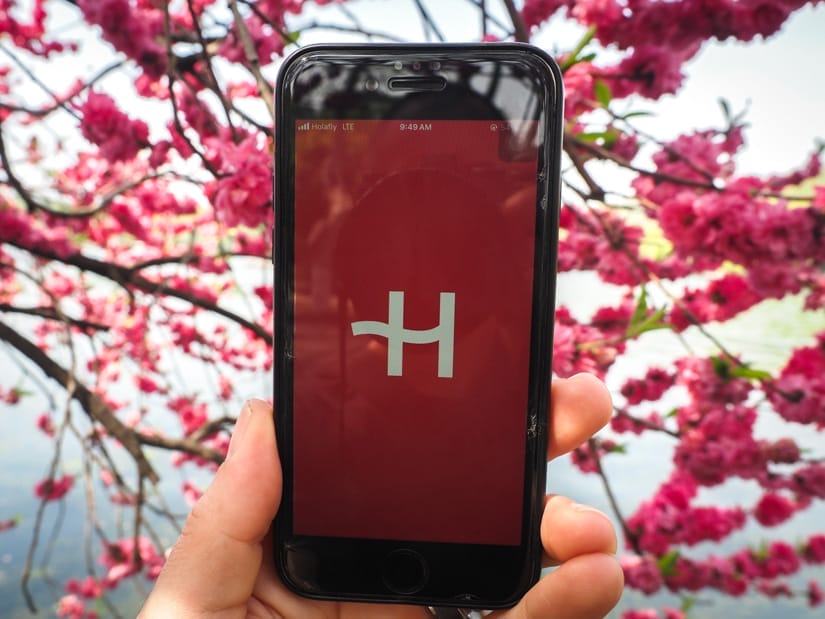
Where Holafly really stands apart is how little you have to think about it once it’s active. Their eSIMs come with unlimited data by default, and for Asia travel in particular, that removes a lot of mental overhead. Instead of watching your data usage or deciding whether you need to top up mid-trip, you just use your phone normally.
What’s more, their Asia plan lets you choose the exact number of days you need across multiple countries, using the same network infrastructure as their country-specific eSIMs.
That means no tracking usage, no deciding when to top up, and less to think about as you move from place to place. Support is available 24 hours a day through their app or website, which becomes surprisingly important when you’re dealing with connectivity on the road.
Holafly’s eSIMs also come with hot spot capability (share data with your travel companions), a six-month refund policy, and no hidden costs.
Airalo does offer unlimited plans, but only for individual country eSIMs, and those are also only available for fixed durations, like 3, 7, 15, or 30 days.
In all the examples I checked, their unlimited plans are also slightly more expensive than Holafly’s.
In the sections below, I’ll break down how these differences play out in real travel situations across Asia.
My Poor Experience Using Airalo in Japan
On a family trip to Japan (read about it here and here), I went through the most frustrating eSIM experience I’ve ever had. One of the big selling points of eSIMs is that they’re supposed to activate automatically when you land. In reality, that didn’t happen for me.
After arriving in Japan, I spent around 20 minutes in the arrivals hall trying to get the eSIM to connect, while my wife and kids stood nearby watching me get increasingly annoyed at my phone. It wasn’t obvious what setting needed to be changed, and I ended up toggling things on and off until it finally kicked in. Not a great start, especially after a long flight.
Once the trip started, I found that every time I used my phone, I was very conscious of the fact that my data was limited. Even though buying more is relatively inexpensive, it was at the back of my mind every time I used my phone – which was often in Japan.
Things got worse partway through the trip. After my data ran out (despite being very data-conscious in my usage), I needed to top up. That happened at a particularly bad moment, on a train ride followed by a transfer at a large station, when we really needed directions and timing info to make the transfer.

I managed to purchase more data, but I couldn’t get it to activate properly. At that point, I was well past carefully following instructions and was just flipping settings in every possible combination, hoping something would work. And of course, I couldn’t contact support because I didn’t have Internet.
In the end, I gave up on that top-up entirely and decided to start over from scratch, purchasing a brand new Airalo eSIM instead (I’d later request a refund for the first one). With some additional trial and error, I managed to get that one working in time to make our connection, but it was stressful and completely undermined the idea of “easy connectivity.”
To be fair, not everyone has issues with Airalo in Japan. I’ve since seen plenty of travelers say it worked fine for them. But I’ve also come across enough similar complaints online to feel that Japan is one of the countries where roaming eSIMs, and Airalo in particular, seem to be more finicky than average.
For my subsequent trips in Asia, I decided to switch over to Holafly. I found the experience much closer to what eSIMs are supposed to be. Once it was active, it simply worked, without me needing to think about data usage or reactivation. That difference is what ultimately shifted my preference, especially for trips where I didn’t want to gamble on things working smoothly under pressure.
My Experience with Holafly in China and Taiwan
On later trips, I’ve used Holafly country-specific eSIMs in both China and Taiwan (read about my travels in China here and in Taiwan here).
China is in a category of its own. Many websites and apps are blocked behind the Great Firewall, and relying on hotel WiFi or a local SIM without a VPN can quickly become frustrating.
One of the biggest reasons travelers look into eSIMs for China is that some of them, including Holafly, are able to route traffic in a way that allows access to blocked services without needing to set up a separate VPN.
In China, I was able to access every website and app I personally needed, including Facebook, Instagram and all Google apps. However, you may still need a VPN for a few specific apps like TikTok and ChatGPT. This is the case for both Holafly and Airalo. I just didn’t use these apps on my trip.
On my China trip, the Holafly China eSIM worked almost exactly the way I hoped it would. After a quick restart of my phone, before even getting off the airplane, the connection came on and stayed stable throughout the trip.
I had data everywhere I went, including hiking in Tiger Leaping Gorge and even more remote Yubeng village in Northern Yunnan. Because the plan was unlimited, I never had to think about how much data I was using, which mattered a lot since I was traveling solo and relying heavily on my phone in the evenings.

If you’re traveling to China and want a more detailed breakdown of how this works, I’ve written a full review of using a Holafly eSIM in China, including setup steps, performance, and what to expect once you arrive.
Taiwan, on the other hand, is one of the easiest places in Asia to get connected. Local SIM cards are cheap, fast, and easy to buy at the airport, and coverage is excellent almost everywhere. In many cases, a regular tourist SIM in Taiwan will be cheaper than an eSIM and even includes a local phone number for making calls.
Taiwan also has some cheaper eSIMs, but most of them require visiting a kiosk at the airport, which takes time out of your trip.
That said, I visit Taiwan every year and have tested out various SIMs and eSIMs on different trips. My Holafly Taiwan eSIM also worked just as well as I could have hoped for.
Note: One member of my Taiwan Facebook group reported facing an identity verification (KYC) step when arriving in Taiwan with an Asia eSIM. If it appears, just follow the steps on screen. If anything gets stuck or you can’t move forward, contact Holafly’s 24/7 support and share your order number so they can resolve it quickly.
When I used Holafly in Taiwan, I had a signal immediately, including in places I wouldn’t normally expect it, including when I was standing on top of Yushan, the highest mountain in Northeast Asia.
For me, that was a good illustration of the trade-off eSIMs offer in places like Taiwan. They’re not always the cheapest option, but they can be extremely convenient, especially if you’re arriving from another country and don’t want to deal with another SIM purchase.
In the future, I look forward to testing the Holafly eSIM in even more countries in Asia and beyond to see if it continues to hold up.
Final thoughts: Holafly vs Airalo for travel in Asia
There isn’t a single eSIM that’s perfect for every trip or every traveler, and this comparison isn’t about crowning a universal winner. It’s about understanding which trade-offs you’re willing to live with while you’re on the road.
Airalo can make sense for some travelers, as long as they don’t mind keeping an eye on their data usage.
But for multi-country itineraries, or travel in parts of Asia where you rely heavily on your phone, I’ve found Holafly to be the less stressful option.
The combination of flexible day-based pricing and unlimited data by default, especially in places like Japan or China, was just what I needed.
If you decide to go with Holafly, you can also get 5% off by using my discount code NICKKEMBEL, or just click this link and the discount will be applied automatically.